Xi’s Survival Doctrine: Why Beijing Won’t Repeat Moscow’s Economic Suicide
The Anti-Gorbachev Strategy: How Xi Jinping is Weaponizing Supply Chains to Outlast the American Century.
4/21/20263 min read
Xi’s Survival Doctrine: Why Beijing Won’t Repeat Moscow’s Economic Suicide
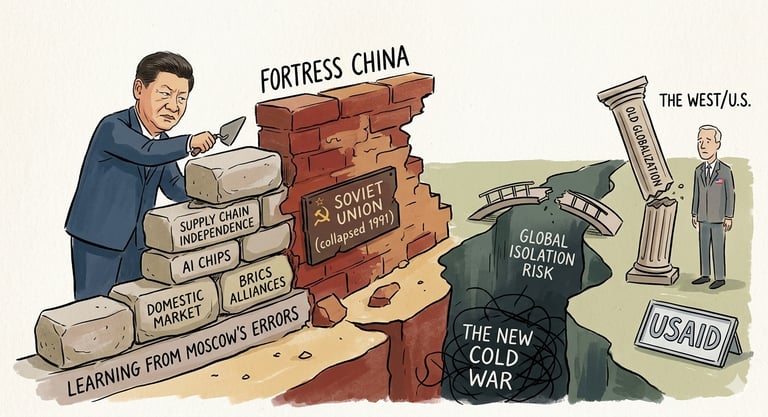
For Xi Jinping, the collapse of the Soviet Union in 1991 wasn't just a historical event; it was a traumatic warning. While Western academics celebrated the "End of History," Xi was performing a strategic autopsy on the Soviet corpse. The evidence suggests that every major move Beijing makes today—from the "Dual Circulation" policy to the crackdown on Big Tech—is designed to fix the structural rot that killed Moscow.
A boots-on-the-ground perspective reveals that Xi isn't just playing for the next quarter; he's playing to ensure the Chinese Communist Party (CCP) outlasts the American century. He saw Gorbachev as a "traitor" who allowed ideological erosion to bankrupt the state. Xi’s message to his inner circle is clear: We will be everything the Soviets weren't.
The Four Pillars of the "Fortress Economy"
The Soviets were a military giant but an economic dwarf, relying on oil exports to buy bread. Xi knows that in a modern Cold War, a nation is only as strong as its supply chain. His strategy rests on four clinical axes:
1. Diversification as a Weapon
Unlike the USSR, which prioritized heavy industry and tanks over consumer goods, Beijing is obsessed with producing everything.
Semiconductors & Chips: Investing billions to break the "Silicon Stranglehold" of the West.
Essential Goods: Ensuring the internal market can survive a total blockade of Western imports.
The Goal: To make the world so dependent on Chinese manufacturing that sanctioning Beijing becomes a suicide pact for Wall Street.
2. Strategic Interconnectivity (The Anti-Isolation Play)
The Soviet Union lived behind an Iron Curtain. Xi’s China is building a "Golden Gateway." By investing heavily in the Global South and the BRICS framework, Beijing is pre-emptively filling the vacuum left by shifting U.S. foreign aid priorities. If Washington pulls back, Xi steps in with "Soft Power" and infrastructure checks, ensuring China is never truly isolated.
3. Sustainable Militarization
Xi has watched the U.S. spend trillions on "forever wars" and saw the USSR bleed out in an arms race it couldn't afford.
Controlled Growth: China’s defense budget grows at a steady 7.2%, consistently outpacing GDP but avoiding the runaway spending that exfiltrated Soviet wealth.
Quality Over Quantity: The focus is on modernizing the navy and cyber-capabilities rather than just stacking up old-school hardware.
4. Total Ideological Immunity
This is the most brutal pillar. Xi believes Moscow fell because it lost control of the narrative.
Digital Totalitarianism: From social media to the classroom, the CCP dictates the national thought-process.
No Fissures: Any sign of "Western ideological erosion" is met with immediate, systemic suppression. For Xi, a free internet is a crack in the fortress wall.
Skin in the Game: The Investor's Dilemma
If you are managing a portfolio today, you aren't just betting on earnings; you are betting on the resilience of these two clashing systems. Wall Street and Big Tech are caught in the crossfire of a China that is actively de-risking from the dollar.
The evidence suggests that Xi believes time is on his side. While Washington struggles with four-year election cycles and shifting aid budgets (like the sunsetting of USAID programs), Beijing is planning for 2049—the centenary of the Revolution.
"The Soviets failed because they were inflexible. We will succeed because we are the world's factory, its bank, and its inescapable partner." — The unspoken mantra of the Zhongnanhai.
The Verdict for 2026
We are in a Cold War where the primary weapons are AI chips, supply chain nodes, and media influence. Xi Jinping has spent his life studying the Soviet collapse so he can build a version of communism that is compatible with global trade—but immune to its democratic "side effects."
For the international investor, the takeaway is stark: The "China Discount" is no longer just about regulation; it’s about a nation that is intentionally decoupling its destiny from yours.
Strategic Intel: The Psychology of a Superpower
To understand the moves Beijing makes today, you must understand the fears that drive them. In The China Nightmare, Dan Blumenthal provides a masterclass in analyzing the CCP’s grand ambitions. He argues that China’s aggressive expansion and internal crackdowns are not signs of a confident hegemon, but of a state terrified of its own internal decay. Blumenthal’s work is essential for the 2t Economics reader who wants to look past the propaganda and see the clinical reality of the U.S.-China rivalry. It’s the definitive guide to understanding why Xi Jinping is willing to risk global stability to avoid the fate of the Soviet Union.
Link: https://amzn.to/48PZaiz
Key words: Xi Jinping Strategic Doctrine, Soviet Collapse Lessons, Dual Circulation Policy U.S.-China Cold War 2026, Global South Influence, Semiconductor Autarky Macroeconomic Resilience, CCP Ideological Control, De-dollarization Trends