
Will Britain Rejoin the EU? Brexit’s Economic Costs Are Reshaping UK Politics
Brexit’s economic fallout is reviving debate over whether the UK should rejoin the European Union amid slowing growth and trade pressure.
5/23/20265 min read
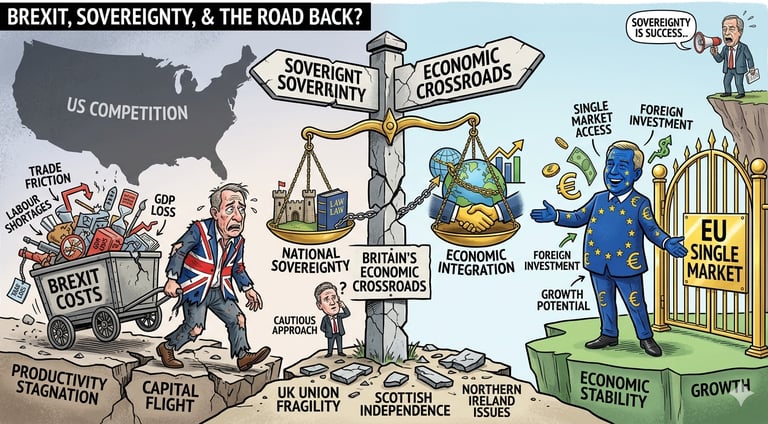
Brexit, Sovereignty, and Britain’s Economic Crossroads: Why Rejoining the EU Is Back on the Political Agenda
Nearly a decade after the Brexit referendum, the United Kingdom faces a political and economic reality few anticipated in 2016: the debate is no longer about how to leave the European Union — it is increasingly about whether Britain can afford to stay outside it.
What began as a sovereignty-driven political movement has evolved into a broader macroeconomic question involving trade competitiveness, foreign investment, labor shortages, productivity stagnation, and Britain’s long-term strategic positioning between the United States and continental Europe.
Inside the Labour Party, voices advocating closer reintegration with Europe are growing louder. At the same time, Eurosceptic forces remain politically powerful, arguing that Brexit’s failures stem not from separation itself, but from weak execution and post-pandemic structural pressures.
The result is a deeply divided Britain confronting a difficult truth: Brexit solved some political frustrations while potentially weakening the country’s economic leverage inside an increasingly fragmented global economy.
Brexit Was Never Only About Trade
The 2016 Brexit referendum is often simplified as an economic dispute. In reality, it reflected a much deeper conflict over sovereignty, national identity, migration, and democratic legitimacy.
The UK had always maintained an uneasy relationship with European integration. Unlike many continental members of the European Union, Britain never fully embraced the idea of supranational governance.
Key examples included:
The UK never adopted the euro
Britain remained outside the Schengen free-movement zone
British governments consistently resisted deeper political integration
Euroscepticism existed across both Conservative and Labour factions for decades
For many British voters, Brexit represented less an economic calculation and more a constitutional correction.
The core argument from Brexit supporters was straightforward:
Laws affecting Britain should be made by British institutions
Immigration policy should remain nationally controlled
The UK should reduce dependence on EU regulatory structures
Brussels had accumulated excessive political authority
This sovereignty argument remains one of the strongest intellectual foundations of Brexit to this day.
The Structural Divide Behind the Brexit Vote
The referendum exposed a profound demographic and geographic split inside the United Kingdom.
Broadly speaking, support for Brexit concentrated among:
Rural voters
Older demographics
Lower-income communities
Less globally integrated regions
Conservative and nationalist constituencies
Meanwhile, opposition was strongest among:
London-based professionals
Younger voters
University-educated populations
Financial and service-sector workers
Cosmopolitan urban centers
This divide reflected two very different economic experiences.
For globally connected sectors such as finance, technology, and multinational services, EU membership enhanced:
Market access
Investment flows
Labor mobility
Capital efficiency
But for many communities outside major metropolitan hubs, the perceived benefits of globalization were far less visible.
In many industrial and rural regions, Brexit became associated with:
Protection of local labor markets
Reduced migration pressure
Resistance to bureaucratic centralization
Recovery of national political control
This helps explain why Brexit was not merely a protest vote — it was a rejection of a broader model of economic integration.
The Economic Costs of Leaving the European Union
While Brexit strengthened Britain’s policy autonomy, the economic trade-offs have become increasingly difficult to ignore.
Several structural challenges emerged after the UK’s departure from the EU single market.
Trade Friction
Before Brexit, the EU accounted for roughly half of British trade flows.
Leaving the bloc introduced:
Customs barriers
Regulatory divergence
Border friction
Higher compliance costs
For export-oriented firms, especially small and medium-sized businesses, these frictions reduced competitiveness.
According to claims referenced in the source material:
Thousands of British firms reportedly reduced or halted exports to Europe
Foreign investment weakened after Brexit
UK GDP may be materially lower than it otherwise would have been
While exact estimates vary across institutions, most mainstream macroeconomic analyses conclude Brexit negatively affected long-term growth potential.
Foreign Direct Investment and Capital Allocation
One of the less discussed consequences of Brexit involves capital allocation incentives.
For multinational firms, EU membership offered Britain strategic advantages:
Access to the entire European market
Regulatory harmonization
Integrated supply chains
Financial passporting rights
After Brexit, some investment activity shifted toward EU-based economies such as:
France
Germany
Netherlands
Ireland
This mattered particularly for sectors dependent on cross-border coordination:
Banking
Logistics
Manufacturing
Pharmaceuticals
Financial services
London remains one of the world’s leading financial centers, but Brexit introduced uncertainty regarding Britain’s long-term role inside European capital markets.
Labor Market Pressures
Brexit also altered labor dynamics.
Before withdrawal, Britain relied heavily on workers from Eastern Europe for sectors such as:
Transportation
Agriculture
Construction
Hospitality
Logistics
Reduced labor mobility contributed to:
Worker shortages
Higher labor costs
Supply-chain inefficiencies
Inflationary pressure in some industries
This became especially visible after the pandemic, when labor shortages amplified logistical disruptions across the British economy.
Why the Rejoin Debate Is Returning
The renewed discussion around rejoining the EU reflects growing concern inside segments of the British political establishment that Brexit’s economic costs may outweigh its sovereignty gains.
Within the Labour Party, some figures increasingly argue that:
Britain’s growth potential weakened outside the bloc
Trade barriers damaged competitiveness
Strategic isolation reduced economic leverage
Rebuilding EU ties is necessary for long-term recovery
Supporters of closer reintegration point to several pressures:
Sluggish productivity growth
Weak business investment
Fiscal constraints
Export challenges
Structural labor shortages
At the same time, Prime Minister Keir Starmer has remained cautious.
Why?
Because Brexit remains politically explosive.
A direct push to rejoin the EU could:
Alienate working-class Brexit voters
Strengthen nationalist parties
Revive anti-establishment sentiment
Deepen political fragmentation
For Labour, the political challenge is balancing economic pragmatism with electoral reality.
Euroscepticism Is Growing Across Europe — Not Disappearing
One of the most important dynamics often overlooked outside Europe is that Brexit did not eliminate Euroscepticism across the continent.
In fact, concerns about centralized EU governance continue expanding in several member states.
Critics of deeper EU integration argue that:
National parliaments lost influence
EU bureaucracy became excessively centralized
Migration policy weakened border control
Democratic accountability became diluted
This movement does not always seek the destruction of the EU itself.
Instead, many Eurosceptic factions advocate:
A looser economic union
Stronger national sovereignty
Reduced regulatory centralization
Greater immigration control
This explains the continued rise of nationalist and anti-establishment parties across Europe.
In the UK, figures such as Nigel Farage continue framing Brexit as a sovereignty success rather than an economic failure.
From this perspective, Britain’s current problems stem from:
Weak domestic governance
Slow adaptation after Brexit
Post-pandemic economic disruptions
Global inflationary shocks — not from leaving the EU itself.
Scotland, Northern Ireland, and the Fragility of the Union
Brexit also intensified constitutional tensions inside the United Kingdom itself.
Both: Scotland andNorthern Ireland voted against Brexit in 2016. This created long-term political complications.
Scotland
Scottish nationalists argue that Scotland was removed from the EU against its democratic preference.
This strengthened demands for:
Another independence referendum
Potential future EU membership as an independent state
Northern Ireland
Northern Ireland became even more sensitive due to the Irish border issue.
The region occupies a uniquely fragile geopolitical position:
Republic of Ireland remains inside the EU
Northern Ireland remains part of the UK
Maintaining open borders while preserving Brexit arrangements created enormous legal and logistical complexity.
The issue remains politically delicate due to the historical legacy of sectarian conflict and Irish reunification movements.
Could Britain Actually Rejoin the EU?
Technically, yes.
Politically and institutionally, however, the process would be extraordinarily difficult.
If Britain sought reentry, several major obstacles would emerge:
Full accession negotiations
Financial contribution requirements
Regulatory alignment obligations
Potential pressure regarding Schengen participation
Reduced opt-out privileges compared to pre-Brexit arrangements
Importantly, the EU itself has changed since 2016.
Current geopolitical priorities include:
Russian security threats
Energy independence
Strategic industrial policy
Ukraine accession debates
Fiscal integration pressures
Brussels may have limited appetite for granting Britain the highly customized membership structure it previously enjoyed.
The Larger Macro Question
The deeper issue extends beyond Brexit itself.Britain is confronting the central macroeconomic challenge facing many advanced democracies:
How do nations preserve political sovereignty while remaining competitive in a world increasingly shaped by scale, integrated capital flows, supply chains, and geopolitical blocs? Brexit represented one answer: national autonomy first.
But the post-Brexit years suggest the trade-offs are larger than many voters expected.
The UK now sits between two competing realities:
Economic integration tends to increase growth efficiency
Political integration often generates democratic backlash
That tension is not uniquely British. It increasingly defines politics across Europe and much of the developed world.
Recommended Reading
One of the most relevant books for understanding Brexit, European integration, and the political fragmentation reshaping Western democracies is: The Road to Somewhere by David Goodhart
The book explores the cultural, demographic, and economic divisions that fueled Brexit and continue reshaping politics across Europe and the United States.
Link: https://amzn.to/4uWjRBW