
Why Wall Street Is Quietly Buying These Overlooked Stocks Before Everyone Else
Discover why Exxon Mobil, CoreWeave, and Sherwin-Williams could be among the most undervalued U.S. stocks in July 2026. Explore Wall Street's outlook, macroeconomic trends, AI infrastructure, dividend investing, and long-term value opportunities in this in-depth market analysis.
7/3/20268 min read
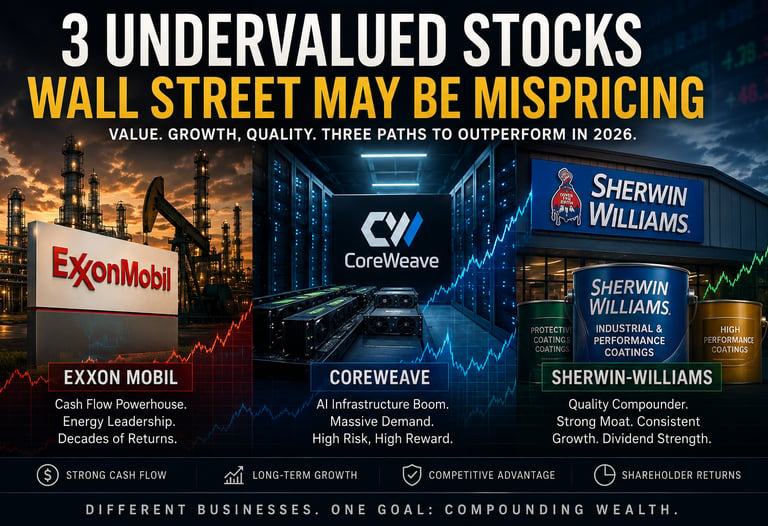
Three Undervalued Stocks Wall Street May Be Mispricing in July 2026
Why Smart Money Is Quietly Positioning Before the Crowd Notices
The market has an unusual habit: it rewards patience only after testing it.
Over the past few years, investors have become obsessed with a handful of narratives. Artificial intelligence has dominated headlines. Mega-cap technology companies have absorbed an unprecedented share of capital inflows. Meanwhile, many fundamentally strong businesses have quietly slipped into the background—not because their operations deteriorated, but because investor attention moved elsewhere.
A boots-on-the-ground perspective reveals something different from what momentum investors often see. Beneath the daily noise, several companies continue generating billions in free cash flow, expanding competitive advantages, and strengthening balance sheets while their valuations become increasingly attractive.
The evidence suggests that today's market is creating opportunities similar to those seen after previous periods of excessive concentration. Whenever capital becomes crowded into one theme, other sectors often become temporarily mispriced.
That does not mean every discounted stock deserves to recover. Markets discount businesses for reasons, and some deserve their lower valuations. The challenge is identifying companies where price has fallen faster than intrinsic value.
Three businesses stand out today for very different reasons:
Exxon Mobil represents resilience and dependable cash generation.
CoreWeave offers one of the highest-risk, highest-upside AI infrastructure stories available.
Sherwin-Williams demonstrates why boring businesses frequently outperform exciting ones over decades.
Each reflects a different investment philosophy, yet together they paint an interesting picture of where Wall Street may be overlooking value.
Exxon Mobil: When the Market Prices Oil Instead of Business Quality
For decades, investors have misunderstood oil companies.
Most market participants don't actually value integrated energy businesses. They value the current oil price.
That distinction matters.
Whenever crude prices surge because of geopolitical tensions, energy stocks rally aggressively. When tensions fade and oil retreats, investors often rush for the exits, assuming profitability will collapse. Reality is rarely that simple.
The World's Most Durable Energy Machine
Founded more than 150 years ago, Exxon Mobil has survived world wars, recessions, oil shocks, financial crises, technological revolutions, and multiple attempts to declare fossil fuels obsolete.
Companies rarely remain industry leaders for over a century without developing extraordinary operational discipline.
Today, Exxon operates across virtually the entire energy value chain:
Oil exploration
Production
Refining
Chemicals
Petrochemicals
Global fuel distribution
Low-carbon technologies
Carbon capture initiatives
Unlike smaller exploration companies, Exxon is not dependent on one segment of the energy cycle. When upstream profits decline, downstream operations often provide stability.
That diversification makes earnings considerably more resilient than investors sometimes appreciate.
The Post-Geopolitical Selloff May Have Created Opportunity
One of the biggest drivers behind Exxon’s recent weakness has been the normalization of oil prices following easing geopolitical tensions in the Middle East.
Markets reacted exactly as expected.
Higher geopolitical risk pushed crude prices sharply upward. Once fears subsided, crude retraced. Energy stocks followed. But here's where long-term investors should pay attention.
Price reacted faster than fundamentals.
The evidence suggests that Exxon continues producing exceptional operating cash flow even after oil prices normalized. That is an important distinction. Cash generation—not headlines—ultimately determines shareholder value.
If a business continues generating enormous free cash flow while its valuation compresses, investors should at least investigate whether the market has become overly pessimistic.
Free Cash Flow Still Rules
In today's market, many technology companies are aggressively increasing capital expenditures.
Billions are flowing toward AI infrastructure, data centers, semiconductor purchases, and cloud expansion. These investments may prove enormously profitable. But they also consume cash today. Exxon represents almost the opposite investment profile.
Rather than sacrificing current profitability in pursuit of uncertain future dominance, the company continues producing massive amounts of distributable cash.
That cash supports:
Dividend increases
Share buybacks
Debt reduction
Strategic acquisitions
Long-term capital investment
Markets occasionally forget a timeless principle: Cash flow eventually wins. Accounting adjustments can change earnings. Narratives can change valuations. Free cash flow is considerably harder to manipulate.
Dividend Growth Remains an Underappreciated Asset
Income investing has become less fashionable during the AI boom.
Yet dividend consistency remains one of the strongest indicators of business quality.
Exxon has built a reputation for returning capital through decades of changing economic conditions.
Even when energy markets become volatile, management prioritizes shareholder returns.
This matters for institutional investors.
Pension funds.
Insurance companies.
Income-focused portfolios.
Endowments.
These investors don't chase speculative momentum.
They seek predictable cash generation.
Exxon continues delivering exactly that.
Why Wall Street Still Sees Upside
Analyst expectations currently suggest meaningful appreciation potential over the next twelve months.
That optimism isn't necessarily based on predicting higher oil prices.
Instead, it reflects confidence that current valuations underestimate:
Operational efficiency
Cash flow resilience
Capital allocation discipline
Long-term energy demand
Shareholder returns
Markets often swing between excessive optimism and excessive pessimism.
Energy has spent much of the past year moving toward the latter.
History suggests those moments deserve attention rather than fear.
The Bigger Picture
One misconception has become increasingly common across financial media. Many investors assume traditional energy companies represent "old economy" businesses with limited future relevance.
That conclusion ignores reality.
Global energy demand continues growing.
Developing economies continue industrializing.
Artificial intelligence itself requires enormous electricity consumption.
Data centers cannot operate without reliable energy infrastructure.
Ironically, one of AI's greatest hidden dependencies is abundant, affordable power generation.
Exxon understands this better than many investors.
Rather than abandoning hydrocarbons overnight, the company is simultaneously investing in carbon capture technologies, operational efficiency, and lower-emission energy solutions.
It is not betting against the future.
It is preparing for multiple futures simultaneously.
That flexibility deserves more attention than it currently receives.
CoreWeave: The AI Infrastructure Bet That Could Define the Next Decade
Artificial intelligence has become the most crowded investment theme since the early days of the internet. Investors have poured trillions into companies building models, designing chips, and expanding cloud infrastructure. Yet one segment of the AI ecosystem continues to receive less attention than it arguably deserves: the companies supplying the computing power that makes modern AI possible.
That is precisely where CoreWeave enters the picture.
Unlike software developers competing to build the next breakthrough language model, CoreWeave provides the computational backbone. Every major AI model requires enormous GPU clusters for training and inference. Those resources are expensive, difficult to obtain, and increasingly scarce.
CoreWeave doesn't compete with its customers. It enables them.
From Crypto Miner to AI Infrastructure Powerhouse
Some of the most successful companies in history began by solving a completely different problem.
Amazon started as an online bookstore.
Netflix mailed DVDs.
NVIDIA built graphics cards for gamers.
CoreWeave's origin story is equally unconventional.
Originally established as a cryptocurrency mining company, management accumulated significant GPU infrastructure during the crypto boom. When cryptocurrency markets cooled, instead of liquidating those assets, the company recognized an emerging opportunity.
Artificial intelligence.
Rather than mining digital currencies, those same GPUs could be rented to AI developers desperately searching for computational capacity.
It was a remarkably well-timed strategic pivot.
Today, CoreWeave has transformed itself into one of the fastest-growing AI infrastructure providers in North America.
Sometimes investing is less about predicting the future and more about recognizing management teams capable of adapting before everyone else.
Why GPUs Have Become the New Oil
During previous industrial revolutions, competitive advantages came from owning railroads, factories, or oil fields.
Today, one could argue that GPU clusters occupy a similarly strategic position.
Without computational power:
AI models cannot be trained.
Enterprise applications cannot scale.
Foundation models cannot improve.
Cloud-based AI services cannot expand.
Every major technology company now competes for access to high-performance computing.
This structural demand has created an entirely new category of infrastructure businesses.
CoreWeave sits directly at the center of that trend.
NVIDIA's Investment Speaks Louder Than Headlines
One reason institutional investors have become increasingly interested in CoreWeave is its relationship with NVIDIA.
The partnership extends far beyond supplier and customer.
NVIDIA has invested directly in the company while simultaneously supplying the GPUs that fuel CoreWeave's cloud infrastructure.
That relationship creates a mutually reinforcing ecosystem.
CoreWeave purchases NVIDIA hardware.
NVIDIA benefits from increased GPU demand.
CoreWeave attracts additional enterprise customers.
Those customers generate recurring infrastructure revenue.
This alignment doesn't eliminate risk, but it does increase credibility.
When one of the world's most valuable semiconductor companies commits capital to an emerging infrastructure provider, investors naturally pay attention.
Revenue Growth That Demands Respect
Few public companies currently report revenue expansion comparable to CoreWeave.
Quarter after quarter, revenue has continued growing at triple-digit rates.
Enterprise demand remains exceptionally strong.
Customers increasingly prefer leasing computing capacity instead of investing billions to build proprietary infrastructure.
That trend creates an attractive business model.
Instead of selling one-time hardware, CoreWeave generates recurring cloud revenue.
As AI adoption expands, infrastructure providers may benefit regardless of which individual AI models ultimately dominate.
This represents one of the more compelling aspects of the investment thesis.
Rather than betting on a single AI winner, investors gain exposure to the broader expansion of computational demand.
Growth Has a Price
Every extraordinary growth story carries hidden costs.
CoreWeave is no exception.
The company's financial statements reveal both tremendous opportunity and significant risk.
Positive indicators include:
Explosive revenue growth.
Expanding enterprise customer base.
Long-term contractual relationships.
Strong liquidity position.
Industry-leading technological relevance.
However, several warning signs deserve equal attention.
The company continues reporting substantial net losses.
Debt has increased rapidly.
Capital expenditures remain enormous.
Infrastructure businesses require continuous investment simply to maintain growth.
This creates an uncomfortable reality.
CoreWeave must continue executing almost flawlessly.
Any slowdown in enterprise AI spending, tightening credit conditions, or delays in customer expansion could materially affect valuation.
The evidence suggests investors should view CoreWeave as a high-conviction growth opportunity—not a defensive investment.
Is Wall Street Underestimating AI Infrastructure?
Many investors remain focused almost exclusively on companies building AI applications.
Yet history often rewards infrastructure providers just as much as application developers.
During the California Gold Rush, countless miners failed.
Companies selling shovels frequently prospered.
The internet boom produced similar outcomes.
Cloud computing generated another.
Artificial intelligence may follow the same pattern.
Regardless of which chatbot, enterprise platform, or autonomous system ultimately dominates, all of them require computational infrastructure.
CoreWeave has positioned itself precisely where that demand continues accelerating.
The market clearly recognizes this potential.
The question is whether current expectations remain too optimistic—or still too conservative.
Only time will answer that.
Sherwin-Williams: The Quiet Compounder Most Investors Ignore
Not every winning investment needs to revolutionize an industry. Sometimes the greatest returns come from businesses that simply execute exceptionally well for decades.
Sherwin-Williams is a textbook example. Paint rarely generates headlines.
Wall Street doesn't celebrate coatings manufacturers during earnings season. Financial television spends far more time discussing artificial intelligence than industrial coatings. Yet markets ultimately reward businesses capable of compounding earnings consistently over long periods.
Sherwin-Williams has done exactly that.
An Invisible Competitive Advantage
Most consumers associate Sherwin-Williams with residential paint. That perception dramatically understates the business.
The company supplies products across multiple industries, including:
Commercial construction.
Residential housing.
Industrial manufacturing.
Aerospace.
Automotive production.
Protective coatings.
Marine applications.
Packaging solutions.
This diversification creates remarkable resilience.
Housing may weaken while industrial demand strengthens. Commercial projects may slow while aerospace expands. Few investors appreciate just how broad Sherwin-Williams' economic footprint has become.
Its competitive moat extends far beyond retail paint stores.
Why "Boring" Businesses Often Beat Exciting Ones
Markets naturally gravitate toward excitement. Investors chase innovation. Financial media rewards volatility. But long-term wealth often comes from consistency rather than excitement.
Sherwin-Williams illustrates this principle perfectly.
The company has spent decades delivering:
Predictable revenue.
Stable operating margins.
Strong free cash flow.
Disciplined capital allocation.
Consistent dividend growth.
None of these characteristics produce viral headlines.
Together, however, they create exceptional shareholder returns over multi-decade investment horizons. Compounding rarely looks spectacular in a single year.Its power becomes obvious after twenty.
Dividend Aristocrats Still Matter
Many investors dismiss low dividend yields in favor of higher-growth opportunities. That approach can work.
But dividend growth deserves more attention than headline yield. Sherwin-Williams has consistently increased shareholder distributions while maintaining healthy business fundamentals.
That discipline reflects confidence. Companies struggling financially rarely commit to decades of rising dividends. Management teams protecting long-term shareholder value often do.
For patient investors, consistency remains one of the strongest competitive advantages available in public markets.