
Why Wall Street Is Ignoring the Biggest Geopolitical Risks of 2026
A deep macroeconomic analysis of escalating U.S.-Iran tensions, North Korea's nuclear expansion, China's strategic role, and why investors may be underpricing a new era of geopolitical risk that could reshape inflation, energy markets, and global growth.
6/7/20265 min read
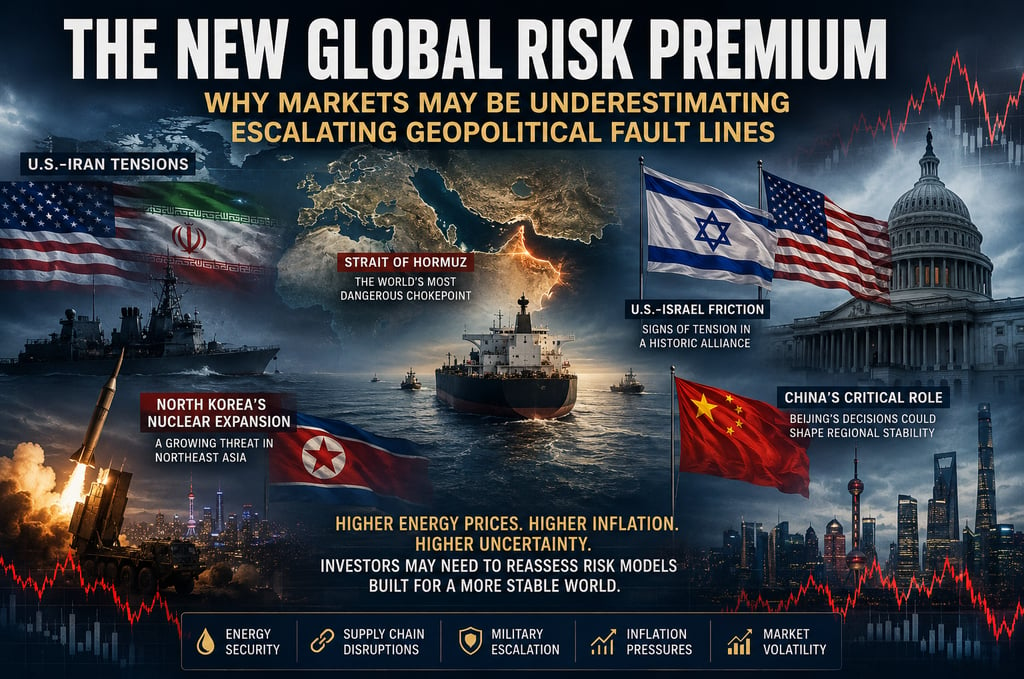
The New Global Risk Premium: Why Markets May Be Underestimating Escalating Geopolitical Fault Lines
From the Strait of Hormuz to Northeast Asia, Investors Face a Dangerous Convergence of Risks
For much of the past decade, markets have repeatedly demonstrated an extraordinary ability to ignore geopolitical tensions. Wars, sanctions, diplomatic crises, and military standoffs have often created only temporary volatility before equity markets resumed their upward march.
The evidence suggests that investors may be approaching another inflection point.
Today, a series of seemingly disconnected developments—from renewed U.S.-Iran tensions and growing friction between Washington and Israel to North Korea's accelerated nuclear ambitions—are creating a geopolitical backdrop that deserves far more attention than it currently receives on Wall Street.
A boots-on-the-ground perspective reveals that these events are no longer isolated incidents. They are increasingly interconnected components of a broader shift toward a more fragmented and confrontational global order.
For investors with real capital at risk, that distinction matters.
The Strait of Hormuz: The World's Most Dangerous Economic Chokepoint
The latest escalation between the United States and Iran has once again placed the Strait of Hormuz at the center of global attention.
Iran has reportedly intensified military actions targeting U.S.-linked assets and commercial shipping while simultaneously insisting that negotiations remain possible under its own terms.
The contradiction is striking but not surprising.
Tehran's position appears increasingly clear:
Iran refuses to abandon its civilian nuclear program.
Iranian leadership demands confidence-building measures before any comprehensive agreement.
The regime seeks the release of frozen financial assets as a prerequisite for deeper negotiations.
Control over maritime access remains a strategic bargaining chip.
For Washington, however, moving in that direction presents enormous political risks.
Any release of frozen Iranian assets would immediately revive criticisms that financial concessions strengthen regional groups aligned with Tehran. This remains one of the most politically sensitive issues in American foreign policy. The result is a dangerous stalemate.
Why Investors Should Care
The market impact extends far beyond Middle Eastern politics. The Strait of Hormuz remains one of the most critical energy corridors on Earth.
A serious disruption could trigger:
Higher oil prices
Rising shipping costs
Renewed inflationary pressure
Delays in global supply chains
Additional challenges for central banks
The Federal Reserve has spent years attempting to bring inflation under control. A sustained energy shock would complicate that mission considerably.
Investors betting on multiple interest rate cuts may be underestimating how quickly geopolitical events can alter the inflation outlook.
America's Growing War Fatigue Is Becoming a Market Variable
An overlooked development is the increasing resistance within the United States to further military escalation.
Recent congressional efforts to limit executive authority regarding military actions abroad reflect a broader sentiment emerging among both voters and lawmakers. This is not merely a political story. It represents a strategic constraint.
Markets have long assumed that Washington retains unlimited flexibility in projecting power internationally. That assumption may no longer be entirely valid.
If domestic political resistance limits military options, adversaries may begin testing those boundaries more aggressively.
For investors, this introduces a new layer of uncertainty regarding America's ability to manage multiple geopolitical crises simultaneously.
The Quiet Friction Between Washington and Israel
One of the most intriguing developments receiving relatively little mainstream attention is the apparent increase in tension between the United States and Israel.
Historically, the strategic relationship between the two nations has been among the strongest alliances in modern geopolitics. Yet signs of friction are becoming increasingly difficult to ignore.
Reports of disagreements regarding regional military operations, combined with concerns inside American defense circles regarding intelligence activities, suggest a relationship that may be entering a more complicated phase.
That does not mean the alliance is collapsing. Far from it. However, markets often fail to recognize that alliances can weaken long before headlines officially acknowledge the shift.
The implications are significant because much of the Middle East's security architecture has been built around close U.S.-Israel coordination.
Any deterioration in that relationship could introduce new uncertainties across the region.
North Korea's Nuclear Expansion Changes the Strategic Equation
While investors focus heavily on the Middle East, another geopolitical flashpoint continues to intensify.
North Korea has announced plans for substantial expansion of its nuclear capabilities, arguing that increasing military threats require a stronger deterrent.
This development is particularly important because it is occurring alongside growing debates in both Japan and South Korea regarding their own security postures.
Several trends deserve attention:
Japan continues expanding defense spending.
Discussions regarding long-term strategic deterrence are becoming more mainstream.
South Korea is increasing cooperation with U.S. military assets.
Regional military modernization is accelerating.
The consequence is clear.
Northeast Asia is entering a period of heightened strategic competition. For global investors, this matters because the region sits at the heart of the semiconductor supply chain.
Any significant escalation would affect:
Advanced chip manufacturing
Artificial intelligence infrastructure
Consumer electronics
Automotive production
Global technology valuations
Investors bullish on AI should remember that semiconductor supply chains remain heavily exposed to geopolitical risk.
China's Role May Become More Important Than Markets Realize
An often-overlooked aspect of the North Korean issue is China's influence. Beijing remains one of the few actors capable of exerting meaningful pressure on Pyongyang.
Recent diplomatic activity suggests that both Washington and Seoul increasingly view China as a potential stabilizing force in managing North Korea's ambitions.
Whether Beijing chooses to play that role remains uncertain. China's strategic interests are complex. A stronger North Korea creates instability. A weaker North Korea could increase Western influence near China's borders.
As a result, Beijing's decisions may ultimately shape the future trajectory of security in Northeast Asia more than any statement coming from Washington.
The Bigger Picture: A Fragmented World Means a Higher Risk Premium
The common thread connecting these developments is the gradual erosion of the post-Cold War geopolitical framework.
For decades, globalization allowed investors to assume that economic efficiency would ultimately outweigh geopolitical competition. That assumption is becoming increasingly fragile.
The evidence suggests we are entering an era characterized by:
Strategic competition between major powers
Regional military buildups
Supply-chain nationalism
Energy security concerns
Increased use of sanctions and economic warfare
This does not necessarily mean a global recession is imminent.
It does mean investors may need to reassess risk models built during a period of relative geopolitical stability. The world appears to be transitioning toward a higher geopolitical risk premium. Markets have not fully priced that reality.
Final Thoughts
Investors should resist the temptation to view these developments as isolated headlines. The Strait of Hormuz, U.S.-Iran tensions, evolving U.S.-Israel relations, North Korea's nuclear expansion, and China's strategic calculations are all pieces of the same puzzle.
The global economy is becoming increasingly shaped by political power, military deterrence, and national security considerations. In that environment, understanding geopolitics is no longer optional for investors.
It is becoming a core component of risk management. For readers seeking a deeper understanding of how geopolitical competition influences economic outcomes, one highly recommended book is The Revenge of Geography by Robert D. Kaplan. Kaplan's work provides a compelling framework for understanding how geography, resources, and strategic interests continue to shape global power dynamics despite technological progress and globalization.