Why the U.S. Stock Market Keeps Surging Despite War, Inflation, and AI Uncertainty in 2026
As geopolitical tensions rise across the Middle East and inflation pressures return to the global economy, the U.S. stock market continues reaching record highs. This in-depth analysis explores how artificial intelligence, Federal Reserve policy, oil prices, and institutional capital are reshaping the future of investing in North America and Europe — and why many analysts believe we are entering a completely new economic era.
5/14/20265 min read
Why the U.S. Stock Market Keeps Rising Despite War, Inflation, and Global Uncertainty
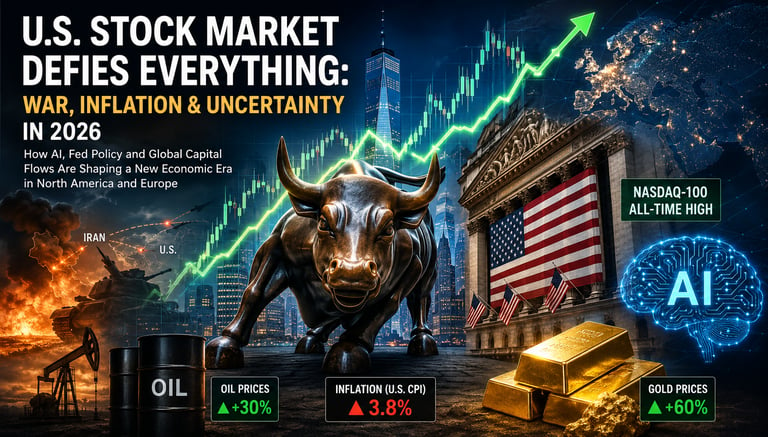
The global economy feels increasingly unstable. Geopolitical tensions are escalating, inflation remains stubbornly high, oil prices are climbing again, and investors across North America and Europe are questioning whether financial markets are disconnected from reality. Yet, despite all of this, the U.S. stock market continues breaking records.
At first glance, it seems contradictory. Historically, wars, inflation shocks, and energy crises have pushed markets downward. But the current economic cycle is unlike most periods investors have experienced before. What we are witnessing is not necessarily a broken market — it may instead be the emergence of a completely new economic regime shaped by artificial intelligence, capital concentration, and structural shifts in global growth.
Geopolitics Has Become a Central Force in Financial Markets
Over the last five years, public interest in geopolitics has surged dramatically. The COVID-19 pandemic, the Russia-Ukraine conflict, trade wars, supply chain disruptions, tariff escalations, and more recently tensions involving the United States and Iran have transformed geopolitics into a daily market driver.
In both Europe and North America, investors are increasingly monitoring political instability with the same attention once reserved for corporate earnings or central bank announcements.
Traditionally, geopolitical instability creates fear across financial markets. Investors usually move capital away from risk assets and toward defensive assets such as gold, oil, and government bonds. Yet today, something unusual is happening: all of these assets are rising simultaneously.
Gold prices are climbing. Oil prices remain elevated. Inflation expectations are rising again. And at the same time, major U.S. indexes like the Nasdaq-100 and the S&P 500 continue pushing toward historic highs.
This divergence is precisely why many investors feel uncomfortable.
The Nasdaq-100 Rally Is Rewriting Historical Expectations
The technology-heavy Nasdaq-100 has experienced one of its strongest rebounds in recent memory. After periods of market fear linked to Middle East tensions and inflation concerns, the index rapidly recovered losses and resumed its upward trend.
Historically, recoveries following major geopolitical shocks often take months — or even years. After the 2008 financial crisis, for example, markets needed years to fully recover. But in the current cycle, declines of more than 10% have been erased within days or weeks.
This speed reflects something important: institutional investors continue to believe that long-term technological growth will outweigh short-term macroeconomic risks. The driving force behind that belief is artificial intelligence.
Artificial Intelligence Is Reshaping the American Economy
The current AI investment cycle is unprecedented in modern economic history. Previous disruptive companies such as Uber, Tesla, and Netflix spent years burning capital before reaching profitability. However, the scale of investment currently flowing into AI infrastructure dwarfs previous technology cycles.
Companies connected to AI development, cloud computing, semiconductors, data centers, and enterprise software are receiving hundreds of billions of dollars in capital allocation. This is not just venture capital enthusiasm — it is becoming a structural transformation of the U.S. economy itself.
The impact is already visible in American GDP growth. Investments in chips, software, cloud infrastructure, and AI-related equipment are becoming major contributors to economic expansion, in some cases surpassing traditional consumer-driven growth.
For investors in both Europe and North America, this changes how markets price risk.
Instead of valuing companies solely based on current earnings, markets are increasingly pricing future AI dominance, productivity gains, and infrastructure control.
Why Stocks, Gold, and Oil Are Rising Together
Under normal economic conditions, rising oil prices and inflation would pressure equities lower. Higher energy costs typically reduce consumer spending, increase business costs, and force central banks to maintain elevated interest rates.
But today’s market behaves differently because investors see two competing narratives unfolding simultaneously.
On one side, inflationary pressure and geopolitical risks continue to threaten global stability. On the other side, AI-driven productivity growth is creating optimism strong enough to offset much of that fear.
In simple terms, investors believe technological acceleration may be capable of sustaining corporate profits even during periods of macroeconomic instability.
That does not mean risks have disappeared. It simply means markets are prioritizing long-term technological transformation over short-term economic turbulence.
The AI Bubble Debate Is Growing
Not every part of the market looks healthy.
Some technology and semiconductor companies are trading at valuation levels reminiscent of the dot-com bubble of the early 2000s. Certain AI-related stocks have gained more than 200% or even 300% within a single year, often reaching extremely elevated price-to-earnings ratios.
This has created legitimate concerns among investors and analysts.
The critical question is whether current valuations reflect sustainable future earnings — or speculative excess.
Still, it is important to understand that the broader market is far more nuanced than headlines suggest.
While a handful of AI leaders dominate media attention, many high-quality global companies remain reasonably valued or even discounted.
Hidden Opportunities Beyond AI Hype
One of the biggest misconceptions about the current market is the belief that “everything is expensive.”
In reality, many sectors outside of AI have underperformed significantly. Luxury companies, consumer brands, healthcare firms, and financial infrastructure businesses have experienced corrections despite maintaining strong fundamentals.
Companies like Visa, Mastercard, Coca-Cola, and UnitedHealth Group continue generating consistent cash flow and global demand.
Meanwhile, luxury giants such as Ferrari and LVMH have faced pressure due to slowing Asian demand and geopolitical uncertainty.
This creates an important distinction: the market may not be irrational as a whole — it may simply be highly concentrated around AI narratives.
For long-term investors, that difference matters enormously.
Interest Rates Remain the Biggest Unknown
The future direction of the U.S. economy largely depends on one variable: interest rates.
If inflation remains elevated due to energy prices and geopolitical disruptions, the Federal Reserve may keep rates higher for longer. That would reduce liquidity, slow economic activity, and pressure speculative assets.
However, if inflation stabilizes and economic growth weakens, rate cuts could return and provide additional fuel for equities.
Markets are currently attempting to price both possibilities simultaneously — which explains much of the volatility investors are experiencing.
Long-Term Investing Still Matters Most
Despite wars, inflation shocks, recessions, pandemics, and financial crises, the American stock market has historically rewarded long-term investors.
One of the biggest mistakes investors make is trying to perfectly time the market. Missing only a handful of the market’s best-performing days over multiple decades can drastically reduce long-term returns.
That is why strategies such as Dollar-Cost Averaging (DCA) remain highly effective.
f(x)=∑i=1nPinf(x)=\frac{\sum_{i=1}^{n} P_i}{n}f(x)=n∑i=1nPi
By consistently investing over time — regardless of short-term volatility — investors reduce emotional decision-making and build exposure during both market highs and market corrections.
For many European and North American investors, this disciplined approach has historically outperformed fear-driven trading during moments of geopolitical panic.
A Different Market, Not Necessarily a Broken One
The current financial environment feels unusual because it is unusual.
Artificial intelligence is accelerating capital flows, reshaping productivity expectations, and changing how markets evaluate future growth. At the same time, geopolitical tensions and inflation risks remain real and unresolved.
This combination creates a market that appears contradictory on the surface — but may simply reflect the transition into a new economic era.
The biggest risk for investors may not be volatility itself, but misunderstanding the structural transformation currently underway.
Those who focus only on short-term fear often miss the broader shifts redefining the global economy.
For readers who want a deeper understanding of long-term market psychology, technological disruption, and investing during uncertainty, a strong recommendation is The Intelligent Investor by Benjamin Graham. It remains one of the most influential books ever written on investing and offers timeless lessons for navigating volatile markets with discipline and rational thinking.
Link: https://amzn.to/4fqyKIa