Why the EU-Mercosur Agreement is the Ultimate Defensive Play Against Trump and China
After 27 years of deadlock, the EU-Mercosur agreement enters its provisional phase on May 1, 2026. This senior analysis deconstructs the geopolitical shift affecting 720 million people, balancing the "Trump factor" against the strategic trade-off between South American commodities and European high-tech.
5/2/20263 min read
The $22 Trillion Atlantic Pivot: EU-Mercosur Deal Finally Breaks Ground
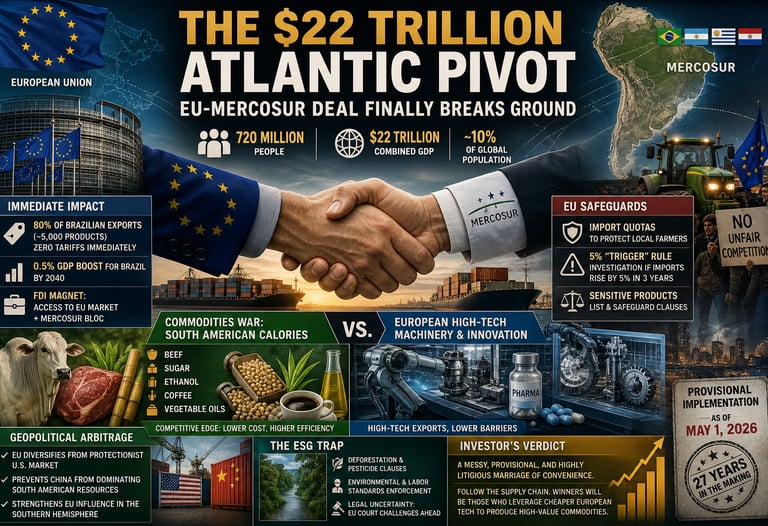
After 27 years of bureaucratic paralysis and "diplomatic fatigue," the behemoth is finally awake. As of Friday, May 1, 2026, the EU-Mercosur Trade Agreement has officially entered its provisional implementation phase. We are looking at a market of 720 million people and a combined GDP of $22 trillion—roughly 10% of the global population.
For investors with skin in the game, this isn't just another trade treaty; it’s a massive geopolitical arbitrage play. However, as an editor who values reality over press releases, I can tell you that the "Swiss watch" of global trade is being adjusted with a jackhammer once again.
The 30-Year Slow Burn: Growth or Mirage?
Don't let the headlines fool you into thinking the floodgates are open. While 80% of Brazilian exports to the EU (roughly 5,000 products) will hit zero tariffs immediately, the full implementation of this deal is a 30-year marathon, not a sprint.
The Immediate Technical Impact:
The 80% Threshold: Most commodities and industrial inputs from the Mercosur bloc now enter the Eurozone with zero or significantly reduced tariffs.
GDP Projections: Estimates suggest a 0.5% boost to Brazilian GDP by 2040. While it sounds modest to a retail trader, in macro terms, that is a massive injection of liquidity into the South American powerhouse.
Foreign Direct Investment (FDI) Magnet: This deal transforms Mercosur from an isolated trade island into a strategic bridge. An investor in the US or Mexico looking at Brazil now gets a "buy one, get five" deal—access to Argentina, Uruguay, Paraguay, and the entire European Union market.
The Commodities War: Commodities vs. High-Tech
The evidence suggests this is a classic trade-off: South American calories for European technology.
Mercosur’s Offensive:
The bloc—specifically Brazil, which accounts for 80% of Mercosur’s exports—is set to dominate in:
Proteins & Agribusiness: Meat, sugar, ethanol, coffee, and vegetable oils.
The Competitive Edge: Brazilian beef and poultry are significantly more competitive than their Polish or French counterparts. This is exactly why we see "tractor protests" across Europe.
The EU’s Counter-Strike:
The EU isn't giving away its market for free. They have baked in "Sensitive Product" safeguards:
Import Quotas: Free trade is limited by predetermined volumes to protect local European farmers.
The 5% "Trigger" Rule: If imports of sensitive products rise by 5% within three years, the EU can trigger an investigation and potentially suspend parts of the agreement.
Industrial Dominance: High-tech machinery, chemicals, and pharmaceuticals from Germany and France will now flood South America with lower barriers, potentially suffocating local "infant" industries that lack the scale of European giants.
Geopolitical Arbitrage: The "Trump Factor"
Why now? Why, after nearly three decades of stalling, did this suddenly cross the finish line?
A boots-on-the-ground perspective reveals that the "Trump Factor" was the ultimate catalyst. The EU has realized that relying solely on a protectionist US market is a high-risk strategy. Diversification isn't just a buzzword for portfolio managers; it’s now the official policy of Brussels.
Furthermore, there is the China Angle. If the EU had failed to ratify this deal, they would have essentially handed South American lithium, food security, and energy transition minerals to Beijing on a silver platter. This deal is the EU’s desperate attempt to remain relevant in the Southern Hemisphere.
The ESG Trap: Green Protectionism or Progress?
The biggest hurdle remains "Regulatory Imperialism." The EU has signaled that it will use environmental mandates as a trade weapon.
The Pesticide & Deforestation Clause: The EU reserves the right to block agricultural products that don't meet their specific environmental or labor standards.
Legal Insecurity: Countries like Poland and France are already threatening to take the deal to the European Court of Justice, claiming the Mercosur regulations are too "flexible" compared to the Eurozone’s rigid ESG mandates.
The Investor's Verdict
The EU-Mercosur deal is a messy, provisional, and highly litigious marriage of convenience. For the US investor, it means a more competitive landscape in South America and a European Union that is trying to claw back its global influence.
The strategy is clear: Follow the supply chain. Companies that can leverage cheaper European tech inputs to produce high-value South American commodities will be the true winners of this $22 trillion experiment.
Keywords: EU-Mercosur Trade Deal 2026, Macro Geopolitical Arbitrage, ESG Trade Mandates International Supply Chain Diversification, 2t Economics Analysis, Brazil EU Trade Tariffs Commodity Supercycle, European Protectionism, Emerging Markets Investment Strategy