
Why the Arctic Route Could Reshape Global Trade and Challenge the Strait of Hormuz
As tensions rise in the Strait of Hormuz, Russia is promoting the Arctic Route as a faster alternative for global trade. Explore the geopolitical battle over oil, shipping corridors, energy security, and the future of international commerce.
5/12/20265 min read
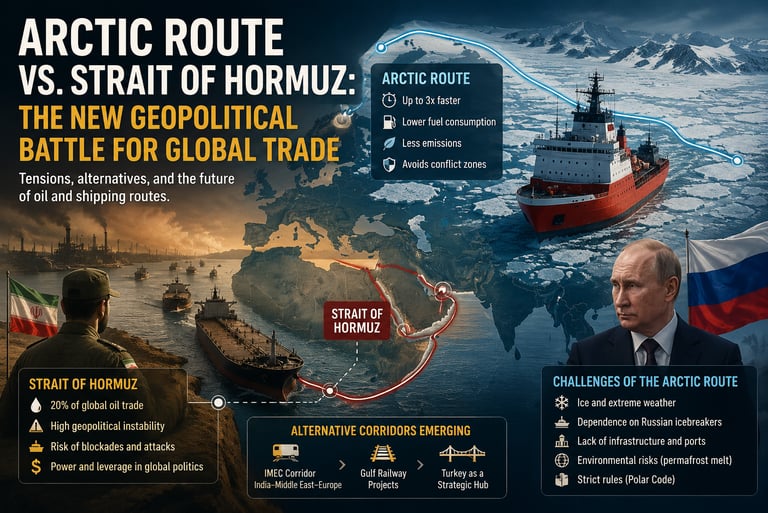
The Arctic Route vs Hormuz: Can Russia Really Redraw Global Trade?
For decades, the global economy has depended on a handful of narrow maritime chokepoints. Few are more important than the Strait of Hormuz — a passage responsible for roughly 20% of the world’s oil trade. Every tanker delay, military escalation, or political threat in the region immediately echoes across energy markets, shipping insurance, inflation expectations, and global supply chains.
Now, amid rising tensions between Iran and the United States, Russia sees an opportunity.
President Vladimir Putin has intensified the promotion of the Arctic shipping corridor — often called the Northern Sea Route — as a strategic alternative to unstable Middle Eastern trade routes. On paper, the proposal sounds revolutionary: shorter shipping times between Asia and Europe, lower fuel consumption, fewer geopolitical bottlenecks, and potentially reduced freight costs.
But beneath the headlines lies a much more complicated reality.
Why the Strait of Hormuz Matters So Much
The modern global economy still runs on physical logistics. Digital finance, AI, and cloud infrastructure may dominate headlines, but the movement of oil, gas, food, and manufactured goods still depends on ports, railways, and maritime corridors.
That is why instability in Hormuz creates global anxiety.
Iran has increasingly signaled that it no longer views the strait as a purely neutral international passage. According to geopolitical discussions surrounding recent events, Tehran has considered selective control over traffic, including restrictions on vessels considered hostile and the possibility of imposing navigation fees.
This transforms the Strait of Hormuz from merely an energy corridor into a geopolitical weapon.
The danger is not theoretical. Military incidents involving Iranian and Western vessels, fragile ceasefire negotiations, and the growing presence of European naval coalitions have all reinforced the perception that global trade is excessively dependent on vulnerable chokepoints.
History has already shown how dangerous these dependencies can become. The blockage of the Suez Canal and instability near Bab el-Mandeb exposed how quickly maritime disruptions can trigger supply chain chaos worldwide.
As a result, governments and corporations are now actively searching for alternatives.
Russia’s Arctic Vision
Russia’s proposal is straightforward: bypass geopolitical instability entirely by moving trade north.
The Arctic route promises several major advantages:
Faster transportation between East Asia and Northern Europe
Lower fuel consumption due to shorter distances
Reduced exposure to Middle Eastern conflicts
Potentially lower freight and insurance costs
Supporters of the route argue that climate change and polar ice melting are opening new commercial opportunities that were previously impossible.
From Moscow’s perspective, the Arctic could become the 21st century equivalent of the Suez Canal — a strategic artery connecting Europe and Asia under strong Russian influence.
This explains why the Arctic has become central not only to Russian economic strategy, but also to broader geopolitical competition involving the United States, Europe, and China.
Even interest in Greenland has intensified because Arctic control increasingly means influence over future shipping, military positioning, and strategic mineral extraction.
The Problem: The Arctic Is Still Not Ready
Despite the ambitious narrative, the Arctic route faces enormous practical limitations.
The first is scale.
While the Strait of Hormuz handles around 150 vessels per day, Arctic traffic remains extremely small. Reports discussed in the analysis referenced only 103 vessels using the Arctic corridor throughout 2025 — a microscopic figure compared to traditional global shipping routes.
The second problem is ice. Even with warming temperatures, Arctic navigation remains highly seasonal and technically difficult. In many periods of the year, ships still require escort by nuclear-powered icebreakers — an area where Russia dominates globally.
This creates a strategic contradiction. The route is marketed as a way to reduce geopolitical dependence on the Middle East, yet it risks creating a new dependence on Russian infrastructure, Russian logistics, and Russian regulatory control.
For many European governments, replacing dependence on Hormuz with dependence on Moscow does not necessarily improve long-term strategic security.
The Infrastructure Gap
Another major obstacle is infrastructure. Traditional routes such as Suez benefit from decades of investment in ports, insurance systems, rescue operations, refueling hubs, and integrated logistics networks.
The Arctic simply does not yet possess this ecosystem. Ports remain underdeveloped, emergency response capabilities are limited, and harsh weather conditions increase operational uncertainty. Shipping companies prioritize predictability above almost everything else — and the Arctic still struggles to provide it consistently.
This is one reason why many analysts believe the route may become more useful for pipelines and energy transport infrastructure than for massive container shipping operations.
In other words, the Arctic may evolve into an energy corridor before it becomes a true commercial replacement for global maritime trade.
The Environmental Contradiction
The Arctic route also exposes one of the greatest contradictions of modern geopolitics.
Climate change is simultaneously creating the opportunity and the danger. As polar ice melts, navigation becomes easier. But that same melting threatens the fragile Arctic ecosystem and increases the risk of releasing massive amounts of methane trapped beneath the permafrost.
Permafrost is permanently frozen ground found across Arctic regions. When it melts, methane — one of the most powerful greenhouse gases — can escape into the atmosphere, accelerating global warming even further.
This creates a dangerous feedback loop:
Rising temperatures melt permafrost
Methane is released
Methane accelerates warming
More permafrost melts
The environmental risks are so severe that international maritime operations in polar regions are governed by the International Maritime Organization Polar Code, a framework imposing strict environmental and safety standards for Arctic navigation.
The irony is difficult to ignore: the same warming that makes Arctic shipping commercially attractive could also intensify the global climate crisis.
Alternative Corridors Are Already Emerging
Russia is not the only actor trying to redesign global trade routes.
The proposed India-Middle East-Europe Corridor (IMEC) seeks to combine maritime shipping with rail infrastructure linking India, the Gulf, and Europe. Gulf nations are also expanding railway integration projects designed to bypass vulnerable maritime chokepoints.
Meanwhile, Turkey continues to gain importance as a strategic bridge between Asia, the Middle East, and Europe through railway and logistics investments.
The broader trend is clear: The world is entering an era of logistics diversification.
Countries no longer want to depend excessively on a single route, single canal, or single geopolitical actor.
The Real Geopolitical Lesson
The most important lesson from the Hormuz crisis and Russia’s Arctic ambitions is not simply about shipping. It is about power. Throughout history, nations controlling trade corridors have exercised enormous geopolitical leverage. The more the world depends on a route, the greater the influence of whoever controls it.
Iran understands this with Hormuz.
Russia understands this with the Arctic.
China understands this with the Belt and Road Initiative.
And Western powers increasingly understand that supply chain security is now inseparable from national security.
The future global economy may not be defined solely by who produces the most goods — but by who controls the safest, fastest, and most reliable routes connecting them.
Final Thoughts
Russia’s Arctic vision is not fantasy. The route offers genuine long-term strategic potential, especially for energy exports and selective cargo transport. But the idea that it can rapidly replace traditional maritime corridors remains highly unrealistic.
The technical challenges are immense. The infrastructure is incomplete. The environmental risks are profound. And the geopolitical trust required for large-scale adoption simply does not yet exist.
Still, the growing instability around the Strait of Hormuz guarantees one thing: the search for alternative trade corridors will only accelerate in the coming decade.
The world is slowly discovering that globalization was never just about economics — it was always about geography.
For readers interested in understanding how geography shapes global power, trade routes, and international conflict, a highly relevant recommendation is the book The Revenge of Geography by Robert D. Kaplan. It offers an excellent perspective on how terrain, maritime chokepoints, and strategic corridors continue to influence world politics far more than many modern analysts assume.
LInk: https://amzn.to/4dozXNT