
Why a “Weakened” Iran Still Dictates Terms to the U.S.: The Hormuz Paradox, Asymmetric Power, and the Hidden Risk Premium in Global Markets
Despite military pressure and economic sanctions, Iran continues to extract geopolitical concessions from the United States. This analysis breaks down the Hormuz chokepoint, asymmetric warfare strategy, and the implications for oil markets, inflation, and global risk pricing.
6/26/20263 min read
Iran–US “Deal” Paradox: Why a “Weakened” Tehran Still Extracts Strategic Concessions from Washington
A boots-on-the-ground perspective reveals a contradiction that Wall Street, Washington, and energy traders cannot ignore: even under sustained military and economic pressure, the Islamic Republic of Iran still appears capable of extracting meaningful geopolitical concessions from the United States.
The evidence suggests something uncomfortable for conventional power analysis—military superiority does not automatically translate into political control.
The Core Paradox: A “Defeated” Iran Negotiating Like a Systemic Player
The narrative presented is straightforward: the United States, under Donald Trump, frames Iran as militarily degraded—navy disrupted, air force neutralized, command structure weakened, and regional projection reduced.
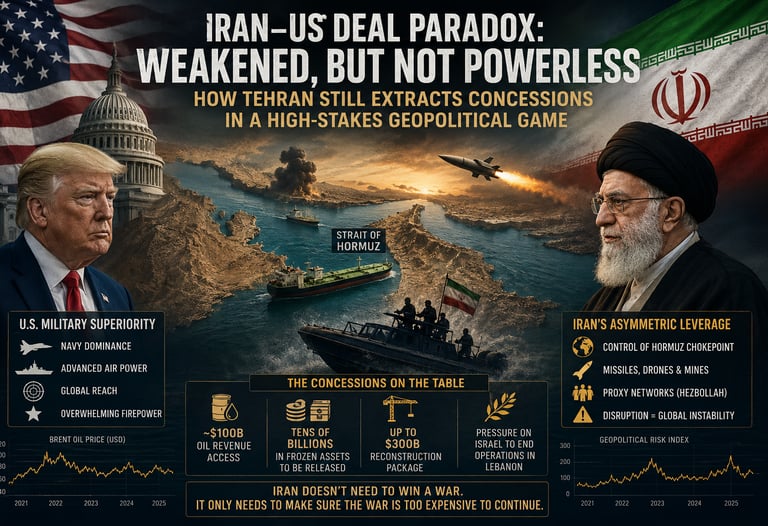
Yet the reported memorandum of understanding points in the opposite direction:
Potential sanctions relief tied to phased compliance
Access to roughly $100B in oil revenues
Release of tens of billions in frozen assets
A reconstruction package potentially reaching $300B
Political clauses indirectly affecting Israeli operations in Lebanon
From a markets perspective, this is the uncomfortable signal: a supposedly “weakened” state is still pricing in geopolitical leverage at scale.
Hormuz: The Asset That Cannot Be Bombed Away
At the center of this entire dynamic is geography—specifically the Strait of Hormuz Strait of Hormuz.
A critical misconception in Western policy circles is the assumption that military degradation equals strategic elimination. It does not.
Hormuz remains:
A choke point for a large share of global seaborne oil flows
A direct transmission mechanism into global inflation expectations
A risk multiplier for shipping insurance premiums
A pressure valve for Asian energy security (China, India, Japan)
A boots-on-the-ground perspective reveals the asymmetry:
Even a weakened Iran does not need naval dominance. It only needs credible disruption capability.
That alone forces Washington into bargaining territory.
Asymmetric Warfare: Why “Losing Battles” Can Still Win Negotiations
The key analytical mistake is confusing battlefield outcomes with strategic leverage.
Iran’s enduring advantage is not conventional military strength. It is:
Geography (Hormuz proximity)
Political will (high tolerance for escalation risk)
Proxy architecture across the region
Low-cost disruption tools (mines, drones, fast boats, missiles)
This is the essence of asymmetric power: Not defeating the opponent militarily, but making victory economically and politically expensive.
Even a fully capable U.S. Navy can escort shipping through Hormuz, but that transforms into:
Permanent deployment costs
Elevated oil price volatility
Higher insurance spreads
Continuous escalation risk management
Markets hate “permanent uncertainty premiums.”
Washington’s Dilemma: Power Without Clean Exit Options
For the United States, the dilemma is structural.
Even overwhelming military capability does not resolve:
Oil price sensitivity in election cycles
Coordination with Gulf allies
Protection commitments to Israel
Risk of regional escalation
Inflation transmission into domestic politics
So Washington is forced into a hybrid posture:
Military dominance on paper
Diplomatic concessions in practice
Market stabilization as a parallel objective
In other words: the U.S. can win battles but still has to price in geopolitical friction.
That is not weakness—it is constraint.
Iran’s Negotiation Stack: Survival Through Fragmentation of Pressure
Iran’s bargaining position is not rooted in strength, but in survivability under fragmentation.
Even under sanctions and infrastructure damage, Tehran retains leverage through:
Oil export normalization as economic oxygen
Unfreezing assets as regime liquidity injection
Regional proxy influence as deterrence depth
Hormuz risk escalation as systemic threat
The critical insight is this:
The regime does not need to win conflicts. It only needs to ensure conflicts remain expensive to ignore. That is enough to force re-entry into negotiations.
Israel, Hezbollah, and the Second Layer of the Board
A major underappreciated dimension is the Israel–Lebanon theater, particularly involving Hezbollah.
This introduces a second-order constraint:
Iran’s deterrence model depends heavily on proxy pressure against Israel
Israel’s objective is to degrade that proxy network
U.S. diplomacy becomes entangled between both
This creates a multi-board negotiation system:
Nuclear negotiations
Energy and sanctions relief
Maritime security (Hormuz)
Proxy warfare in Lebanon
The result is fragmentation of conflict into interconnected bargaining tables—exactly how asymmetric actors offset conventional weakness.
Market Implications: This Is Not Geopolitics—It’s Risk Pricing
For investors, the key takeaway is not ideology—it is pricing behavior.
If Hormuz risk remains structurally embedded, markets must continuously reprice:
Brent crude volatility floors
Shipping insurance premiums
LNG arbitrage spreads
Inflation expectations in the U.S. and EU
Defense sector risk premiums
The evidence suggests that even without open war, the geopolitical risk premium is becoming semi-permanent.
That changes how portfolios behave in macro cycles.
Conclusion: Victory Without Control Is Not Victory in Markets
The central contradiction remains unresolved.
The United States retains overwhelming conventional superiority. Yet Iran—despite significant losses in personnel, infrastructure, and military capacity—still manages to extract strategic concessions by threatening systemic disruption at precisely the weakest point of global trade.
That is not traditional power. That is leverage through instability and in macro terms, instability that cannot be fully eliminated is still priced as power.
For readers trying to understand this dynamic more deeply, a relevant framework comes from “The Revenge of Geography” by Robert D. Kaplan. It explains why physical space, chokepoints, and immutable geography continue to dominate even in an era of technological military superiority.