
US-Iran Deal Uncertainty Reignites Oil Market and Geopolitical Risk Fears
Markets priced peace between the US and Iran too early as oil risks, sanctions uncertainty, and Gulf tensions continue rising.
5/25/20265 min read
Washington’s Iran Dilemma Is Becoming a Market Risk Again
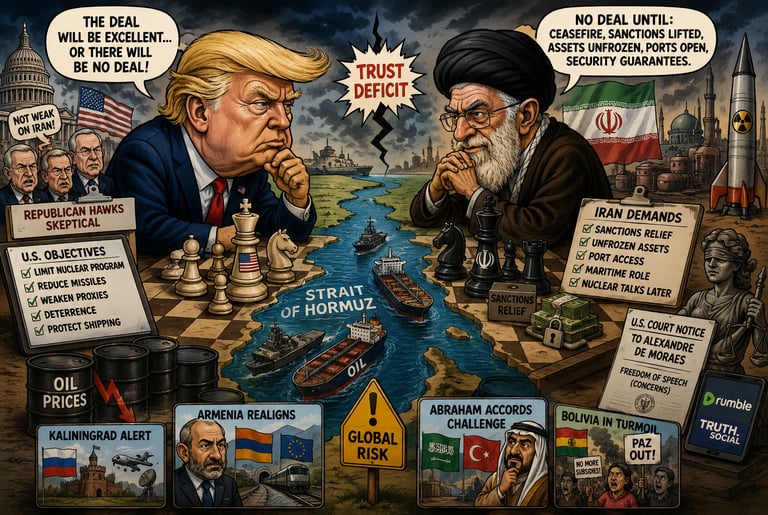
Financial markets briefly priced in the possibility of a geopolitical de-escalation between the United States and Iran after energy prices softened over the weekend. Brent crude and fuel markets reacted as if a diplomatic breakthrough was approaching, particularly around the security of the Strait of Hormuz — one of the world’s most critical energy chokepoints.
But the political messaging from both Washington and Tehran remains deeply contradictory.
According to the narrative emerging from both sides, negotiators appear to be communicating different positions privately and publicly. The White House signals progress while simultaneously hardening its rhetoric. Iran, meanwhile, claims negotiations are possible but only under conditions that would effectively reverse many of the sanctions and military pressures imposed during the conflict.
The result is a geopolitical environment where markets are attempting to price peace while political actors continue preparing for strategic confrontation.
Why Markets Initially Interpreted the Situation as Bullish
Several developments encouraged investors to believe a deal could be imminent:
Falling oil and fuel prices suggested reduced fears of prolonged supply disruption.
U.S. officials hinted that negotiations were close to completion.
President Donald Trump publicly projected optimism about a potential agreement.
Reports circulated that a diplomatic framework could emerge within days.
For energy markets, the key issue is not merely Iran itself, but the broader stability of Gulf shipping routes. Any credible reduction in risks surrounding the Strait of Hormuz immediately affects:
Global oil benchmarks
Inflation expectations
European energy security
Freight and insurance costs
Federal Reserve and ECB inflation assumptions
However, optimism faded quickly after Trump reportedly instructed negotiators not to rush toward a final agreement.
That reversal exposed a deeper problem inside the Republican coalition itself.
Republican Fractures Are Becoming Increasingly Visible
One of the most important macro-political developments is not Iran directly, but the growing tension between traditional Republican foreign policy hawks and the MAGA-aligned nationalist wing surrounding Trump.
As Trump’s approval ratings soften ahead of U.S. midterm elections, parts of the Republican establishment appear increasingly uncomfortable with the optics of a negotiated settlement perceived as favorable to Tehran.
Prominent Republican figures raised concerns that:
Iran could emerge economically stronger after the conflict.
Sanctions relief may fund future regional influence operations.
Tehran may retain elements of its nuclear infrastructure.
The U.S. could appear strategically weakened after months of confrontation.
Critics inside the party argue that if the outcome of the conflict is merely a reopening of maritime routes that were operational before the war — while simultaneously restoring Iranian financial access — Washington risks appearing to have absorbed substantial geopolitical and economic costs without securing lasting strategic concessions.
That criticism matters because markets increasingly view U.S. foreign policy through a domestic political lens. A divided Republican Party creates uncertainty around:
The durability of any agreement
Future sanctions enforcement
U.S. military posture in the Gulf
Long-term energy stability
The Core Strategic Problem: What Exactly Would the U.S. Gain?
The emerging criticism from conservative circles centers on a simple question: After months of economic disruption and military escalation, what structural changes would actually occur?
Originally, the conflict was framed around several objectives:
Limiting Iran’s nuclear program
Reducing missile capabilities
Weakening Iran-backed regional networks
Restoring deterrence credibility
Protecting Gulf shipping lanes
Yet the framework currently discussed publicly appears significantly narrower.
According to Iranian statements, negotiations would require:
A ceasefire
Sanctions relief
Unfreezing Iranian assets
Reduced restrictions on ports and shipping access
Broader normalization measures
From the perspective of critics inside Washington, this risks creating the perception that Iran could emerge diplomatically rehabilitated without fundamental concessions.
Trump himself attempted to counter this narrative by attacking the 2015 Obama-era nuclear agreement, arguing that prior sanctions relief enabled parallel uranium enrichment and expanded Iranian regional influence.
But politically, repeating criticism of the Obama deal may no longer be sufficient to unify Republican factions if voters perceive current negotiations as strategically inconsistent.
The Strait of Hormuz Remains the Global Economic Flashpoint
The most economically consequential issue remains the Strait of Hormuz.
Roughly one-fifth of global oil flows pass through the corridor, making it central to:
Global inflation dynamics
European industrial energy costs
Asian manufacturing supply chains
LNG trade stability
Shipping insurance pricing
Iranian officials signaled that they would not impose direct transit tariffs, but simultaneously suggested that “security services” in the region may carry financial costs. That language introduces major uncertainty.
Markets are now attempting to assess whether Tehran seeks:
A formal maritime security role
Military oversight mechanisms
Indirect shipping fees
Expanded strategic leverage over Gulf logistics
Even ambiguous language surrounding Hormuz can materially affect risk premiums in energy and shipping markets.
For institutional investors, this matters because persistent geopolitical uncertainty keeps:
Oil volatility elevated
Inflation expectations unstable
Central banks cautious
Defense spending expectations high
China Quietly Emerges as a Potential Stabilizer
An underappreciated development is Iran’s reported willingness to negotiate uranium transfer arrangements involving China.
According to regional reports, Tehran may consider placing enriched uranium under Chinese supervision, potentially with mechanisms allowing reversal if ceasefire commitments collapse.
This is geopolitically significant for several reasons:
China’s Strategic Position Expands
Beijing increasingly positions itself as a pragmatic mediator capable of maintaining relations with:
Iran
Gulf monarchies
Russia
European trade partners
Washington Appears More Comfortable With Chinese Mediation Than Russian Involvement
The U.S. reportedly views China as a comparatively more reliable intermediary than Moscow in this specific context.
Multipolar Diplomacy Accelerates
The situation reinforces the broader macro trend toward a less U.S.-centric geopolitical order, where regional stability increasingly depends on overlapping power brokers rather than singular American dominance.
For investors, this evolution matters because it affects:
Dollar diplomacy
Energy settlement systems
Commodity pricing power
Long-term reserve currency dynamics
The Abraham Accords Could Complicate Diplomacy Further
Trump also reportedly linked broader Gulf normalization efforts to renewed momentum around the Abraham Accords.
The logic is straightforward: If Washington succeeds in stabilizing the Gulf, regional states should deepen diplomatic recognition of Israel. But this may create additional complications rather than facilitate peace.
Several countries remain politically constrained:
Saudi Arabia continues balancing regional leadership with domestic and regional support for the Palestinian cause.
Turkey under President Recep Tayyip Erdoğan remains openly critical of Israeli policy.
Public opinion across much of the Arab world hardened significantly after recent regional conflicts.
The original Abraham Accords normalized ties between Israel and several Arab states in exchange for economic, security, and diplomatic incentives. While strategically important, expanding the framework under current conditions may prove substantially more difficult than during the initial 2020 normalization wave.
Secondary Geopolitical Risks Are Also Expanding
Beyond the Gulf, several additional geopolitical stress points emerged simultaneously.
Russia and Kaliningrad
Reports of drone activity near Kaliningrad triggered renewed Russian security measures in the Baltic region.
This reinforces investor concerns about:
NATO-Russia escalation risks
European defense spending
Baltic transportation vulnerabilities
Broader East-West tensions
Armenia’s Strategic Realignment
Armenia continues distancing itself from Moscow while increasing engagement with Europe and regional infrastructure initiatives involving Turkey and neighboring states.
That shift weakens Russia’s long-term influence in the Caucasus and reflects a broader post-Ukraine geopolitical realignment.
Latin American Political Volatility
The transcript also highlights instability in Bolivia, where inflation, subsidy reductions, fiscal austerity, and political fragmentation are intensifying domestic unrest.
While not systemically important for global markets, such instability reinforces a broader emerging-market theme: Governments facing fiscal constraints are increasingly struggling to sustain subsidy-heavy economic models amid elevated global financing costs.
Investment Implications
The broader takeaway is that markets may have prematurely priced a clean diplomatic resolution.
Several realities remain unresolved:
Republican political divisions in Washington
Iran’s actual willingness to compromise
Long-term enforcement mechanisms
Security arrangements in the Gulf
The future role of sanctions
The strategic positioning of China
For macro investors, the environment continues to favor elevated geopolitical risk premiums across:
Energy
Defense
Shipping
Commodities
Inflation-sensitive assets
The biggest mistake markets could make is assuming that temporary de-escalation equals structural stability.
At this stage, the diplomatic process appears less like a finalized peace framework and more like an unstable negotiation shaped by domestic political pressures, strategic ambiguity, and competing visions of regional order.
Final Takeaway
The central contradiction remains unresolved: Washington wants a deal strong enough to project deterrence credibility, while Tehran wants normalization without strategic capitulation.
Those objectives may not be compatible. Until markets receive clarity on sanctions architecture, nuclear oversight, and Gulf security guarantees, geopolitical volatility is likely to remain a defining macroeconomic variable rather than a temporary headline risk.
Recommended Reading
A highly relevant book for understanding the intersection of U.S. foreign policy, energy security, and Middle Eastern geopolitics is The Prize: The Epic Quest for Oil, Money & Power by Daniel Yergin. The book provides essential historical context on how energy routes, oil markets, and geopolitical power struggles shape global economic systems.
Link: https://amzn.to/4v7M4WH