
Trump's Tariff Strategy Faces a Reality Check: Why America's Trade Deficit Is Still Growing
America's trade deficit continues to widen despite aggressive tariff policies. Discover how global supply chains, corporate strategy, and geopolitical risks are reshaping U.S. manufacturing, Wall Street, and the future of international trade.
7/7/20268 min read
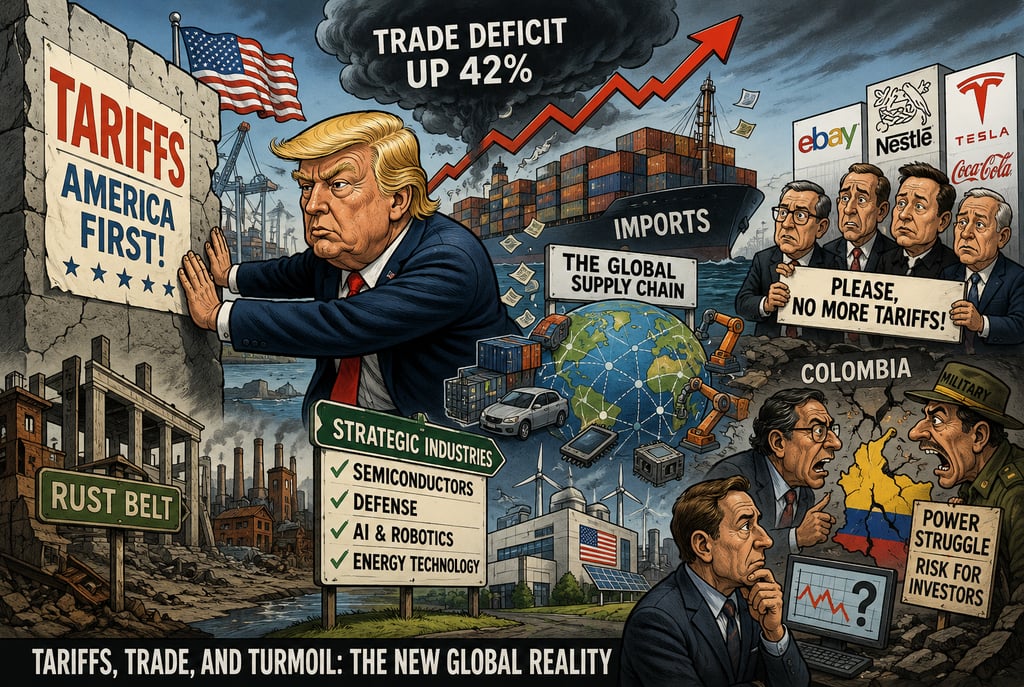
Why America's Trade Deficit Is Growing Despite Trump's Tariff Strategy
For years, Washington has promoted tariffs as the cornerstone of America's industrial revival. The political message is simple: make imports more expensive, encourage domestic manufacturing, create jobs, and reduce the trade deficit.
Reality, however, is proving far more complicated.
Recent trade figures reveal that the U.S. trade deficit expanded sharply even after successive rounds of tariffs and protectionist measures. For investors, this matters because it exposes an uncomfortable truth: modern economies no longer operate as isolated national systems. They function through deeply interconnected global supply chains that cannot be redesigned overnight.
The evidence suggests that tariffs alone cannot reverse decades of globalization. Instead, they often create unintended consequences that ripple through corporate earnings, consumer prices, and financial markets.
The Promise of Reindustrialization Meets Economic Reality
There is no question that the United States experienced significant industrial decline over the past several decades.
Entire regions once dominated by steel mills, heavy manufacturing, and automotive production gradually transformed into what became known as the Rust Belt. Factories closed, production shifted overseas, and millions of manufacturing jobs disappeared.
This historical trend became one of the central arguments behind Donald Trump's economic agenda.
The objective was straightforward:
Bring manufacturing back to American soil.
Reduce dependence on foreign suppliers.
Strengthen national security through domestic production.
Rebuild middle-class employment.
From a strategic perspective, these goals are understandable.
No major power wants to depend entirely on foreign countries for semiconductors, defense components, pharmaceuticals, or critical minerals. Recent geopolitical tensions have only reinforced this concern.
However, the challenge lies in distinguishing strategic industries from industries that moved abroad simply because global capitalism made them more efficient elsewhere.
That distinction is where the debate becomes significantly more complex.
Not Every Factory Should Return Home
Political speeches often imply that every manufacturing job lost overseas should be brought back. Markets don't work that way.
Global production migrated because companies optimized costs, logistics, labor specialization, and access to international markets.
A footwear manufacturer, for example, does not produce in Southeast Asia because executives dislike America.
It produces there because:
Labor costs are dramatically lower.
Supplier ecosystems already exist.
Transportation networks are highly optimized.
Profit margins remain competitive.
Relocating every labor-intensive industry back to the United States would almost certainly increase production costs.
Those higher costs rarely disappear.
They are eventually passed to consumers through higher prices or absorbed by shareholders through lower margins.
Neither outcome is particularly attractive for investors.
Strategic Manufacturing Is Different
That does not mean all reshoring efforts are misguided. A boots-on-the-ground perspective reveals that certain industries deserve a different treatment.
These include:
Semiconductor fabrication
Defense manufacturing
Aerospace
Advanced robotics
Critical medical supplies
Artificial intelligence infrastructure
Energy technology
These sectors carry strategic value beyond immediate profitability.
The COVID-19 pandemic demonstrated how vulnerable advanced economies become when critical products depend on distant suppliers.
Likewise, growing tensions with China have made semiconductor independence a national priority rather than merely an economic objective.
In these industries, higher production costs may represent an acceptable trade-off for increased resilience.
That calculation looks very different from attempting to manufacture low-cost textiles or commodity consumer goods domestically.
Why the Trade Deficit Keeps Expanding
One of the biggest surprises for financial markets has been the continued deterioration of America's trade balance despite aggressive tariff policies.
At first glance, this appears contradictory. If imports become more expensive, shouldn't imports decline? Not necessarily.
Businesses respond to incentives far more quickly than governments can redesign supply chains.
Many corporations anticipated additional tariffs and accelerated purchases before new duties could take effect. This front-loading behavior temporarily increases imports rather than reducing them.
Several additional forces have also contributed to the widening deficit:
Weaker export performance.
Higher imports of industrial inputs.
Continued investment in AI infrastructure requiring imported components.
Energy market disruptions affecting global trade flows.
The result is an important lesson for investors.
Trade balances do not respond instantly to policy announcements. They reflect years—sometimes decades—of accumulated production decisions. Changing those structures requires far more than tariff schedules.
The Global Factory Cannot Be Rebuilt Overnight
Perhaps the greatest misconception surrounding modern protectionism is the belief that companies manufacture products entirely within one country.
That world disappeared decades ago. Today's multinational corporations operate inside what economists often call the "global factory." An aircraft assembled in the United States may contain components sourced from dozens of countries.
An electric vehicle may rely on batteries, software, electronics, specialty metals, and precision parts produced across multiple continents. Breaking those networks is extraordinarily expensive.
Every new tariff imposed on imported components raises production costs not only for foreign competitors—but also for American companies themselves. This is the hidden cost of aggressive protectionism.
In the next section, we'll examine why major U.S. corporations—including Tesla, Coca-Cola, Nestlé, and eBay—have pushed back against additional tariffs, and whether Trump's industrial strategy is beginning to produce measurable long-term gains despite its short-term economic costs.
Why America's Largest Corporations Are Opposing More Tariffs
One of the strongest arguments against blanket tariffs is not coming from economists.
It is coming from Corporate America.
Several multinational companies have openly expressed concern that expanding tariffs would damage their operations, increase costs, and ultimately hurt American consumers.
This creates an interesting contradiction.
The very businesses expected to benefit from protectionism are, in many cases, asking Washington to slow down.
Why?
Because modern corporations are no longer purely domestic businesses.
They are global organizations managing supply chains that stretch across dozens of countries.
For many executives, tariffs are less about protecting American industry and more about disrupting systems that took decades to optimize.
Global Supply Chains Are America's Competitive Advantage
Many political discussions assume imports are a weakness.
For multinational companies, imports are often a competitive advantage.
Consider industries such as:
Automotive manufacturing
Consumer electronics
Aerospace
Food processing
Industrial machinery
A single finished product may cross international borders several times before reaching the final customer.
An American manufacturer may import:
Specialized steel
Electronic sensors
Industrial chemicals
Precision bearings
Semiconductors
Packaging materials
Tariffs increase the cost of each imported component.
The consequence is straightforward.
Higher production costs lead to:
Lower corporate margins.
Higher consumer prices.
Reduced global competitiveness.
Lower investment capacity.
Ironically, policies designed to strengthen American manufacturing can temporarily weaken the financial performance of American manufacturers themselves.
Protectionism Has Benefits—But Only When Applied Carefully
This does not mean tariffs are inherently bad policy.
The evidence suggests that targeted protection can serve legitimate national interests.
Countries throughout history have protected strategic industries during critical stages of development.
The United States itself did so during the nineteenth century.
South Korea, Japan, and even China relied heavily on selective industrial policies while building globally competitive manufacturing sectors.
The problem emerges when protection becomes excessively broad.
Blanket tariffs create distortions that extend far beyond the intended targets.
Instead of protecting key industries, they begin raising costs across the entire economy.
Investors should pay close attention to this distinction.
Markets generally reward efficiency—not political symbolism.
Has Trump's Strategy Produced Any Success?
Critics often portray tariff policies as complete failures.
Supporters describe them as transformational.
Reality, as is often the case, lies somewhere in between.
The evidence suggests that some manufacturers are indeed expanding investment inside the United States.
Several large industrial projects have been announced over recent years, particularly in sectors tied to automobiles, semiconductors, batteries, and advanced manufacturing.
One notable example is Toyota's decision to expand production capacity in Texas through a multibillion-dollar investment.
From Washington's perspective, announcements like these reinforce the argument that protectionist policies encourage companies to manufacture closer to the American market.
For local economies, the benefits can be substantial.
New industrial facilities often generate:
Direct manufacturing jobs.
Construction employment.
Infrastructure investment.
Local tax revenue.
Secondary business development.
These projects create visible economic gains that politicians understandably emphasize.
The Bigger Question Investors Should Ask
However, investors should avoid focusing solely on headline announcements.
The more important question is whether these investments represent genuinely new production—or simply the geographic redistribution of existing production capacity.
If a company shifts part of its manufacturing from one North American location to another while maintaining its broader supply chain, the long-term macroeconomic impact may be smaller than political narratives suggest.
Likewise, many corporations continue investing simultaneously in the United States, Mexico, Canada, and Asia.
This reflects a simple reality. Businesses diversify production because resilience has become almost as important as efficiency.
Recent geopolitical tensions, pandemic disruptions, and shipping bottlenecks have convinced executives that concentrating manufacturing in one location creates unnecessary risk.
Rather than abandoning globalization, many firms are redesigning it. The future appears less about reshoring everything and more about building regional supply chains that reduce dependence on any single country.
For investors, this distinction is critical. Capital flows toward flexibility—not ideology.
In the final section, we'll examine how political instability in Colombia illustrates a broader challenge facing emerging markets, why institutional stability matters far more than election rhetoric, and what global investors should learn from these events.
Colombia's Political Turmoil Is a Reminder That Institutions Matter More Than Elections
While financial markets remain focused on inflation, tariffs, and Federal Reserve policy, political instability continues to shape investment decisions across emerging markets.
Recent developments in Colombia offer another example of how quickly political uncertainty can undermine investor confidence.
Following a contested presidential transition, accusations of electoral manipulation, corruption investigations, and calls for civil resistance have raised concerns about institutional stability.
Whether every allegation proves accurate is ultimately less important than the perception they create. Markets do not wait for political debates to end. They price uncertainty immediately.
When political leaders question election results, suspend transition processes, or encourage institutional confrontation, investors begin demanding higher risk premiums.
That translates into:
Currency volatility.
Capital outflows.
Higher government borrowing costs.
Reduced foreign direct investment.
Slower long-term economic growth.
The evidence suggests that institutional credibility is one of the most valuable assets any country can possess.
Why Investors Care More About Stability Than Ideology
Financial markets rarely reward governments simply because they lean left or right.
Instead, investors consistently favor countries where institutions remain predictable.
A change in administration is normal in every democracy.
A breakdown in the peaceful transfer of power is not.
History repeatedly demonstrates that uncertainty surrounding property rights, judicial independence, regulatory consistency, and constitutional order tends to discourage long-term investment.
Capital seeks environments where rules remain stable regardless of which political party wins an election.
This explains why institutional strength often outweighs ideology when international investors evaluate risk.
Countries with transparent legal systems and reliable governance generally attract investment even during periods of slower economic growth.
By contrast, economies plagued by political confrontation frequently struggle to maintain investor confidence despite offering attractive demographics or abundant natural resources.
The Bigger Lesson for Global Markets
Although headlines often focus on individual events—whether tariffs, elections, or geopolitical disputes—the broader lesson is that today's investment landscape is defined by interconnected risks.
Trade policy influences inflation.
Inflation shapes central bank decisions.
Interest rates affect corporate valuations.
Political instability alters capital allocation.
Supply chains determine competitiveness.
None of these factors operate in isolation.
That is why investors should avoid viewing tariff policies solely through a political lens.
The more relevant question is whether those policies strengthen or weaken long-term economic productivity.
Likewise, political transitions should not be judged exclusively by campaign rhetoric but by the resilience of the institutions managing the transfer of power. Markets ultimately reward predictability far more than promises.
Final Thoughts
The debate surrounding tariffs has become increasingly polarized.
Supporters argue they are essential for restoring American manufacturing and protecting national security.
Critics warn they raise costs, distort supply chains, and reduce competitiveness.
The evidence suggests that both sides capture part of the truth.
Selective industrial policy aimed at strategic sectors—such as semiconductors, defense, energy, and advanced technologies—can strengthen economic resilience.
However, broad protectionist measures risk imposing higher costs on businesses that depend on globally integrated production networks.
For investors, the objective should not be to choose sides in political debates.
It should be to identify where capital is likely to generate sustainable long-term returns despite changing political environments.
The global economy is becoming less globalized than it was two decades ago—but it is not retreating into economic isolation.
Instead, it is evolving toward a new model built around regional supply chains, strategic manufacturing, and economic security.
Understanding that transition may prove far more valuable than reacting to the next tariff announcement or political headline.