
Trump’s Taiwan Gamble, Cuba Crisis, and Gulf War Fears: The New Geopolitical Shock Reshaping Global Markets
From Cuba’s energy collapse to rising Gulf tensions and Trump’s shifting stance on Taiwan, a new geopolitical era is emerging. Discover how trade wars, oil shocks, semiconductors, and strategic alliances are reshaping global markets and investment risk.
5/18/20265 min read
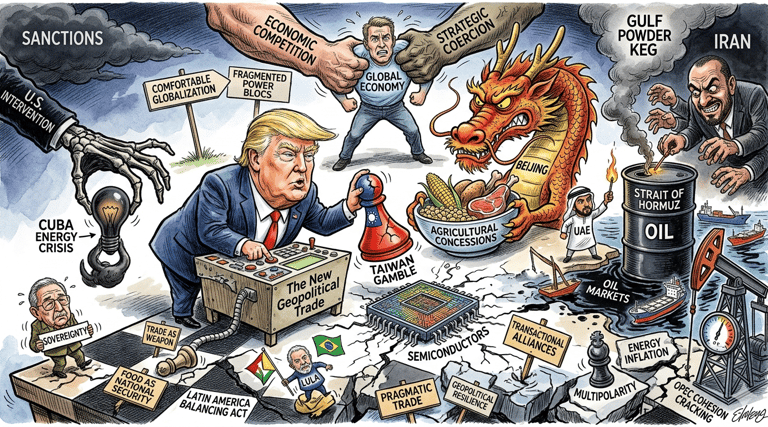
The New Geopolitical Trade: Cuba, Gulf Escalation, and Trump’s Taiwan Gamble
A World Moving From Economic Competition to Strategic Coercion
The global economy is no longer operating under the assumptions that dominated the post-Cold War era. Trade, sanctions, military pressure, energy routes, agricultural dependency, and technological sovereignty are now interconnected weapons in a broader geopolitical chessboard.
A boots-on-the-ground perspective reveals something many Wall Street analysts still underestimate: the market is no longer pricing only growth, inflation, and earnings. It is pricing territorial risk, regime stability, supply chain fragmentation, and resource security.
And right now, three flashpoints deserve immediate attention:
Cuba and the possibility of intensified U.S. intervention
A dangerous Gulf escalation involving the UAE and Iran
Donald Trump’s increasingly ambiguous posture toward Taiwan in negotiations with China
The evidence suggests these are not isolated stories. They are pieces of the same strategic transition: the end of globalization as investors knew it.
Cuba: Humanitarian Collapse or Strategic Opening?
Energy Sanctions Are Becoming a Geopolitical Weapon
According to the narrative emerging from Cuban officials, the island is entering a severe energy crisis after intensified restrictions on fossil fuel imports. Electricity shortages in Cuba are not merely an economic inconvenience. They threaten:
Hospital operations
Water distribution systems
Food logistics
Industrial production
Basic sanitation infrastructure
In modern geopolitical warfare, energy denial has become as effective as military blockade.
Washington officially frames pressure against Havana as part of a broader campaign against corruption, authoritarianism, and the alleged economic dominance of GAESA — the military-linked conglomerate accused of controlling large segments of the Cuban economy.
But investors should avoid naïve interpretations.
The evidence suggests U.S. strategic interest in Cuba is not purely ideological. Cuba represents a potentially massive untapped market positioned just 90 miles from Florida, with long-term opportunities in:
Tourism
Agriculture
Mining
Port logistics
Caribbean energy infrastructure
If GAESA’s economic dominance weakens, American capital could eventually move aggressively into the island.
That is the deeper story.
The Raul Castro Scenario: Pressure Through Political Destabilization
Speculation surrounding Raul Castro has intensified after reports discussing possible U.S. actions similar to pressure campaigns previously used against other anti-American governments.
Raul Castro, despite his advanced age, still symbolizes continuity within Cuba’s revolutionary establishment and maintains influence tied to state-controlled economic structures.
The geopolitical calculation is straightforward:
Remove old revolutionary pillars
Fragment elite cohesion
Increase internal economic pressure
Open pathways for political restructuring
However, regime-change operations rarely unfold according to spreadsheets designed in Washington think tanks.
The Cuban government has already responded with rhetoric centered on sovereignty, resistance, and anti-imperialist legitimacy. Historically, external pressure often strengthens nationalist narratives instead of weakening them.
And that creates a dangerous feedback loop.
The Gulf Powder Keg: UAE, Iran, and the Risk Markets Are Ignoring
The UAE Is Signaling Strategic Independence
One of the most underreported developments in global geopolitics is the growing assertiveness of the United Arab Emirates.
The country appears increasingly frustrated with both:
Iranian regional aggression
The inability of Gulf alliances to coordinate effective deterrence
The discussion surrounding potential Emirati operations near Iranian territory represents something much larger than a localized dispute.
It reflects a broader fracture inside the Gulf security architecture.
Why This Matters for Oil Markets
For decades, investors treated Gulf stability as an assumption. That assumption is now weakening.
The UAE’s dissatisfaction with production coordination frameworks and regional passivity carries enormous implications for:
Oil pricing mechanisms
OPEC cohesion
Shipping security in the Strait of Hormuz
Energy inflation expectations
Global insurance costs
If tensions escalate into direct confrontation involving Iran-linked infrastructure or territory, energy markets could experience extreme volatility.
And unlike previous regional crises, today’s world economy is already structurally fragile:
Europe remains vulnerable to energy shocks
China faces slowing growth
U.S. debt financing costs remain elevated
Supply chains are still adapting after years of disruption
One serious Gulf escalation could reignite global inflation faster than central banks can respond.
Military Reality: Why a Full-Scale War Still Looks Unlikely
From a hard-power perspective, Iran remains vastly more difficult to confront than many Western commentators imply.
Key asymmetries include:
Iran’s Structural Advantages
Large population base
Complex mountainous geography
Deep missile inventory
Extensive proxy networks
Strategic depth across the region
UAE Advantages
Superior military technology
Stronger Western integration
Higher military spending efficiency
Access to U.S. and Israeli systems
But military technology alone does not guarantee strategic victory. The Iraq and Afghanistan wars already demonstrated that regional dominance cannot simply be purchased with advanced hardware.That is precisely why Gulf investors are nervous.
The Gulf monarchies want:
Tourism
Financial inflows
Real estate growth
International capital
Global business hubs
A regional war destroys all five simultaneously.
Trump, Taiwan, and the Silent Negotiation With Beijing Trump’s Rhetoric Is Raising Strategic Questions
Perhaps the most financially important part of this geopolitical puzzle is Donald Trump’s increasingly ambiguous messaging regarding Taiwan.
Recent statements questioning:
U.S. military involvement
future weapons sales
the strategic value of defending Taiwan
have triggered concern across defense and semiconductor circles. Because Taiwan is not merely a geopolitical issue. It is the nerve center of the modern digital economy.
The Real Asset at Stake: Semiconductors
The global economy depends heavily on Taiwanese semiconductor manufacturing capacity, especially through Taiwan Semiconductor Manufacturing Company.
A serious Taiwan crisis would affect:
Artificial intelligence infrastructure
Consumer electronics
Military systems
Automotive manufacturing
Cloud computing
Data centers
In practice, Taiwan has become the single most important industrial chokepoint in the world economy. That is why Trump’s posture matters.
The evidence suggests Beijing may be offering selective economic concessions — particularly agricultural purchases and tariff adjustments — in exchange for reduced American strategic assertiveness regarding Taiwan.
The Agricultural Battlefield Nobody Talks About China’s “Virtual Water” Strategy
One of the smartest points often ignored in mainstream financial coverage is China’s dependence on imported “virtual water.” This concept refers to the enormous water consumption embedded in agricultural production.
When China imports:
soybeans
corn
beef
pork
poultry
it is effectively importing water-intensive production capacity from abroad. This matters because China faces growing long-term water stress. From Beijing’s perspective, importing agricultural commodities is not weakness. It is strategic resource management.
Why U.S.-China Trade Normalization Could Reshape Commodity Markets
The earlier tariff war accelerated diversification away from American agricultural suppliers.
Countries such as Brazil benefited enormously, especially in:
soybean exports
meat exports
corn exports
But if Washington and Beijing reduce tensions, American agribusiness could regain lost market share.
That creates several implications:
pressure on global commodity prices
intensified competition among exporters
shifting capital flows into logistics and agriculture
new bargaining power for Beijing
This is why investors should monitor agricultural diplomacy as closely as semiconductor policy.
Because food security is becoming geopolitical infrastructure.
Latin America’s Strategic Balancing Act
Lula’s Message to Washington
In recent remarks discussing relations with the United States and China, Luiz Inácio Lula da Silva emphasized sovereignty, multipolarity, and pragmatic trade relations.
That message reflects a broader shift occurring across much of the Global South:
Countries increasingly refuse binary alignment
Economic diversification is replacing ideological loyalty
China is viewed as a capital provider
The U.S. is still viewed as a security and financial anchor
The strategic competition now revolves around who delivers:
infrastructure
investment
industrial access
financing
market opportunities
not merely military protection.
Final Market Takeaway: The Era of Comfortable Globalization Is Ending
For years, markets operated under the assumption that economic interdependence reduced geopolitical risk. That assumption is breaking down in real time.
Today:
trade is weaponized
energy is strategic leverage
food is national security
semiconductors are geopolitical assets
sanctions are economic warfare
alliances are becoming transactional
The world is moving toward fragmented power blocs competing simultaneously through finance, technology, military deterrence, and resource control.
Investors who continue analyzing markets purely through quarterly earnigs and central bank speeches are increasingly blind to the deeper forces shaping the next decade. The smart money is already repositioning around geopolitical resilience.
Recommended Reading
A highly relevant book for understanding this new geopolitical-economic landscape is The Revenge of Geography by Robert D. Kaplan. The book explains how geography, energy routes, territorial pressure, and historical power dynamics continue shaping global conflicts despite the illusion of a fully globalized world.
Link: https://amzn.to/496fpIw