
Trump’s Iran Setback: How Congressional Resistance Could Reshape U.S. Power and Global Markets
Congress is moving to limit presidential military authority against Iran, exposing fractures within Washington and raising major questions for investors, energy markets, the Federal Reserve, and America’s global influence.
6/4/20264 min read
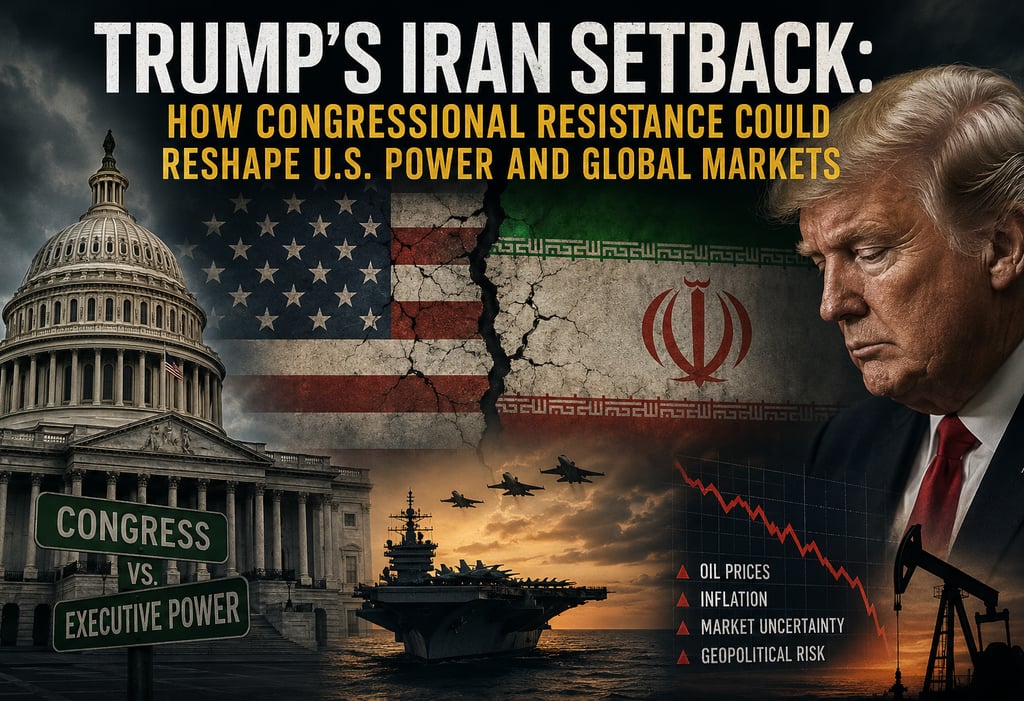
Trump’s Iran Setback Exposes a Deeper Fracture Inside America’s Power Structure
Congressional Revolt Signals That Washington’s Foreign Policy Consensus Is Cracking
For months, financial markets have focused on inflation, interest rates, artificial intelligence, and the trajectory of the U.S. economy. Yet a potentially more consequential story is unfolding beneath the surface: the growing confrontation between the White House and Congress over the limits of presidential power during military conflicts.
The evidence suggests that what appears to be a procedural dispute over military authorization is actually a much larger battle over who controls American foreign policy in an increasingly unstable world.
If Congress succeeds in restricting the president’s ability to launch new military operations against Iran without explicit legislative approval, the implications extend far beyond the Middle East. Investors, energy markets, defense contractors, and America's geopolitical rivals are all paying attention.
And they should be.
The Political Shock Wall Street May Be Underestimating
A boots-on-the-ground perspective reveals something many analysts are missing. The story is not simply about Iran. It is about cracks emerging inside the president’s own political coalition.
When lawmakers from the governing party begin supporting measures that directly limit executive authority, markets should take notice. Historically, internal fractures often become visible before broader political weakness appears in polling data.
Several trends are converging simultaneously:
Rising voter fatigue with foreign military engagements
Concerns about inflation linked to geopolitical instability
Growing tensions between establishment conservatives and populist factions
Increased scrutiny over executive authority during international crises
Political capital, much like financial capital, is finite. Every foreign policy confrontation consumes part of it.
Why Iran Matters Beyond the Battlefield
The strategic question is not whether the United States possesses military superiority. It clearly does.
The real question is whether Washington can convert military strength into political leverage.
Critics of the administration argue that prolonged confrontation with Iran has produced unintended consequences:
Higher energy market volatility
Increased shipping risks across critical maritime corridors
Additional pressure on consumer prices
Greater uncertainty for global supply chains
For investors, this matters because geopolitical instability eventually becomes an economic variable.
Every oil tanker rerouted, every shipping lane threatened, and every escalation risk premium ultimately appears somewhere on a corporate balance sheet.
Markets may temporarily ignore geopolitical tensions, but earnings statements rarely do.
The Hidden Cost of Middle East Escalation
Energy Markets Remain the Critical Transmission Mechanism
The Middle East remains one of the world's most important energy-producing regions. Even in an era of expanding domestic U.S. energy production, global oil pricing remains interconnected.
A prolonged conflict involving Iran creates several risks:
Disruptions to maritime trade routes
Higher insurance costs for shipping operators
Supply uncertainty
Increased inflationary pressure
For central banks already struggling to balance economic growth with inflation control, additional energy shocks are the last thing policymakers want.
The Federal Reserve may not set monetary policy based on military developments. However, it certainly reacts when those developments affect inflation expectations.
A Republican Divide Is Becoming Harder to Ignore
Perhaps the most significant development is not the dispute itself, but what it reveals about the governing coalition. A growing divide has emerged between:
The Populist Nationalist Wing
This faction prioritizes:
Strong executive authority
America-first policies
Direct confrontation with perceived adversaries
Skepticism toward traditional foreign policy institutions
The Traditional Conservative Wing
This group generally emphasizes:
Constitutional constraints
Institutional checks and balances
Fiscal discipline
Predictable international engagement
As long as political momentum remains strong, these factions can coexist.
When approval ratings soften or policy outcomes disappoint, those differences become much more visible.
History shows that political coalitions rarely fracture during victories. They fracture during periods of uncertainty.
The Iran Narrative Is Already Shifting
One of the most overlooked aspects of modern geopolitics is perception. Military power matters. Economic power matters. Narrative power matters too.
Iranian leadership has increasingly framed recent developments as evidence that American influence is weakening and that Washington faces growing constraints at home.
Whether that interpretation is accurate is almost secondary.
What matters is that rivals are beginning to test the proposition. Geopolitics often resembles financial markets.
Once participants believe momentum is shifting, their behavior changes accordingly.
The Israel-Lebanon Ceasefire: Stability or Temporary Pause?
At the same time, another fragile front remains under scrutiny.
The latest ceasefire arrangement between Israel and armed actors operating from Lebanese territory is being presented as a pathway toward de-escalation.
Yet history encourages caution. The region has witnessed numerous ceasefires that ultimately failed to produce lasting stability.
Several risks remain:
Competing political interests inside Lebanon
Armed non-state actors maintaining operational capabilities
Deep regional rivalries
Limited trust between parties
From a market perspective, the issue is straightforward. Investors prefer certainty. The Middle East continues to offer very little of it.
Why Investors Should Pay Attention
Many market participants dismiss geopolitical events as noise.
That can be a costly mistake. Major geopolitical shifts often begin as political stories before becoming economic realities.
The key questions investors should monitor are:
Can the White House maintain foreign policy flexibility?
Will Congress reclaim greater authority over military decisions?
How will energy markets respond to future tensions?
Can the Federal Reserve navigate another inflationary shock if oil prices surge?
Will global investors continue viewing U.S. political institutions as a source of stability?
These questions may ultimately matter as much as the next inflation report or employment release.
The Bigger Picture
The most important takeaway is not whether one side wins a legislative battle. It is that America's political system appears to be entering a period of increased institutional friction.
For decades, global markets operated under the assumption that U.S. foreign policy, while occasionally controversial, remained highly predictable.
That assumption is becoming harder to defend. The evidence suggests that investors are entering a world where political fragmentation, geopolitical competition, and economic uncertainty are increasingly intertwined and in markets, uncertainty is rarely priced correctly until after it arrives.
Recommended Reading
For readers seeking a deeper understanding of how political power, strategic rivalry, and global economic influence interact, one of the most relevant books is The Tragedy of Great Power Politics by John Mearsheimer. The book provides a compelling framework for understanding why major powers continually compete for influence, even when cooperation appears rational on the surface.
Link: https://amzn.to/4uZdqPi