
Trump's Iran Deal Explained: Why Markets Celebrate What Strategists Fear
A deep macroeconomic analysis of Trump's Iran agreement, the future of sanctions, oil markets, Israel's strategic position, and what investors need to understand about the shifting balance of power in the Middle East.
6/19/20265 min read
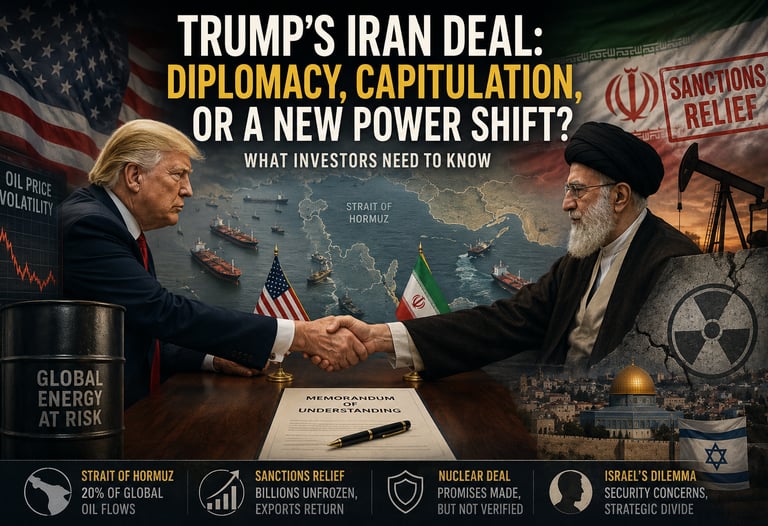
Trump's Iran Deal: Diplomacy, Capitulation, or the Beginning of a New Middle East Power Shift?
The War Ended. But Did America Actually Win?
Financial markets love certainty. Oil traders love open shipping lanes. Politicians love peace agreements they can sell as historic victories.
But investors who have capital at risk know that the real question is never whether a war ends. The real question is who emerges stronger when it does.
The newly announced memorandum of understanding between the United States and Iran is being presented as a diplomatic breakthrough. President Donald Trump portrays it as proof that American military power forced Tehran to negotiate.
Yet a closer examination suggests a far more complicated reality.
The evidence suggests that while Washington secured an immediate end to hostilities and restored stability to global energy markets, Tehran may have extracted significant strategic concessions while giving up surprisingly little in return.
For global investors, this distinction matters enormously.
Because the outcome of this agreement could reshape energy markets, regional security dynamics, defense spending, and geopolitical risk premiums for years to come.
Why Markets Care More About Hormuz Than About Politics
At the heart of this conflict sits one of the world's most critical economic chokepoints:
The Strait of Hormuz
Roughly one-fifth of global oil consumption passes through this narrow waterway.
During the conflict, Iran demonstrated a fundamental reality that military planners have understood for decades:
You do not need to defeat the United States militarily to create severe economic consequences. You simply need to make victory too expensive.
A boots-on-the-ground perspective reveals something Wall Street quickly recognized during the crisis:
Energy prices became highly sensitive to escalation risks.
Shipping insurance costs surged.
Global supply chain concerns resurfaced.
Inflation expectations rose across major economies.
For the Federal Reserve, this represented a nightmare scenario.
A prolonged disruption in Hormuz could have reignited inflation just as policymakers were attempting to normalize monetary conditions.
The reopening of maritime traffic therefore delivers an immediate economic benefit not only for Washington, but for Europe, Asia, and global financial markets.
The Asymmetric Victory Nobody Wants to Admit
Military conflicts are often judged by destroyed assets, battlefield losses, or territorial gains.
History suggests this is frequently the wrong metric. Asymmetric warfare operates under a different logic. The weaker side does not need battlefield superiority.
It only needs to raise costs until the stronger side changes its objectives.
According to the framework outlined in the memorandum:
Naval restrictions begin to ease.
Iranian oil exports regain access to global markets.
Financial restrictions begin unwinding.
Frozen assets become available.
Reconstruction financing is established.
Future negotiations continue under reduced pressure.
From Tehran's perspective, this outcome may represent a remarkable strategic achievement.
Iran survived and survival was arguably its primary objective from the beginning.
The Sanctions Question: Washington's Most Valuable Leverage
The most controversial aspect of the agreement involves sanctions relief. For years, sanctions served as America's primary instrument of economic pressure.
The system constrained:
Oil exports
Banking access
International financing
Foreign investment
Currency stability
The memorandum appears to place that pressure architecture on a path toward dismantlement. Critics argue this creates a dangerous precedent. Their concern is straightforward:
If sanctions are removed before irreversible concessions are secured, the negotiating leverage disappears.
Historically, this has been one of the central criticisms leveled against previous diplomatic engagements with Tehran.
The concern is not ideological. It is transactional. Once economic benefits arrive, incentives to make further concessions often diminish.
Investors should pay close attention to how rapidly sanctions relief translates into increased Iranian energy production.
A meaningful return of Iranian crude to global markets could exert downward pressure on long-term oil prices.
The Nuclear Issue Remains Unresolved
Perhaps the most significant weakness in the agreement involves the nuclear question.
The memorandum reportedly includes Iranian commitments not to pursue nuclear weapons. However, critics point out that promises alone are not verification mechanisms.
The difference matters. Markets generally react positively to diplomatic language. National security planners focus on enforcement.
The key unresolved issues include:
Verification
Inspection mechanisms remain unclear.
Enforcement procedures remain undefined.
Long-term monitoring structures require negotiation.
Enriched Material
Material reportedly remains inside Iran.
Future enrichment discussions remain open.
Final implementation details are still pending.
For investors, uncertainty itself carries a cost.
An unresolved nuclear question means geopolitical risk has been deferred rather than eliminated.
Israel's Strategic Dilemma
Perhaps no country faces more difficult questions from this agreement than Israel.
From Jerusalem's perspective, military operations may have achieved tactical successes. Yet diplomacy may be producing strategic constraints.
The agreement's language regarding Lebanon and regional hostilities raises concerns that future Israeli military freedom of action could become politically complicated.
This creates a potential divergence between Washington and Jerusalem.
Such divergence matters because one of the pillars of Middle Eastern stability has traditionally been the close strategic alignment between both governments.
Any visible fractures could alter regional calculations among allies and adversaries alike.
Markets often underestimate these second-order effects. They shouldn't. Geopolitical alliances frequently shape economic outcomes far more than investors initially expect.
The Real Winner May Be Global Markets
Despite all the controversy, one reality remains undeniable. The agreement significantly reduces immediate systemic risk.
For markets, that matters.
The reduction in tail-risk events means:
Lower probability of an energy shock.
Reduced inflation pressure.
Greater stability in shipping routes.
Improved visibility for multinational corporations.
Reduced probability of direct military confrontation.
These factors explain why financial markets often celebrate agreements that military analysts criticize. Investors prioritize predictability. Military strategists prioritize deterrence. The two objectives do not always align.
A New Chapter in Great Power Politics
The broader lesson extends beyond Iran. The world is entering an era where economic resilience increasingly matters as much as military strength.
The conflict demonstrated that even a vastly superior military power can face enormous costs when confronting an opponent capable of disrupting global trade and energy flows.
The evidence suggests that future geopolitical conflicts may be decided less by battlefield dominance and more by economic endurance, supply chain leverage, and financial pressure.
That reality should concern policymakers across Washington, Brussels, Beijing, and beyond.
Because in a globally interconnected economy, the ability to create economic pain may be becoming as important as the ability to win wars.
Final Thoughts: Peace Today, Uncertainty Tomorrow
The memorandum delivers immediate relief. Oil flows resume. Markets stabilize. Political leaders claim victory. Yet the deeper strategic questions remain unanswered. Has the agreement permanently reduced the Iranian threat?
Or has it merely postponed the next phase of confrontation while providing Tehran with financial breathing room?
Investors should remain skeptical of simplistic narratives. The history of geopolitics teaches that peace agreements are often judged not by the headlines they generate, but by the incentives they create.
And the incentives embedded in this deal will determine whether history remembers it as a diplomatic breakthrough or a costly strategic miscalculation.
For readers interested in understanding the relationship between power, incentives, strategy, and geopolitical decision-making, one of the most relevant books on this subject is "The Tragedy of Great Power Politics" by John J. Mearsheimer. Its analysis of how states pursue security and influence in an anarchic international system provides a powerful framework for evaluating agreements like this one.