
Trump's Iran Deal Could Unlock a $400 Billion Economic Boom—And Reshape Global Markets
A deep analysis of Trump's emerging Iran agreement, the potential $400 billion investment wave, Middle East geopolitics, energy markets, and why Tehran may be the biggest winner in the deal.
6/18/20264 min read
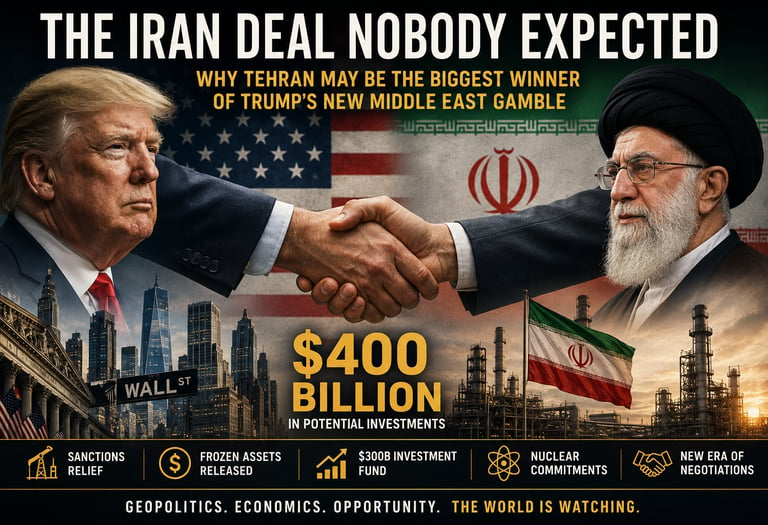
The Iran Deal Nobody Expected: Why Tehran May Be the Biggest Winner of Trump's New Middle East Gamble
For years, investors, policymakers, and geopolitical analysts viewed Iran as one of the world's most isolated major economies. Sanctions, diplomatic hostility, military confrontations, and political uncertainty transformed a nation rich in natural resources into a largely untapped market.
Now, if reports regarding the emerging U.S.-Iran memorandum of understanding prove accurate, we may be witnessing one of the most consequential geopolitical shifts of the decade.
The question is simple:
Is this a historic diplomatic victory for Washington, or is Tehran quietly walking away with the better deal?
From a capital allocation perspective, the answer may surprise many investors.
A New Chapter in U.S.-Iran Relations
According to reports surrounding the proposed agreement, several major provisions stand out:
Progressive removal of U.S. sanctions against Iran.
Release of frozen Iranian assets.
Creation of a massive investment fund potentially reaching $300 billion.
Commitments from Iran regarding nuclear weapons development.
New negotiations over missile programs and long-term security arrangements.
Expanded access for international investment into Iran's economy.
President Donald Trump has publicly framed the agreement as a path toward regional stability and economic normalization.
The evidence suggests that Washington's primary objective is not merely diplomatic. The White House appears increasingly concerned about global economic stability, energy markets, inflation pressures, and the growing cost of prolonged geopolitical conflict.
In other words, this is as much an economic deal as it is a security deal.
Why Wall Street Should Be Paying Attention
Most Western investors have spent decades focusing on China, India, Southeast Asia, and Eastern Europe as emerging growth stories.
Iran rarely enters the conversation. That may soon change.
The Untapped Economic Giant
Iran possesses:
Approximately 92 million citizens.
One of the largest natural gas reserves in the world.
Massive oil reserves.
Strategic access to critical Middle Eastern trade corridors.
A highly educated urban population.
Significant infrastructure modernization needs.
From a pure investment perspective, Iran resembles a market frozen in time.
Decades of sanctions have prevented substantial foreign capital inflows. As a result, infrastructure, logistics, energy systems, transportation networks, and industrial facilities require enormous investment.
For multinational corporations and private equity funds, that combination often translates into opportunity.
A boots-on-the-ground perspective reveals something many policymakers overlook: capital does not automatically chase democracy. Capital chases returns.
Investors care deeply about property rights, contract enforcement, regulatory predictability, and political stability.
If Tehran can provide those conditions, global capital will not remain on the sidelines for long.
The $400 Billion Question
Perhaps the most remarkable aspect of the proposed framework is the scale of potential investment.
Reports suggest:
Roughly $100 billion in frozen assets could be released.
A separate investment initiative may attract approximately $300 billion in private capital.
Together, that creates the possibility of nearly $400 billion entering the Iranian economy over time.
That number should capture the attention of every energy investor, infrastructure fund, sovereign wealth manager, and multinational corporation operating in emerging markets.
To put this into perspective, many developing nations would experience a complete economic transformation from capital inflows of that magnitude.
The implications for energy production, manufacturing, transportation infrastructure, and consumer markets could be profound.
Why Israel Is Not Celebrating
One of the most controversial elements of the agreement is the reaction from Israel.
Several Israeli officials have reportedly expressed concerns that the deal offers substantial economic relief to Tehran while leaving critical security questions unresolved. This criticism is not difficult to understand.
The proposed framework appears to postpone rather than immediately resolve disputes involving:
Iran's missile programs.
Regional proxy networks.
Long-term military capabilities.
Future security arrangements in the Middle East.
From Israel's perspective, economic normalization without comprehensive security guarantees creates strategic uncertainty.
From Washington's perspective, however, the calculation appears different. The administration seems focused on reducing immediate conflict risks while creating economic incentives that could gradually alter Iran's behavior.
Whether that strategy succeeds remains an open question.
The Real Story: Economics Over Ideology
Many analysts continue to frame Middle Eastern politics primarily through ideological lenses. Investors should resist that temptation. Economic incentives often prove more powerful than political rhetoric.
Iran faces serious domestic challenges:
High inflation.
Declining purchasing power.
Infrastructure constraints.
Water scarcity concerns.
Growing pressure from a younger population seeking economic opportunity.
These realities create powerful incentives for reform.
The leadership in Tehran may understand that economic modernization is no longer optional. The country possesses extraordinary resource wealth, but resources alone do not generate prosperity.
Institutions do. Investment does. Productivity does. Capital formation does.
The next decade may determine whether Iran becomes the Middle East's next major growth story or remains trapped by its own political contradictions.
A New Emerging Market Opportunity?
Investors should not mistake possibility for certainty. Significant risks remain:
Political Risks
Internal power struggles.
Regulatory unpredictability.
Future sanctions risks.
Regional tensions.
Economic Risks
Currency instability.
Banking sector modernization.
Foreign investment restrictions.
State intervention in key industries.
Geopolitical Risks
U.S. political transitions.
Israeli-Iranian tensions.
Gulf state rivalries.
Chinese and Russian strategic involvement.
Yet despite those risks, the opportunity is difficult to ignore.
History shows that markets often generate their greatest returns when investors identify change before consensus does.
If Iran successfully opens its economy, global capital markets may eventually view Tehran the way they once viewed Vietnam, India, or post-Cold War Eastern Europe. That possibility alone deserves serious attention.
Final Thoughts
The prevailing narrative in Western media often focuses on military victories, diplomatic wins, and political symbolism.
Investors should focus elsewhere. They should focus on incentives. If sanctions are lifted, capital flows begin, and economic reforms follow, Iran could emerge as one of the most important frontier-market stories of the next decade.
The evidence suggests that this agreement may deliver more immediate economic benefits to Tehran than to Washington.
Whether that ultimately becomes a strategic success for the United States will depend on what happens after the headlines fade and the investment capital starts moving.
For readers interested in understanding the deeper relationship between economic incentives, political institutions, and national prosperity, one highly recommended book is Why Nations Fail by Daron Acemoglu and James A. Robinson. Few books explain more clearly why some nations successfully convert opportunity into wealth while others struggle despite abundant resources.