Trump’s China Return Signals a New AI Cold War as Inflation and Oil Shock Shake Wall Street
Trump’s historic return to China alongside Nvidia, Apple, Tesla, and BlackRock CEOs reveals a new era of AI geopolitics, inflation risk, and market volatility. Discover how Taiwan, oil prices, Treasury yields, and the AI boom are reshaping Wall Street and the global economy.
5/18/20265 min read
Trump’s China Return, the AI Arms Race, and the Inflation Shock Reshaping Global Markets
For the first time in nearly a decade, a U.S. president returned to China carrying something far more powerful than diplomacy alone: Wall Street itself.
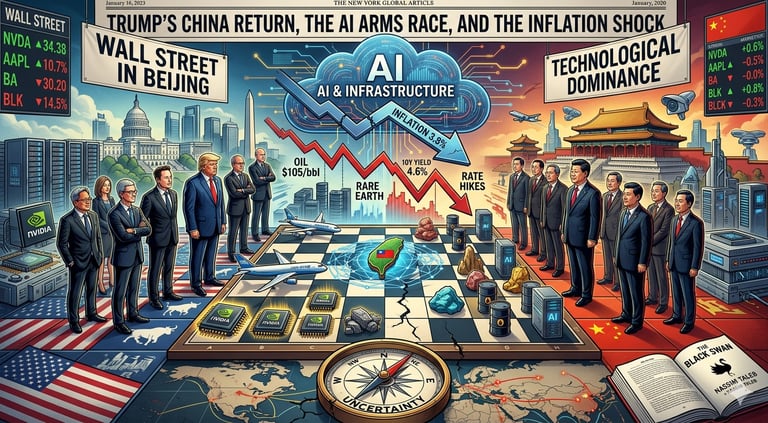
Donald Trump’s high-profile trip to Beijing was not a symbolic handshake tour. It looked more like a geopolitical board meeting disguised as statecraft. Standing beside him were 17 CEOs from America’s most strategic corporations — including NVIDIA, Apple, Tesla, BlackRock, and Boeing.
The message was unmistakable: the next phase of U.S.-China competition will not be fought only through tariffs or military posturing. It will be fought through semiconductors, artificial intelligence infrastructure, rare earth minerals, and control over global capital flows and markets are beginning to realize that this new Cold War is inflationary by design.
Wall Street Went to Beijing — But Investors Wanted More
The market expected a breakthrough moment. Instead, investors got partial agreements, cautious language, and unresolved geopolitical tension.
Among the headline developments:
The U.S. reportedly loosened restrictions on advanced AI chip sales, allowing Nvidia’s H200 chips to reach select Chinese firms.
Boeing secured an agreement for 100 aircraft purchases.
Trade discussions touched on tariffs, AI infrastructure, and rare earth supply chains.
Taiwan remained unresolved.
Iran and the Strait of Hormuz crisis were effectively ignored.
From a boots-on-the-ground perspective, this is exactly why markets reacted with hesitation. Investors had priced in something much larger — perhaps a structural easing in U.S.-China tensions or a sweeping commercial framework. Instead, they received tactical concessions wrapped in diplomatic theater.
The Boeing deal perfectly illustrates the disappointment. Traders had circulated expectations of as many as 500 aircraft orders. Delivering only 100 turned optimism into immediate repricing.
The evidence suggests markets are no longer impressed by symbolic diplomacy. They want supply-chain certainty, energy stability, and visibility into the next decade of technological dominance.
Nvidia Just Became a Geopolitical Asset
The most important story from the trip was not Boeing. It was Nvidia.
The release of advanced AI chips into the Chinese market signaled something larger than a commercial decision. It revealed that Washington may be recalibrating its strategy in the AI race.
Today, AI dominance depends on three pillars:
1. Advanced Chips
Companies building frontier AI models require enormous computational power. Nvidia has become the central infrastructure provider of that ecosystem.
Its valuation crossing the multi-trillion-dollar threshold is not speculative mania alone. Unlike the dot-com bubble, these firms are generating extraordinary cash flow and demand visibility.
2. Taiwan’s Semiconductor Monopoly
Taiwan remains the nerve center of global semiconductor manufacturing.
Every major AI expansion plan — from hyperscale data centers to military-grade computing systems — ultimately depends on Taiwan’s chip ecosystem.
That is why Taiwan has become the most dangerous geopolitical pressure point in the global economy.
A military disruption in the Taiwan Strait would not resemble a normal recessionary event. It would look more like an instantaneous seizure of the digital economy itself.
3. Rare Earth Minerals
The AI boom is not just software.
It is physical infrastructure:
Data centers
Electrical grids
Cooling systems
Battery technology
Semiconductor fabrication plants
All of this depends heavily on rare earth supply chains, where China still maintains overwhelming leverage.
This is why geopolitical negotiations increasingly revolve around minerals rather than ideology.
Inflation Is Back — And the Fed Knows It
While markets were distracted by diplomatic headlines, the macro picture deteriorated rapidly. U.S. inflation reached 3.8% in April, surprising expectations to the upside.The main catalyst was energy. Oil surged toward $105 per barrel as tensions between the United States and Iran escalated, particularly around threats to shipping routes near the Strait of Hormuz.
This matters because energy inflation spreads fast:
Gasoline prices rise
Airline costs jump
Electricity expenses increase
Transportation margins compress
Consumer inflation expectations worsen
The 10-year Treasury yield climbing toward 4.6% tells the real story.
Bond markets are effectively signaling: “We no longer believe rate cuts are coming soon.”
Only months ago, many investors expected aggressive Federal Reserve easing by 2026. Now the conversation has shifted toward the possibility that the Fed may need to keep rates elevated for much longer — or even hike again if energy-driven inflation becomes entrenched.
That changes everything for equity valuations.
Why This Tech Rally Is Different From the Dot-Com Bubble
Critics continue comparing today’s AI boom to the collapse of 2000.
There are similarities:
Technology now represents roughly 35% of the S&P 500
Investor concentration is extreme
Valuations are historically elevated
But there is one crucial difference.
The companies dominating today’s market are immensely profitable. Back in 2000, many tech firms had no earnings, no scalable business model, and no durable cash generation.
Today’s leaders — Nvidia, Apple, Microsoft, Meta, Amazon — produce massive free cash flow while simultaneously controlling critical AI infrastructure. The evidence suggests this is not purely speculative excess. It is a genuine repricing of strategic technological power. That does not mean the market cannot correct sharply. Higher yields always pressure growth stocks.
But this cycle is being supported by real earnings, real demand, and real geopolitical necessity.
The Nubank Case Reveals a Bigger Market Problem
One of the more overlooked developments is the market reaction to Nubank.
Despite:
Record quarterly profit
135 million customers
Rising revenue per user
Expanding operational efficiency
…the stock still sold off heavily after earnings.
This reflects a broader reality in global markets today:
good companies are no longer enough.
When interest rates remain elevated, investors become brutally selective. Any earnings miss — even minor — gets punished disproportionately.
Yet long-term investors may interpret this differently. Digital banking penetration across Latin America remains early relative to U.S. and European markets. Nubank’s scale advantages, customer acquisition efficiency, and ecosystem expansion still position it as one of the most important fintech experiments outside the United States.
The market’s short-term frustration may ultimately prove disconnected from the company’s structural trajectory.
The Fed, Oil, and Geopolitics Are Now Interconnected
One of the biggest investing mistakes today is analyzing inflation, technology, and geopolitics separately. They are now deeply intertwined.
Consider the chain reaction:
U.S.-Iran tensions push oil higher
Higher oil drives inflation
Inflation keeps Treasury yields elevated
Higher yields pressure equity multiples
AI companies require enormous capital expenditures
Semiconductor supply chains remain exposed to Taiwan risk
China controls critical mineral processing
This is no longer a traditional business cycle. It is a geopolitical macro cycle. And investors who ignore that reality are operating with outdated frameworks.
Blind Investing Is Becoming Increasingly Dangerous
One of the strongest points raised in the original discussion was the warning against blindly copying investment recommendations. That warning matters now more than ever.
Markets today are being driven by:
Central bank credibility
Military conflicts
Commodity supply shocks
AI infrastructure races
Regulatory fragmentation
National security policy
A TikTok clip or YouTube stock pick cannot adequately capture those risks.
The evidence suggests the next decade will reward investors who deeply understand macroeconomic linkages — not those chasing momentum headlines.
In periods like this, capital preservation becomes just as important as upside capture.
Final Thoughts: The AI Economy Will Be Built on Political Power
Trump’s return to China symbolized something bigger than diplomacy. It revealed the emerging structure of the global economy:
Governments need Big Tech
Big Tech needs geopolitical access
AI requires energy dominance
Semiconductor control equals strategic power
The market is beginning to understand that the future will not be shaped solely by innovation. It will be shaped by who controls the infrastructure behind innovation.
That distinction changes how investors should think about risk, inflation, supply chains, and valuation entirely.
For readers who want to go deeper into the intersection of geopolitics, markets, and systemic fragility, one essential recommendation is The Black Swan by Nassim Nicholas Taleb. Few books explain modern uncertainty, hidden risk, and market vulnerability more effectively in an era increasingly defined by geopolitical shocks and asymmetric outcomes.
Link: https://amzn.to/4wwtbyh