Trump vs Xi: Why the U.S.–China Summit Could Reshape Global Power, AI, and the Future of Taiwan
As Donald Trump and Xi Jinping prepare for one of the most important geopolitical meetings in years, global markets are watching closely. This deep macroeconomic analysis explores the U.S.–China trade war, AI arms race, Taiwan tensions, semiconductor dominance, rare earth minerals, and how the rivalry between Washington and Beijing could redefine the future of global power, Wall Street, and international security.
5/14/20266 min read
The Trump–Xi Summit Could Define the Next Global Order
For years, investors treated U.S.–China tensions as background noise — something important, but distant. That era is over.
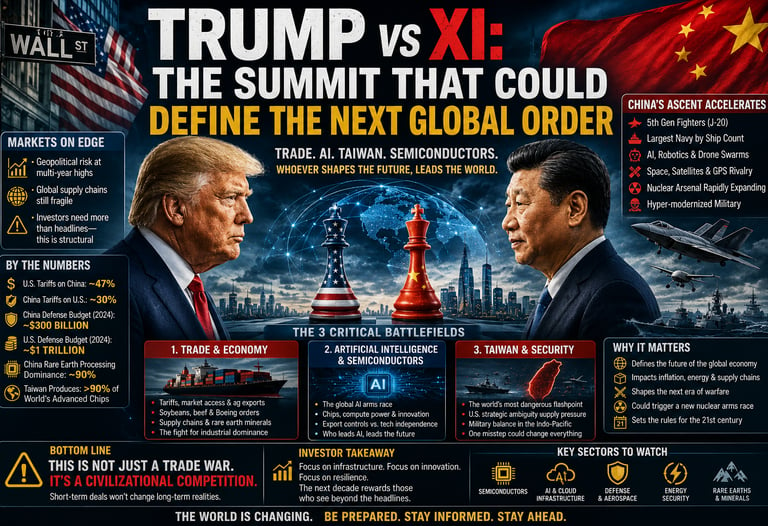
The upcoming meeting between Donald Trump and Xi Jinping may become one of the most consequential geopolitical events of the decade. This is no longer just about tariffs or trade balances. The evidence suggests the world is entering a phase where economics, military power, artificial intelligence, semiconductor dominance, and national security are merging into a single strategic battlefield.
And unlike previous diplomatic summits, this one arrives during a period of accelerating instability:
The AI arms race is intensifying.
Taiwan has become the most dangerous flashpoint in global geopolitics.
Global supply chains remain fragile.
China and the United States are both preparing for long-term strategic confrontation.
Wall Street, Silicon Valley, and the Pentagon are now deeply interconnected.
From a boots-on-the-ground macro perspective, markets still underestimate how structural this rivalry has become.
This Is No Longer a Trade War — It Is a Civilizational Competition
For much of the last three decades, Washington believed economic integration would gradually liberalize China politically.
That thesis failed. Instead of becoming more aligned with Western democratic systems after joining global trade institutions, China used globalization to accelerate industrial capacity, technological self-sufficiency, and geopolitical influence.
Now the United States faces a strategic rival powerful enough to challenge American dominance in:
Manufacturing
Artificial intelligence
Electric vehicles
Semiconductors
Rare earth minerals
Military modernization
Space infrastructure
Global trade routes
This is the core reality driving the summit. Temporary agreements may reduce tensions for months. They will not remove the structural collision course between the world’s two largest powers.
Trump and Xi Represent a New Era of Centralized Power
One of the most overlooked aspects of this meeting is the political profile of both leaders. Xi Jinping has consolidated authority inside China to a degree not seen since Mao Zedong. Presidential term limits disappeared. Internal opposition weakened. Strategic planning became increasingly centralized around Xi’s long-term vision for Chinese power.
Meanwhile, Trump has reshaped the Republican Party and American political dynamics around his own leadership style in a way few modern U.S. presidents have achieved.
This creates a rare geopolitical scenario: two highly centralized political figures negotiating directly over the future of global power distribution.But their governing styles could not be more different.
Trump’s Style: Transactional and Unpredictable
Trump prioritizes visible wins, leverage, and tactical negotiation pressure.
His approach to foreign policy often resembles high-stakes corporate dealmaking:
tariffs as leverage,
economic threats as negotiation tools,
and strategic ambiguity as pressure.
Markets struggle with this because investors prefer predictability.
Xi’s Style: Strategic Patience and Long-Term Positioning
Xi’s approach is slower, more disciplined, and heavily institutional. China operates on decade-long strategic planning cycles, while American democracy changes direction every election cycle. Beijing understands this asymmetry and often exploits it.
That difference matters enormously in areas like AI infrastructure, semiconductor policy, and Taiwan.
The Rare Earth Mineral Crisis Is Quietly Reshaping Global Power
One of the most important — and least discussed — issues behind the summit is rare earth dependency.
China dominates the global processing of critical minerals such as neodymium, which are essential for:
humanoid robotics,
advanced defense systems,
electric vehicles,
wind turbines,
and AI hardware infrastructure.
Even Elon Musk has publicly emphasized how critical these materials are for the future of robotics and automation.
This is why rare earths matter far beyond mining. Whoever controls critical mineral processing controls the next industrial revolution.
Washington now understands the vulnerability created by decades of outsourcing industrial capacity to China.
The United States is attempting to diversify supply chains through domestic investment and partnerships with allied nations, but rebuilding industrial resilience takes years — not quarters.
The Semiconductor War Is the Real Frontline
The most decisive economic battle is no longer oil.
It is semiconductors.
Advanced chips now sit at the center of:
AI systems,
military drones,
autonomous robotics,
cloud computing,
cybersecurity,
quantum research,
and next-generation weapons systems.
Taiwan remains the single most critical node in that system.
Taiwan Semiconductor Manufacturing Company produces the overwhelming majority of the world’s most advanced chips. American officials increasingly acknowledge that the U.S. economy would face severe disruption without Taiwanese semiconductor production.
That is why Taiwan matters far beyond geography. Taiwan is effectively the silicon foundation of the modern global economy.
Why Taiwan Could Become the Most Dangerous Flashpoint of the Century
The Taiwan issue is where economics, military strategy, and ideology collide. Beijing views Taiwan as part of China. Washington maintains strategic ambiguity while continuing military and technological support for the island.
The danger is that both sides increasingly see Taiwan not simply as territory — but as a symbol of credibility and future dominance.
From Beijing’s perspective:
reunification is tied to national legitimacy,
military modernization,
and Xi Jinping’s long-term political legacy.
From Washington’s perspective:
abandoning Taiwan could destroy confidence among U.S. allies,
destabilize Asia,
and accelerate nuclear proliferation globally.
A boots-on-the-ground strategic analysis reveals something investors rarely price correctly:
if America signals weakness on Taiwan, countries like Japan and South Korea could rapidly reconsider their own nuclear posture.
That would fundamentally reshape global security architecture.
China Is Preparing for the Warfare of the Future
China’s military expansion is no longer theoretical.
Over the last two decades:
defense spending surged dramatically,
naval power expanded rapidly,
stealth fighter programs accelerated,
satellite infrastructure improved,
and AI-driven military systems advanced at extraordinary speed.
But the most important development may be China’s focus on asymmetric warfare:
drone swarms,
AI-assisted targeting,
cyber warfare,
autonomous systems,
and robotic military integration.
The war in Ukraine and Middle East conflicts have become live laboratories for future warfare models. Beijing is studying every lesson carefully.
Artificial Intelligence Has Become a National Security Weapon
The AI race between the United States and China is no longer purely commercial.
It is geopolitical. Whoever dominates frontier AI systems could gain advantages in:
military intelligence,
cyber operations,
autonomous weapons,
economic productivity,
financial systems,
and strategic planning.
That is why both governments increasingly treat AI development as a matter of national survival.
The problem is that geopolitical competition often accelerates technological development faster than safety frameworks can evolve.
This creates enormous systemic risk.
Three Possible AI Outcomes
There are currently three realistic paths forward:
1. Limited Transparency Agreements
Both sides communicate safety protocols without fully cooperating.
This mirrors Cold War nuclear communication frameworks.
2. Shared International AI Standards
The U.S. and China establish common regulatory principles.
At the moment, this appears unlikely due to deep mutual distrust.
3. Full Verification and Oversight
Both nations allow inspections and monitoring mechanisms.
Realistically, this is almost impossible under current geopolitical conditions.
The evidence suggests the world is moving toward competitive acceleration rather than coordinated restraint. That may become one of the defining risks of the 21st century.
Wall Street Still Underestimates the Structural Nature of This Conflict
Markets continue reacting to headlines:
tariffs,
summit statements,
chip export restrictions,
or diplomatic gestures.
But the deeper issue is structural. The United States and China are now competing for:
technological supremacy,
military influence,
industrial leadership,
reserve currency dominance,
and control over strategic infrastructure.
History shows that rising powers and established powers rarely coexist peacefully forever. That does not mean conflict is inevitable tomorrow.
But it does mean temporary trade agreements will not reverse the trajectory already underway.
Investors Need to Think Beyond the Next Quarter
Most investors still analyze U.S.–China relations as short-term market volatility.
That is a mistake.
This rivalry will likely shape:
energy markets,
defense spending,
AI investment cycles,
semiconductor supply chains,
inflation dynamics,
and global capital flows for decades.
The companies that survive and dominate this environment will not simply be the ones with the best quarterly earnings.
They will be the ones controlling infrastructure:
cloud systems,
semiconductor manufacturing,
rare earth processing,
robotics,
and AI compute power.
That is where the next era of geopolitical capital concentration is forming and Wall Street knows it.
Final Thoughts: The World Is Entering a More Dangerous Transition Phase
The upcoming Trump–Xi meeting matters because it reveals how both powers interpret the next decade.
A successful summit could temporarily stabilize markets and reduce escalation risks.
But no handshake can erase the structural reality now shaping global politics:
China wants a larger role in the world order, and the United States is not prepared to surrender leadership peacefully.
The modern global economy was built during an era of relative American dominance and expanding globalization. That era is changing. What replaces it may define the geopolitical and financial environment for the next generation.
For readers who want to understand the deeper historical patterns behind rising powers, geopolitical rivalry, and the collision between China and the United States, one essential recommendation is Destined for War: Can America and China Escape Thucydides’s Trap? by Graham Allison. The book explores how history repeatedly shows tensions emerging when an established global power faces a rapidly rising challenger — and why the current U.S.–China rivalry may become one of the defining geopolitical tests of the 21st century.
Link: https://amzn.to/4dLSBzt