
The Malacca Stranglehold: Is the US-Indonesia Pact a Death Sentence for Chinese Trade?
The Malacca Noose: How the U.S. and Indonesia Are Positioning to Cut China’s Lifeblood.
4/21/20263 min read
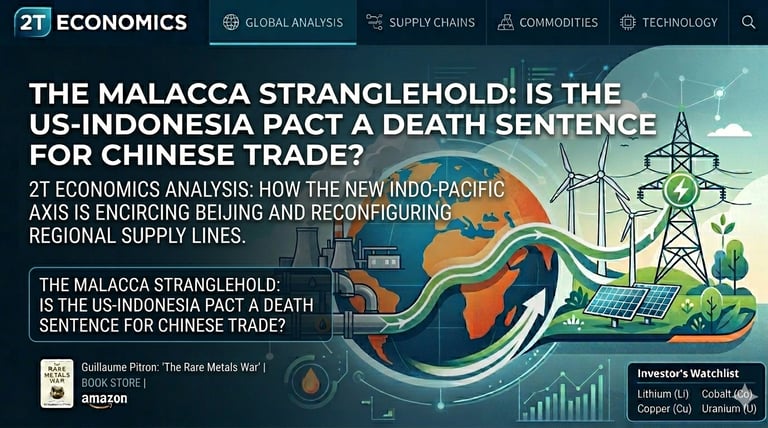
The Malacca Stranglehold: Is the U.S.-Indonesia Pact a Death Sentence for Chinese Trade?
For decades, the "Malacca Dilemma" was a theoretical ghost haunting the halls of the Communist Party in Beijing. Today, that ghost has taken the form of a U.S. military flight path.
A boots-on-the-ground perspective reveals that we are no longer talking about "if" a blockade could happen, but "how" it will be executed. The recent Major Defense Cooperation Partnership between the U.S. and Indonesia is a geopolitical earthquake. For an investor, this isn't just about ships in a strait; it’s about the potential severing of the world’s most vital economic artery.
The End of Indonesian Neutrality?
Indonesia has long prided itself on a "free and active" foreign policy, refusing to take sides between Washington and Beijing. However, the tides are shifting. While Jakarta officially maintains that "sovereignty is inviolable" and denies the establishment of U.S. bases, the reality of the Super Garuda Shield exercises and the new defense pact suggests a strategic tilt.
The U.S. has reportedly requested authorization for military overflights—a move that would place American eyes and ears directly over the Malacca Strait. In the cold logic of Wall Street and the Pentagon, "cooperation" is often a polite word for "operational access."
The Malacca Dilemma: China’s $7 Trillion Choke-point
The Strait of Malacca is the ultimate single point of failure for the Chinese dragon. The numbers are staggering and represent a risk profile that should make any Big Tech or energy investor lose sleep:
Energy Dependency: Roughly 80% of China’s oil imports and 60% of its total maritime trade pass through this narrow corridor.
The Phillips Channel: Near Singapore, the strait narrows to just 1.7 miles (2.8 km). This is a tactical nightmare.
Global Volume: We are looking at 23.2 million barrels of oil per day—that’s 29% of the world’s total maritime oil flow.
The Industrial Heartbeat: 25% of the world’s automobile trade and the vast majority of semiconductor shipments flow through here.
If the U.S. and its allies (including the AUKUS bloc) secure the ability to monitor or interdict this flow, they don't need to fire a single shot at Beijing; they just need to turn off the lights.
The "Death of the Butterfly" vs. The Belt and Road
Beijing isn't blind. Former President Hu Jintao famously coined the "Malacca Dilemma" because he knew that relying on this route was a gamble. China has spent billions on the Belt and Road Initiative (BRI) and the Arctic Silk Road to bypass this choke-point, but the evidence suggests these alternatives are nowhere near ready to handle the volume Malacca carries.
Terrestrial Routes: Trains can't carry 23 million barrels of oil a day.
The Arctic Route: While melting ice opens new paths, it remains seasonal and logistically punishing.
The Southern Routes: Alternatives like the Sunda or Lombok straits are also within Indonesia's reach—bringing us right back to the U.S.-Indonesia partnership.
Skin in the Game: Why Investors Should Watch Nusantara
While China is the primary investor in Indonesia’s new $35 billion capital, Nusantara, the U.S. is moving in on the security front. This creates a fascinating "tug-of-war" where Jakarta takes China's cash for infrastructure but looks to Washington for a security umbrella.
The Bottom Line: If you have capital in global shipping, semiconductors, or energy, you are now a stakeholder in the stability of the Malacca Strait. A sudden "diplomatic freeze" or a ramp-up in U.S. military presence here could send Brent crude and logistics costs into a tailspin that no AI-driven efficiency can fix.
We are moving away from a collaborative maritime environment into a contested one. The "Dilemma" is no longer just China's—it's the world's.
Essential Intelligence: The Map is Your Destiny
To truly understand the stakes in the Indo-Pacific, one must look at the world through the eyes of Robert D. Kaplan. In his seminal work, The Revenge of Geography, Kaplan demonstrates why land and sea barriers still dictate the fate of empires, regardless of our digital age. He brilliantly frames the South China Sea and the Malacca Strait not just as trade routes, but as the primary battlefield where the next global order will be decided. For any strategist tracking the U.S.-China rivalry, Kaplan’s insights are the gold standard for understanding why a few miles of water in Indonesia are worth more than a thousand diplomatic summits.
Link: https://amzn.to/4cJkN5p
Key words: Malacca Dilemma, U.S.-Indonesia Defense Pact, China Energy Security Geopolitical Choke-points, Maritime Trade Blockade, Indo-Pacific Strategy South China Sea Dispute, Nusantara Capital Investment, Global Supply Chain Risk