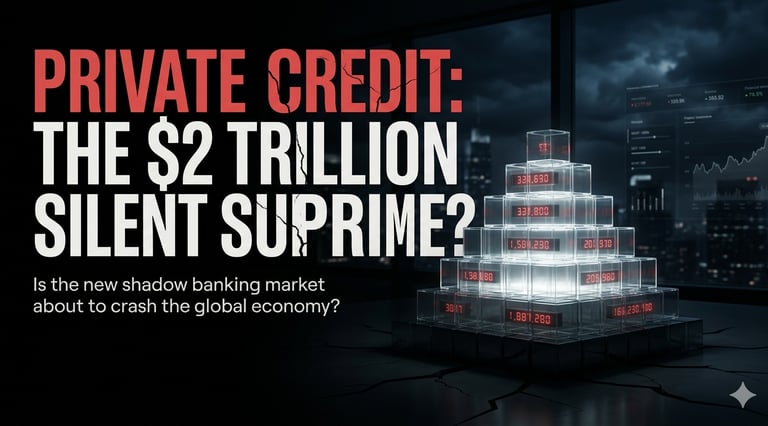
The $2 Trillion Shadow: Is Private Credit About to Crash the Global Economy?
We are currently witnessing a paradox in the global financial market. While regulators celebrate the robustness of the traditional banking system post-2008, a $2 trillion giant has grown in the shadows. Private credit, once hailed as the "lifeline" for companies neglected by major banks, is now showing signs that it could be the epicenter of the next great economic instability.
5/2/20263 min read
The Origin: Filling the Banking Vacuum
The meteoric rise of this sector was no accident. Since the 1980s, the number of commercial banks has plummeted, and following the 2008 financial crisis, strict regulations forced traditional lenders to pull back. Private credit stepped into this void, financing everything from daily operations to payroll. However, herein lies the danger: it operates where the regulator's light does not reach. It is a market that is opaque by definition.
The Dangerous Loop: Leverage on Top of Leverage
The symbiosis between Private Equity and Private Credit has created a "debt-on-debt" structure:
Private Equity firms acquire companies using debt.
To maximize returns, they borrow even more from private credit funds.
These funds, in turn, often leverage themselves with traditional banks to increase their lending power
The result? An interdependent web where risk is never eliminated; it is merely hidden and multiplied. When one link fails, a domino effect is inevitable.
The Interest Rate Trap: The End of Easy Money
The landscape shifted drastically with the rise in interest rates. Since most of these loans carry floating rates, the cost for borrowing companies has exploded.
Imagine a company that was paying $4 million in annual interest and suddenly sees that bill jump to $8 million. For many, this is the thin line between survival and insolvency.
Furthermore, investors now have the "safe haven" of Treasury bonds yielding around 5%. Why risk capital in private credit for 9% or 10% when the risk premium is shrinking and default rates are knocking at the door? BlackRock’s recent decision to limit withdrawals in one of its credit funds is living proof that liquidity in this sector is often a mirage.
Systemic Risk and the Real Economy
Unlike 2008, where the issue was residential mortgages, private credit irrigates the cash flow of businesses. If this market freezes:
Companies cannot finance inventory.
Cost-cutting leads to mass layoffs.
The impact moves from Bloomberg terminals directly into the lives of families.
While banks appear well-capitalized, their indirect exposure to these funds has grown more than 12 times in the last decade. The "healthy" banking system is, in fact, financing the "shadow" system that could bring it down.
Are We Ready for the Bailout?
The conclusion is sobering: we are facing a highly leveraged, opaque market operating under interest rate pressures it has never truly tested before. If a collapse occurs, governments may be called upon for another bailout, but this time in a climate of persistent inflation and record public debt.
At 2t Economics, our view is clear: prudence is currently worth more than yield. Private credit may not break the global economy tomorrow, but the cracks in the foundation are already visible to the naked eye.
Deep Dive: Building an Antifragile Portfolio
To truly understand how opaque systems like Private Credit accumulate hidden risks, I highly recommend reading "Antifragile" by Nassim Nicholas Taleb. While the market often mistakes "lack of volatility" for "stability," Taleb masterfully explains how debt-heavy structures become fragile and prone to collapse under stress. If you want to move beyond surface-level charts and learn how to position your investments to survive—and even thrive—during systemic shocks, this book is essential. It provides the intellectual framework needed to navigate the $2 trillion shadow we discussed today.
Link: https://amzn.to/4eiScX0
This analysis explores the Private Credit Market and its growing Systemic Risk in 2026, comparing the current Shadow Banking expansion to the 2008 Subprime Crisis. We examine how Floating Rate Loans and the rise of PIK Loans are impacting Financial Stability, especially as Default Rates begin to climb. The article breaks down the dangerous synergy between Leveraged Buyouts, Private Equity, and Unitranche Debt structures. Highlighting recent liquidity alarms, such as BlackRock Credit Fund Withdrawals, we evaluate the exposure of Traditional Banking to this $2 trillion sector and what it means for the Global Economy.