The Death of Efficiency: Is Friend-Shoring the New Global Trade Gospel?
From Low Costs to Loyal Allies: The Strategic Pivot Redefining Global Supply Chains.
4/21/20263 min read
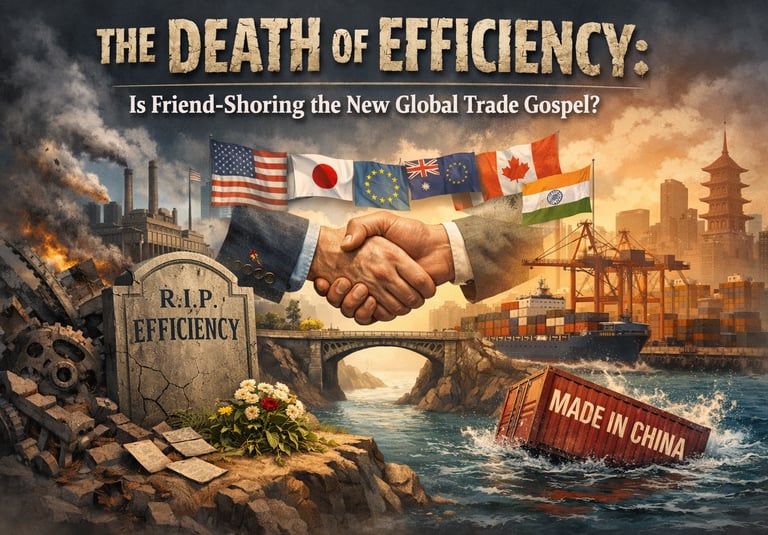
The End of Efficiency: Why "Friend-shoring" is the New Global Gospel
For thirty years, the mantra in every boardroom from Manhattan to London was simple: chase the lowest cent. A world map in a CEO's office was a grid of cost-saving opportunities, where political risk was a secondary concern to shaving a fraction off a microchip's price.
The evidence suggests those days are dead. A boots-on-the-ground perspective reveals a profound strategic retreat. Today, that same map isn't a trophy of efficiency; it’s a blueprint of vulnerabilities. When 70% of your critical components sit behind a single geopolitical fault line, you aren't "optimized"—you're one diplomatic freeze away from bankruptcy. We are witnessing the birth of Friend-shoring: a world where shared values and strategic trust now outrank the bottom line.
The Death of "Cheapest is Best"
The shift from a cost-driven global economy to one defined by security isn't a corporate trend; it's a policy-driven survival tactic. While globalization promised a rules-based utopia, a series of systemic shocks has forced a violent reassessment of the "just-in-time" model.
The Great Wake-up Calls
Geopolitical Weaponization: The dynamic between the U.S. and China has moved from competition to a strategic race. Concentration risk is now seen as a national security threat.
The Pandemic Fracture: COVID-19 proved that supply chains optimized purely for cost are incredibly fragile. When the world needed masks and ventilators, the "efficient" distant networks collapsed.
The Energy Hammer: The Russia-Ukraine conflict demonstrated how quickly vital supply lines—food and energy—can be severed. Trade between Russia and the EU dropped nearly 80% post-invasion, forcing a costly, desperate scramble for diversification.
The New Map: Winners and the "Technology Apartheid"
As the world fragments into distinct economic blocs based on UN voting patterns and shared ideologies, the map of global trade is being redrawn in real-time.
The New Hubs of Trust
The North American Fortress: Mexico has surged as a primary nearshoring destination, leveraging the USMCA to become a top U.S. trading partner.
The Asian Alternative: Vietnam and India are the clear beneficiaries of the "China Plus One" strategy. Apple now reportedly manufactures 1 in 7 iPhones in India—a staggering shift in a few short years.
The European Shift: Central and Eastern Europe (CEE) are seeing massive inflows of FDI as Western European firms move production closer to home to mitigate logistics risks.
The Strategic Trade-Offs: Tech-Apartheid?
There is a darker side to this security. We are entering an era of "Technology Apartheid."
Excluded Nations: Countries deemed "non-aligned" or hostile risk being systematically cut off from the building blocks of the future—advanced semiconductors, AI, and green energy tech.
The Efficiency Tax: Friend-shoring is inherently more expensive. By moving production to "friendly" but higher-cost nations, we are baking a "security premium" into global inflation.
Policy as a Weapon: The Trillion-Dollar Subsidies
Governments are no longer just making suggestions; they are putting massive capital at risk to force these shifts. This is the era of industrial policy as a primary lever of power.
U.S. CHIPS Act: $52 billion in direct subsidies plus massive tax credits to pull semiconductor manufacturing back to American soil.
Inflation Reduction Act (IRA): A powerhouse of subsidies designed to secure the green tech supply chain within the U.S. and its allies.
EU Chips Act: A €43 billion plan to double Europe's share of the global semiconductor market.
Investor’s Bottom Line: Resilience Above All
The global economy is evolving into a system where reliability is prized above all else, even if it comes with a higher price tag. As an investor, the "Skin in the Game" reality is that your portfolio must now account for political trust as much as quarterly earnings.
The era of the "unreliables" is ending. We are moving toward a world of "firebreaks" within the system—building walls to ensure that when the next ship gets stuck or the next conflict erupts, the friendly neighborhood stays open for business.
Strategic Intel: Navigating the End of Globalization
To understand why the "Efficiency Era" is collapsing, you must read Peter Zeihan’s The Accidental Superpower. Zeihan is the analyst who predicted the current fragmentation of global trade long before it hit the headlines. He argues that the globalized world we’ve known was a historical anomaly, and we are now returning to a world where geography, demographics, and secure alliances are the only things that matter. For the 2t Economics reader, this book is more than a geopolitical study—it’s a survival manual for the next decade of investing. If you want to know which nations will thrive in the age of Friend-shoring and which ones will be left in the dark, Zeihan’s aggressive, data-driven logic is indispensable.
Get your copy here: The Accidental Superpower: The Next Generation of Gridlock and the End of the Long Peace
Key words: Friend-shoring, Supply Chain Resilience, Geopolitical Risk CHIPS Act, Inflation Reduction Act, Semiconductor Decoupling Nearshoring Mexico India, Technology Apartheid, Global Trade Fragmentation