The AI Profit Supercycle: Record S&P 500 Highs, Semiconductor Surges, and the Oil Floor of 2026
Analyzing the April 2026 market surge: How the AI infrastructure boom and record insider buybacks are driving the S&P 500 to new heights despite geopolitical friction in the Strait of Hormuz.
4/26/20262 min read
The 2026 Tech Surge: AI Profits, Oil Resilience, and the S&P 500 Record Run
As we close the final week of April 2026, the American market is sending a clear message: resilience is the new baseline. From the diplomatic "lukewarm water" in the Middle East to the historic decoupling of tech earnings from traditional cycles, the macro landscape is shifting.
For the investor with skin in the game, understanding these structural changes is the difference between chasing rallies and building generational wealth.
1. Geopolitics: The Hormuz Stalemate and the Oil Floor
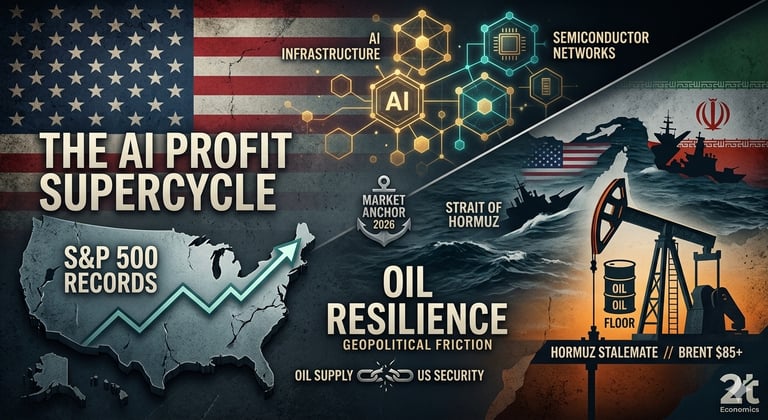
The U.S.-Iran conflict has entered its eighth week. While President Trump has extended the ceasefire indefinitely—bringing a sigh of relief to the markets—the Strait of Hormuz remains a critical bottleneck.
The Supply Crunch: With 20% of global oil flow still restricted, Brent crude has stabilized above $85.
Inventory Depletion: Goldman Sachs data reveals a significant drawdown in global oil inventories. As freight costs rise, those holding physical reserves are liquidating, creating a tighter market for the second half of 2026.
2. The S&P 500 and Nasdaq: Records Built on Silicon
The major indices continue to defy gravity, with the S&P 500 up 4.67% YTD and the Nasdaq 100 surging over 8%.
The AI Multiplier: Artificial Intelligence is no longer a "future" play. Today, 45% of the S&P 500's total market cap is tied to companies integrated with AI. In 2022, that figure was just 25%.
The Infrastructure Supercycle: The SOXX ETF (Semiconductors) has seen 17 consecutive positive sessions. The demand for cloud computing and API infrastructure is so high that even legacy players like Intel are seeing a resurgence, with a 156% increase in quarterly profit.
3. Corporate Sentiment: The Buyback Signal
One of the most bullish indicators right now is the record level of insider buybacks.
Executives at firms like Adobe (10.6% buyback rate), Salesforce, and Qualcomm are purchasing their own shares at the highest rate in 15 years.
When the people running the companies decide their stock is the best place for their personal capital, the market takes notice.
4. Earnings Season: The "Big Tech" Gauntlet
The final week of April will be the ultimate litmus test for the 2026 rally. We are entering a "firewall" of earnings:
Tuesday: Coca-Cola, Visa, and GM.
Wednesday (The Big One): Microsoft, Amazon, Meta, and Google.
Thursday: Apple and Mastercard.
The market is pricing in a "EPS (Earnings Per Share) surprise" across the board, driven by AI-led cost-cutting and margin expansion. However, the divergence of Tesla—falling 16% YTD due to market share erosion and missed delivery targets—proves that even within the "Magnificent Seven," quality and execution are non-negotiable.
5. Historical Perspective: Volatility is Not Loss
Data since 1928 shows that the most common annual return for the S&P 500 is between 10% and 20%.
The Reality of Drawdowns: Most positive years see an average intra-year drop of 14%.
The Lesson: Volatility is the price of admission for long-term gains. Permanent loss only occurs when an investor exits during the inevitable 10% corrections that precede record highs.
Strategic Intelligence: The 2026 Roadmap
In this environment, "buying the dip" in infrastructure ETFs and maintaining a consistent Dollar-cost averaging strategy remains the most effective path.
To understand the deeper psychological framework of these market cycles, we highly recommend 'The Psychology of Money' by Morgan Housel. It is essential reading for staying rational when the charts go vertical.