The AFTA Illusion: Why Washington’s Protectionism Will Rig Any New American Free Trade Deal
A macroeconomic analysis of the proposed American Free Trade Agreement (AFTA). Discover why USMCA sunset clauses, food security subsidies, and protectionist shifts mean a pan-American trade bloc is a structural trap for global investors.
7/10/20263 min read
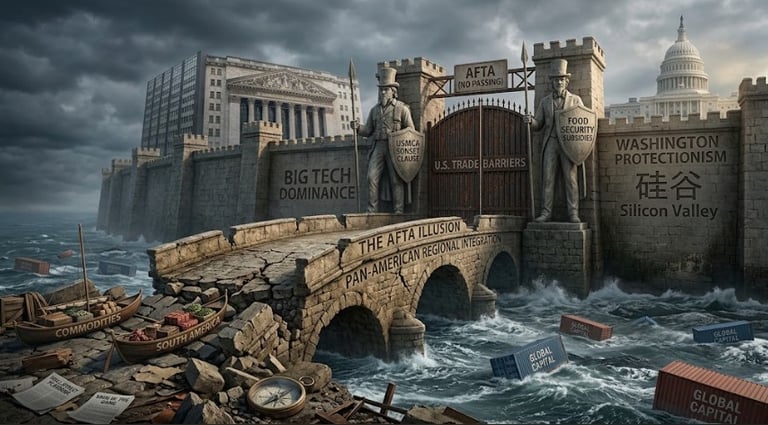
The "AFTA" Illusion: Why Wall Street and Washington Will Never Grant South America a Free Pass
The global trade landscape is fractured, and the narrative of pure "free trade" is effectively dead on arrival in 2026. Yet, a boots-on-the-ground perspective reveals that political actors across the Western Hemisphere are still trying to resurrect the ghost of 1990s neoliberalism. The latest trial balloon floating through the corridors of Washington is the "AFTA" (American Free Trade Agreement)—a proposal to bypass current trade tensions by locking South American economies into a sweeping free trade zone with the United States.
To the untrained eye, it sounds like an elegant escape hatch from impending Section 301 tariffs. But if you have capital at risk in these markets, you know that Washington’s playbook hasn't changed. The evidence suggests that any modern iteration of a pan-American trade bloc will be heavily rigged in favor of US domestic interests, leaving regional partners with all the risk and none of the upside.
The Ghost of NAFTA and the Weaponization of "Sunset Clauses"
To understand why a new American trade bloc is a minefield for international investors, look no further than what happened to NAFTA. The original agreement was designed for an era of rapid globalization. It allowed US multinationals to leverage low-cost manufacturing hubs right across the border, effectively shifting industrial capital away from the Rust Belt.
When the USMCA replaced it, it wasn't a consensus; it was an ultimatum from Washington. The updated framework heavily restricted the automotive sector and imposed aggressive digital service rules designed to protect Silicon Valley’s monopoly power.
The 2026 Reality Check: Under the current US administration, the activation of the Sunset Clause has started a strict 10-year countdown toward expiration.
Washington is using this mechanism not to foster open markets, but to squeeze concessions. If Uncle Sam is willing to systematically dismantle a highly integrated supply chain with Canada and Mexico because of trade deficits, anyone betting on a smooth, bilateral ride with South American partners is economically blind.
The Complementary Trap: Tech Hegemony vs. The "Food Security" Shield
Proponents of an expanded trade zone argue that the US and South American economies are naturally complementary. The thesis is simple: the US exports high-margin technology, intellectual property, and industrial machinery, while South America supplies the critical minerals (such as the world's second-largest rare earth element reserves) and agricultural commodities needed to fuel global growth.
On paper, this sounds like a win-win for multinational corporations. In practice, it is a structural trap for asset allocation.
The Asymmetric Trade Matrix
The US Demand: Immediate, unrestricted access to the critical mineral alliances to break Western dependence on Chinese supply chains, alongside aggressive enforcement of US payment system standards against localized fintech alternatives.
The Structural Wall: Immediate invocation of "Food Security" and aggressive agricultural subsidies by the US government whenever foreign agricultural or livestock imports threaten the domestic farming lobby.
The math simply doesn’t track for foreign capital. Washington expects structural protections for its Big Tech, defense, and industrial sectors, while simultaneously using tariffs and non-tariff barriers to insulate its own farmers from cheaper, more competitive imports from the south. It is managed trade masquerading as a free market.
Institutional Bottlenecks: The Custom Unions Standoff
Even if a regional government decides to pragmatically play ball with Washington to capture corporate nearshoring trends, the institutional architecture of regional trade blocs makes unilateral deals a legal impossibility.
or any country locked into a customs union, signing a separate, comprehensive free trade agreement with the US without total consensus from its regional partners is a non-starter. If cheap US goods enter one port duty-free, they can theoretically bypass trade barriers across the entire bloc. This institutional friction guarantees years of diplomatic gridlock, exposing cross-border investors to immense regulatory uncertainty and currency volatility.
Capital Has No Creed, but Washington Has a Playbook
As macroeconomic analysts and allocators, we must view the world pragmatically: capital has no creed, and money has no color. Whether a nation trades with Beijing, Wall Street, Frankfurt, or Tokyo, the overriding objective must be the defense of sovereign economic interests and net-positive capital inflows.
However, expecting the current political apparatus in Washington to engage in a balanced, mutually beneficial integration is a fundamental misreading of modern geopolitics. The US is deeply entrenched in a neo-protectionist cycle. Any trade agreement stamped with a new acronym will inevitably be used as a geopolitical tool to secure critical raw materials and digital dominance, while slamming the door on access to the lucrative US consumer market. Investors looking for structural growth should stop chasing the mirage of pan-American free trade and price in a world of localized, heavily guarded economic fortresses.
For a deeper look into how the mechanics of global trade agreements are weaponized by dominant superpowers to shape corporate supply chains, one cannot overlook classical economic critiques of trade architecture.
To truly understand how global trade frameworks can structurally disadvantage developing regions under the guise of open markets, read Bad Samaritans: The Myth of Free Trade and the Secret History of Capitalism by Ha-Joon Chang. It is an essential reality check for any investor operating under the illusion that global trade is ever a level playing field.