The 2026 Sovereign Risk: How the Trump Assassination Attempt and Global Instability Shook the Markets
Analyzing the ripple effects of the Cole Thomas Allen security breach, the U.S.-Mexico sovereignty crisis, and the rising jihadist pressure in Mali. Why institutional stability is the ultimate 2026 macro anchor.
4/26/20262 min read
Institutional Fragility: The Rising Cost of Sovereign Risk in 2026
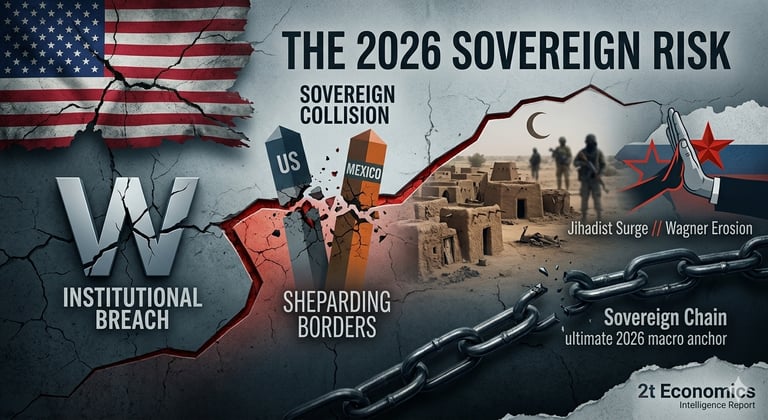
The global landscape in April 2026 is no longer defined by linear growth, but by systemic volatility. From the heart of Washington D.C. to the resource-rich plains of Mali, the traditional "anchors of stability" are fraying. For the investor with skin in the game, these aren't just headlines—they are indicators of a shifting risk premium.
1. The Washington Security Breach: A Crisis of Perception
The assassination attempt on the U.S. President by Cole Thomas Allen at the White House Correspondents' Dinner is a watershed moment for Political Risk Analysis.
The Breakdown: Despite being a "lone wolf" with a high-tech background (Computer Science/Engineering), Allen bypassed elite security tiers, reaching within 15 meters of the executive core.
Macro Impact: When the "Leader of the Free World" is perceived as vulnerable, the Safe Haven Premium of the U.S. Dollar faces scrutiny. We are seeing a move toward "Fortress Politics," where increased security spending by defense primes becomes a mandatory fiscal burden.
2. Mexico & The Sovereignty Collision
The death of two U.S. agents in Mexican territory has ignited a diplomatic firestorm between the Claudia Sheinbaum administration and Washington.
The Conflict: Mexico claims a violation of sovereignty; Washington hints at the necessity of "extra-territorial" operations to combat cartels fueled by U.S.-made weaponry.
Economic Friction: This tension threatens the Nearshoring Trend. If the U.S.-Mexico security coordination collapses, the supply chains moving from Asia to North America face a "Sovereignty Tax" in the form of higher insurance and logistics disruption.
3. The Andean & Sahelian Fractures: From Colombia to Mali
Instability is a contagion.
Colombia: As the May elections approach, the bombing attributed to FARC dissidents (targeting the lineage of Gustavo Petro) signals that Political Violence remains the primary obstacle to Andean foreign direct investment.
Mali & The Wagner Legacy: In the Sahel, the military junta is facing a pincer movement from Tuareg separatists and Al-Qaeda-linked JNI-M.
The Russia Factor: The struggle to maintain Russian influence in Mali is a proxy for the broader battle over African Critical Minerals. A coup within a coup in Mali would send uranium and gold prices into a tailspin of uncertainty.
The Bottom Line: Diversifying Against Chaos
In 2026, the traditional "low-risk" zones are evaporating. The assassination attempt in D.C. and the shadow wars in the Global South confirm one thing: Security is the new global currency. As we monitor the $4.95 range of the USD/BRL and the aggressive moves of the Nomad platform for capital protection, one strategy remains clear: Liquid assets in stable jurisdictions are no longer a luxury; they are a survival requirement.
Strategic Intelligence: The Logic of Global Hegemony
Navigating this landscape requires an understanding of the raw, structural competition between powers. To dive deeper into the "Realist" view of these collisions, we recommend John Mearsheimer’s 'The Tragedy of Great Power Politics'. It is the roadmap for understanding why these frictions are inevitable.