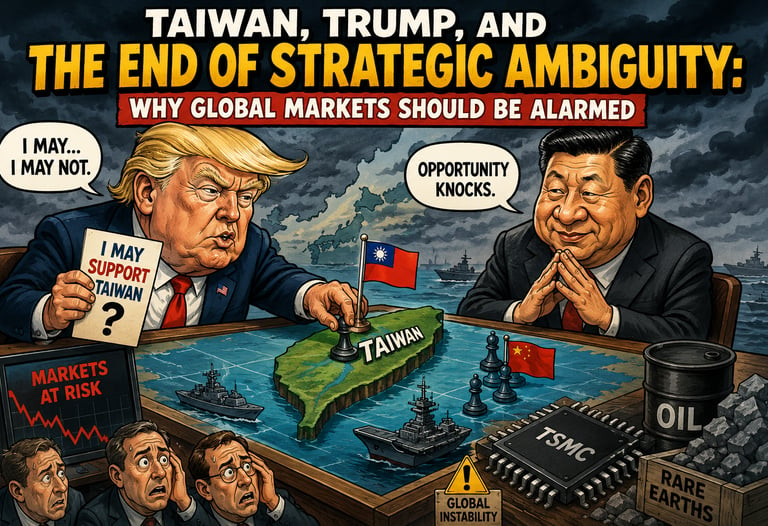
Taiwan, Trump, and the End of Strategic Ambiguity: Why Global Markets Should Be Alarmed
Trump’s latest Taiwan comments may signal a historic shift in U.S.-China strategy. Explore how semiconductors, military deterrence, AI supply chains, and global markets are now dangerously intertwined in the Indo-Pacific power struggle.
5/17/20265 min read
The Taiwan Gamble: Is Washington Quietly Rewriting 50 Years of Strategic Deterrence?
For nearly half a century, America’s Taiwan policy survived because it was built on a paradox: clarity hidden inside ambiguity.
Washington never explicitly promised to defend Taiwan militarily, but it also never allowed Beijing to believe the island was abandoned. That carefully engineered uncertainty became one of the most sophisticated deterrence frameworks in modern geopolitics.
Now, the evidence suggests that framework may be entering its most dangerous phase since the 1996 Taiwan Strait Crisis.
Recent statements by President Donald Trump after high-level meetings with Chinese President Xi Jinping are sending shockwaves through defense circles, semiconductor markets, and Indo-Pacific security alliances. And unlike previous rhetorical flare-ups, this time the implications stretch far beyond diplomacy.
This is about chips, naval power, energy routes, inflation, rare earths, and ultimately the future of American primacy in the Pacific.
Trump’s Taiwan Comments Were Not Ordinary Political Theater
Following bilateral discussions in Beijing, Trump publicly refused to clarify whether the United States would militarily defend Taiwan in the event of a Chinese invasion.
On the surface, some analysts argue this merely reflects the long-standing doctrine of “strategic ambiguity.” But a boots-on-the-ground perspective reveals something fundamentally different.
Traditional ambiguity was institutional. Trump’s ambiguity is transactional. That distinction matters enormously.
The original framework established after the 1979 Taiwan Relations Act and reinforced by Reagan’s “Six Assurances” was designed to achieve two objectives simultaneously:
Deter China from invading Taiwan
Deter Taiwan from declaring formal independence
The system worked because every actor understood the invisible guardrails.
But when Trump publicly states:
“I may approve the weapons package, I may not”
“Taiwan stole the chip industry”
“China is a very powerful country and Taiwan is a very small island”
…the signaling changes entirely.
Markets hear uncertainty. Beijing hears opportunity. Taipei hears abandonment.
Taiwan Is Not Just Another Geopolitical Flashpoint
Western audiences still underestimate what Taiwan actually represents inside the global economic machine.
This is not merely a territorial dispute. Taiwan sits at the center of the most critical industrial chokepoint on Earth.
The Semiconductor Reality
Taiwan Semiconductor Manufacturing Company — commonly known as TSMC — produces over 90% of the world’s most advanced semiconductors.
Its clients include:
Apple
NVIDIA
Advanced Micro Devices
Qualcomm
The entire AI race currently unfolding across Wall Street depends on uninterrupted Taiwanese chip production.
Every major bullish thesis surrounding:
AI infrastructure
hyperscaler growth
autonomous systems
military computing
cloud expansion
ultimately runs through Taiwan. If Beijing gained control over Taiwan — even temporarily disrupting production — the economic consequences would likely exceed the supply-chain shocks seen during COVID.
This would not resemble a regional war. It would resemble a systemic financial seizure.
“Taiwan Stole Our Chips” Is Politically Useful — But Historically Misleading
Trump’s repeated claim that Taiwan “stole” America’s semiconductor industry resonates politically inside populist economic circles.
But the historical record tells a different story. The U.S. did not lose semiconductor manufacturing because Taiwan committed industrial theft.
America voluntarily optimized for higher-margin design and software layers while outsourcing fabrication capacity abroad. Taiwan filled a vacuum Washington willingly created.
For decades:
Silicon Valley focused on architecture and IP
Wall Street rewarded asset-light business models
U.S. corporations prioritized quarterly margins over manufacturing resilience
TSMC emerged because the foundry model solved a problem American firms no longer wanted to solve internally.
The irony is brutal:
The same globalization model once celebrated by financial markets is now being reframed as strategic betrayal.
The Bigger Trade: Is Taiwan Becoming a Bargaining Chip?
This is where the geopolitical picture becomes darker.
China currently holds leverage in several areas the White House desperately needs stabilized:
Beijing’s Strategic Pressure Points
Rare Earth Supply Chains
China dominates global rare earth processing capacity, essential for:
EV batteries
missiles
radar systems
advanced defense manufacturing
Hormuz and Energy Inflation
With Middle East tensions escalating, Washington needs Beijing’s influence over Iran more than many policymakers publicly admit.
Any disruption in the Strait of Hormuz immediately translates into:
higher oil prices
stickier inflation
rising Treasury yields
political pain for American consumers
Agricultural Leverage
China remains a major buyer of American agricultural products. Midwestern farming states remain politically critical in U.S. elections.
Logistics and Manufacturing
Even after years of “decoupling” rhetoric, American supply chains remain deeply dependent on Chinese industrial infrastructure.
Against that backdrop, some analysts increasingly fear Taiwan could become part of a broader grand bargain:
reduced American military commitment in exchange for economic stabilization.
No administration would openly admit such a shift.
But strategic retrenchment rarely announces itself publicly at first.
It appears gradually through hesitation, ambiguity, and delayed commitments.
The Indo-Pacific Balance Could Collapse Faster Than Markets Expect
Many investors still view Taiwan risk as a low-probability tail event.
That assumption may prove dangerously outdated.
Why Taiwan Matters Militarily
Taiwan anchors the so-called “First Island Chain” — the defensive maritime arc stretching from Japan through Okinawa to the Philippines.
If China successfully absorbed Taiwan, the People’s Liberation Army Navy would gain vastly expanded access to the Pacific. That would fundamentally alter the regional balance of power.
Countries suddenly facing direct strategic exposure would include:
Japan
Philippines
South Korea
Australia
For U.S. allies, the question would no longer be: “Can America deter China?”
The question becomes: “Can America still be trusted to maintain regional commitments?”
That psychological shift alone could trigger:
accelerated regional militarization
nuclear proliferation debates
fractured alliance structures
capital flight from Asian markets
Wall Street Still Looks Underprepared
A remarkable disconnect currently exists between geopolitical risk and market pricing.
The Nasdaq continues trading as though semiconductor supply chains are permanent, stable infrastructure.
They are not. The AI boom has dramatically increased Western dependence on advanced chips at precisely the moment geopolitical risk around Taiwan is intensifying.
That combination creates a highly asymmetric vulnerability.
Key Exposure Areas Investors Underestimate
AI infrastructure concentration risk
Maritime shipping vulnerabilities
Rare earth dependency
Defense-industrial supply fragility
Energy inflation spillovers
Insurance and reinsurance shocks
Currency volatility across Asia
The lesson from Russia’s invasion of Ukraine should already be obvious: markets consistently underestimate geopolitical regime shifts until the repricing becomes violent.
Europe Should Be Paying Closer Attention
Many European policymakers still frame Taiwan primarily as an American security issue. That view is increasingly obsolete.
Europe’s industrial economy is deeply exposed to:
Asian semiconductor flows
maritime trade routes
energy pricing volatility
Chinese export markets
Any Taiwan escalation would almost certainly trigger:
severe manufacturing disruptions in Germany
inflationary pressure across the Eurozone
renewed energy instability
deeper NATO fractures over strategic priorities
Meanwhile, Washington is simultaneously reconsidering troop deployments in Europe while pressuring NATO members to expand defense spending. The transatlantic security architecture is entering a period of visible stress.
Strategic Ambiguity Only Works When Everyone Understands the Rules
This is the core issue. For decades, strategic ambiguity succeeded because all parties believed the system itself was stable. But once ambiguity becomes personalized rather than institutional, the probability of miscalculation rises dramatically.
And history repeatedly shows that wars often begin not because leaders want conflict — but because one side incorrectly believes the other side will not respond.
That is the real danger now emerging in the Taiwan Strait. Not certainty. Misjudgment.
Final Thought
Financial markets love predictable narratives. Geopolitics destroys them.
The Taiwan question is no longer a distant diplomatic abstraction buried inside foreign policy journals. It is becoming one of the defining macroeconomic variables of the decade — alongside inflation, AI, energy security, and deglobalization.
Investors who still view Taiwan as a niche geopolitical story are likely underestimating the scale of systemic exposure embedded inside the modern global economy nd if there is one lesson history keeps teaching, it is this: Empires rarely lose dominance all at once.
They lose it gradually through hesitation, strategic confusion, and the slow erosion of deterrence credibility.
For readers wanting a deeper understanding of how great-power rivalry and strategic miscalculation shape global order, one essential recommendation is The Tragedy of Great Power Politics by John Mearsheimer — a foundational work on realism, deterrence, and the dangerous logic that often drives superpower confrontation.
Link: https://amzn.to/4uRsyxx