SpaceX’s $2 Trillion IPO, Rising Inflation, and the Fed’s Next Move: What Investors Need to Know
SpaceX’s historic $2 trillion market debut, persistent U.S. inflation, Federal Reserve uncertainty, AI-driven market concentration, and Bitcoin exposure are reshaping Wall Street. Discover the key risks and opportunities investors should watch in 2026.
6/14/20265 min read
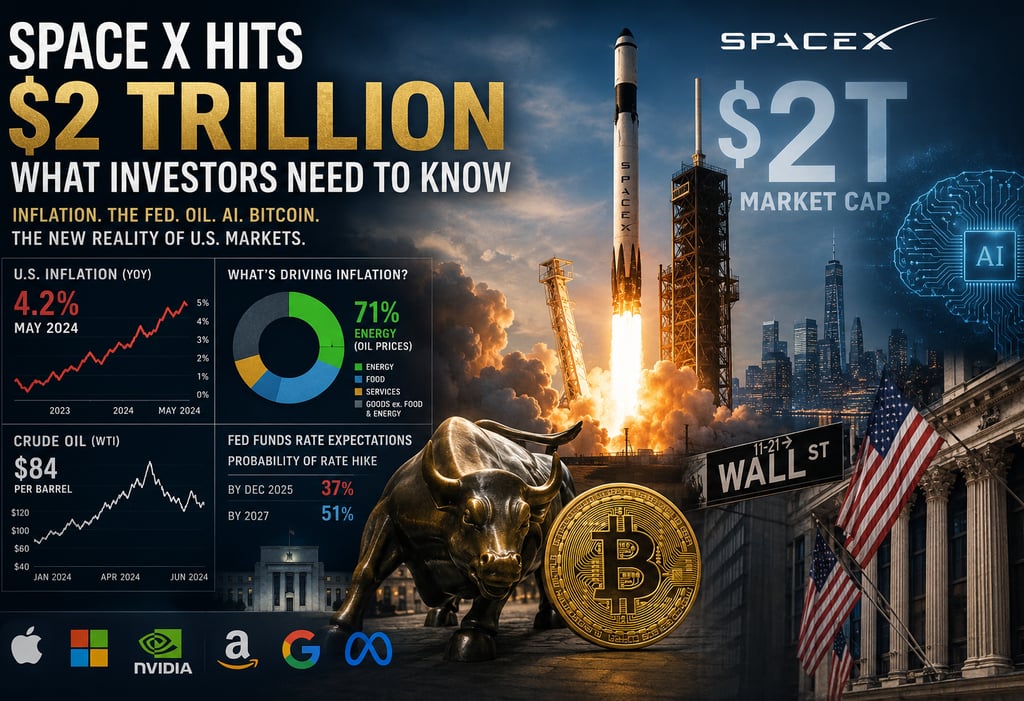
SpaceX’s $2 Trillion Debut, Rising Inflation, and the New Reality of U.S. Markets
The Market Is Not Pricing Perfection Anymore
For most of the past two years, investors have been conditioned to believe that artificial intelligence, Big Tech dominance, and endless liquidity would keep pushing equity markets higher. The evidence suggests that this narrative is beginning to face its first meaningful stress test.
While Wall Street remains close to record highs, a combination of geopolitical tensions, persistent inflation, and changing Federal Reserve expectations is forcing investors to reassess risk.
From a boots-on-the-ground investor perspective, the biggest story isn't necessarily the recent volatility. It's the fact that markets are starting to price uncertainty again and uncertainty changes everything.
The Iran Factor: Why Oil Still Matters More Than Many Investors Think
Markets entered the week worried about escalating tensions between the United States and Iran.
Energy traders immediately reacted to the possibility of a prolonged conflict, sending oil prices significantly higher compared to levels seen earlier this year.
Although diplomatic signals now suggest that both sides may be approaching a negotiated settlement, investors should not underestimate the economic damage already done.
Why oil remains the inflation engine
Higher energy prices create a ripple effect across the economy:
Transportation costs rise.
Manufacturing becomes more expensive.
Consumer goods face pricing pressure.
Corporate margins shrink.
This is one of the reasons inflation has remained stubborn despite aggressive monetary tightening.
The market is effectively betting that peace will bring oil back toward more sustainable levels. However, expecting a rapid return to previous lows may be unrealistic.
The world remains structurally dependent on energy, and geopolitical risk premiums are unlikely to disappear overnight.
Inflation Is No Longer a Temporary Problem
Recent U.S. inflation data delivered exactly what economists expected. That may sound reassuring. It shouldn't. What matters is the trend.
Inflation has been accelerating over consecutive months, suggesting that underlying price pressures remain alive despite years of restrictive monetary policy.
Key observations
Energy remains a primary inflation driver.
Service inflation continues to show resilience.
Consumer demand has not weakened as much as many expected.
Labor markets remain relatively strong.
The Federal Reserve now faces a difficult balancing act.
Cut rates too soon, and inflation may reignite.
Keep rates elevated for too long, and economic growth could slow more aggressively. Neither outcome is particularly bullish.
The Federal Reserve Is Quietly Becoming More Hawkish
Perhaps the most important shift happening beneath the surface is investor expectations regarding interest rates. Only months ago, markets were aggressively pricing future rate cuts.
Today, a growing number of investors are discussing the possibility that rates remain elevated for much longer—or even move higher if inflation continues surprising to the upside. For global capital flows, this matters enormously.
When U.S. Treasury yields remain attractive:
Global investors demand less risk.
Emerging markets lose capital inflows.
The U.S. dollar strengthens.
Equity valuations face pressure.
This is especially relevant because Treasury securities remain the world's benchmark risk-free asset.
When investors can earn attractive returns with minimal risk, speculative capital becomes far more selective.
The AI Boom Is Entering Its Next Phase
The market narrative around artificial intelligence is evolving.
The first phase rewarded infrastructure builders:
Semiconductor manufacturers.
Data center operators.
Cloud providers.
Energy suppliers.
The second phase may look very different.
Many of today's AI leaders are spending hundreds of billions of dollars on capital expenditures to build computational infrastructure.
The question investors are beginning to ask is simple: Who actually monetizes all this investment?
The emerging winners
Recent market leadership suggests investors are rotating toward:
Companies that benefit from AI adoption.
Businesses with existing customer ecosystems.
Firms capable of increasing productivity without massive AI spending.
This distinction is critical.
Owning the companies selling picks and shovels during a gold rush can be profitable.
But eventually investors start asking who is actually finding gold.
The Concentration Risk Nobody Wants to Discuss
A decade ago, America's largest public companies represented a relatively diverse mix of industries.
Today, market concentration has reached extraordinary levels.
Technology companies dominate index performance, investor attention, and institutional portfolios. This concentration has produced tremendous wealth creation. It has also created vulnerability.
If a handful of mega-cap companies stumble, the impact on passive investors could be significant.
The evidence suggests that investors are increasingly underestimating concentration risk because recent returns have conditioned them to believe diversification is unnecessary. History rarely rewards that mindset for long.
SpaceX Goes Public—and Instantly Becomes a $2 Trillion Giant
The biggest financial event of the year may have arrived. SpaceX's long-awaited public debut immediately propelled the company into the upper echelon of American corporate giants.
At approximately $2 trillion in market capitalization, SpaceX entered public markets larger than most companies spend decades trying to become.cThat headline alone deserves attention. But the real story lies underneath.
Why SpaceX is different from typical IPOs
Most high-profile technology companies went public relatively early in their lifecycle. SpaceX did the opposite. The company spent roughly two decades developing privately before opening itself to public investors. This distinction matters because public shareholders are not investing in an early-stage startup.
They are investing in a mature enterprise with:
Proven launch capabilities.
Government contracts.
Global satellite infrastructure.
Significant strategic relevance.
In many ways, SpaceX resembles critical infrastructure more than a traditional technology company.
The Valuation Question Nobody Can Ignore
Here's where things become controversial.
Many investors view SpaceX as a once-in-a-generation company. That may be true. But great companies can still be terrible investments at the wrong price. The evidence suggests that enthusiasm surrounding the IPO may have detached from traditional valuation frameworks.
Investors should remember:
A great business is not automatically a great stock.
Narrative does not eliminate valuation risk.
History is filled with exceptional companies that delivered poor returns because investors overpaid.
SpaceX may ultimately justify its valuation. But investors purchasing purely because of excitement are assuming significant risk and risk tends to reveal itself when expectations become unrealistic.
The Bitcoin Connection Could Become a Major Story
One overlooked aspect of the SpaceX story is its exposure to Bitcoin.
As institutional ownership expands and the company eventually becomes integrated into major indices, indirect Bitcoin exposure may spread throughout retirement portfolios and passive investment products.
This could create a powerful secondary narrative. Not because SpaceX is a cryptocurrency company. But because its growing influence could indirectly increase Bitcoin's presence inside mainstream financial products. The implications for institutional adoption should not be underestimated.
Elon Musk's Trillion-Dollar Moment
SpaceX's debut has reinforced a reality many investors already suspected: Elon Musk now occupies a category of wealth creation unlike anything modern markets have witnessed.
Whether one admires or criticizes him is largely irrelevant from an investment perspective. The market has repeatedly demonstrated its willingness to assign enormous value to founders capable of reshaping entire industries.
SpaceX, Tesla, and other Musk-led ventures collectively represent one of the largest concentrations of entrepreneurial wealth ever created. The lesson isn't about celebrity. It's about ownership.
The biggest fortunes in modern history continue to be built through concentrated equity ownership in transformative businesses.
What Investors Should Watch Next
Several developments will determine market direction over the next six months:
Macro Risks
U.S. inflation trajectory.
Federal Reserve policy decisions.
Energy market volatility.
Geopolitical developments in the Middle East.
Market Risks
Big Tech earnings growth.
AI monetization progress.
Corporate capital expenditure trends.
Valuation compression across growth stocks.
SpaceX-Specific Risks
Post-IPO volatility.
Institutional ownership trends.
Future inclusion in major indices.
Ability to justify current valuation expectations.
The market remains fundamentally healthy. But healthy does not mean cheap and it certainly does not mean risk-free.
Investors who mistake momentum for certainty often learn expensive lessons. The current environment rewards discipline, valuation awareness, and patience far more than blind optimism.
For readers interested in understanding the deeper relationship between innovation, market bubbles, and investor psychology, one essential recommendation is "The Most Important Thing" by Howard Marks. Few books explain risk, market cycles, and valuation discipline more clearly for investors navigating periods of extreme enthusiasm like today's AI and SpaceX-driven market environment.