
SpaceX IPO Analysis: Why Wall Street Is Pricing a $2 Trillion Future Built on Starlink, AI, and Elon Musk’s Empire
A deep macroeconomic and institutional analysis of the upcoming SpaceX IPO, examining Starlink profitability, AI infrastructure bets via xAI, governance risk under Elon Musk, and why markets may be pricing a narrative rather than fundamentals.
6/1/20264 min read
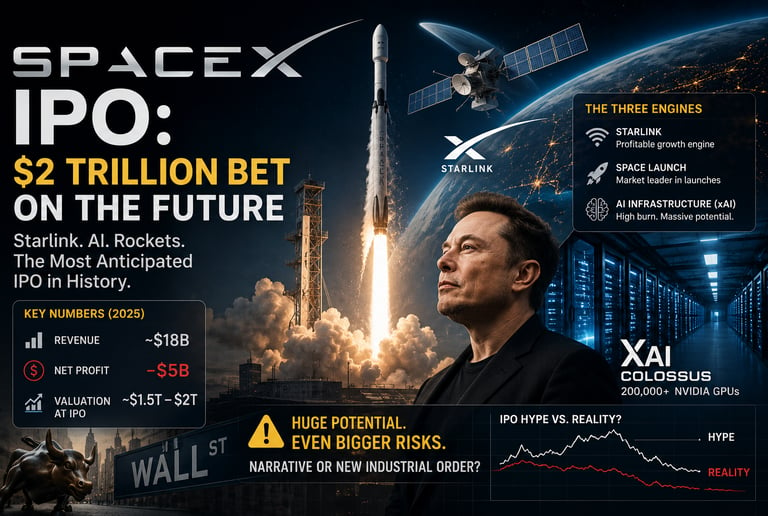
SpaceX IPO: The Most Overheated Listing in Modern Market History—or the Beginning of a New Industrial Order?
The Biggest IPO Ever—or the Biggest Narrative Trade?
Wall Street is preparing for what may become the most aggressive initial public offering ever priced: the SpaceX listing, reportedly targeting a valuation near $1.5–$2 trillion, with expected pricing around $130 per share and a ticker rumored as SPCX.
On paper, this is not just another IPO. It is a convergence of aerospace, satellite broadband, artificial intelligence infrastructure, and government defense contracts—wrapped into a single equity narrative dominated by Elon Musk.
The evidence suggests the market is not pricing a company. It is pricing an ecosystem—and possibly a belief system about the future of industrial capitalism.
A boots-on-the-ground perspective from institutional desks reveals something more uncomfortable: nobody is fully confident they understand what exactly they are buying.
The Three Engines Behind SpaceX’s Valuation
1. Space Launch: A Dominant but Low-Margin Engine
SpaceX has already reshaped the global launch industry, achieving:
~650 total launches historically
Over 80% of global orbital missions in recent years
~85% reuse rate of rockets (a structural cost advantage)
But despite the dominance, launch services are not the profit center anymore.
The evidence suggests this segment is closer to strategic infrastructure than a high-margin business. Pricing power exists—but so does heavy reinvestment and operational intensity.
2. Starlink: The Only Profitable Core Today
The real cash engine is Starlink.
Key data points:
From 0 to ~10 million subscribers in under 5 years
Operating in 160+ countries
Estimated contribution: the only consistently profitable division (~$1B+ operating profit range implied in disclosures)
What matters here is not just scale—it is geopolitical embeddedness. Starlink has already been deployed in conflict zones, including Ukraine, where satellite connectivity became a tactical infrastructure layer. That alone changes how defense planners think about telecom dependency.
In investment terms: this is not broadband. It is sovereign-grade connectivity infrastructure.
3. AI + X Integration: The High-Burn, High-Conviction Bet
The most controversial pillar is the AI stack tied to xAI and the broader “X ecosystem.”
Reported structure includes:
Massive GPU clusters (Colossus-scale data centers)
~200,000+ Nvidia GPU-class infrastructure deployments
Multi-billion-dollar annual CapEx burn
Integration with X (formerly Twitter) as real-time data layer
Key institutional concern:
Estimated ~$30B+ annual AI infrastructure spending
Revenues still uncertain or indirectly structured
Heavy reliance on future compute monetization
A boots-on-the-ground perspective reveals a tension: this is being priced like AWS before AWS had customers. Except this time, the infrastructure is far more capital-intensive.
The IPO Math That Makes Investors Uncomfortable
Valuation vs Reality
Expected valuation: $1.5T–$2T
Revenue (2025 estimate): ~$18B
Profit: negative (multi-billion-dollar losses driven by AI CapEx)
That implies:
~100x revenue multiple at IPO pricing
For context:
Amazon: ~3–4x revenue in mature stages
Microsoft: ~10–15x in high-growth phases
Nvidia: premium justified by extreme margins + demand clarity
SpaceX at IPO would sit in a different category entirely: a “future narrative multiple,” not a fundamentals multiple.
The Core Institutional Concern
The evidence suggests three uncomfortable realities:
Profitability is currently concentrated almost entirely in Starlink
AI infrastructure burn is accelerating, not stabilizing
Valuation assumes multi-trillion-dollar TAM expansion in AI + space
This is not a balanced business. It is a leveraged bet on technological convergence.
The Market Structure Problem: Who Is Really Selling?
One underappreciated aspect of the IPO structure:
~95% of shares already held privately
Only ~5% expected to float publicly
Early investors gain liquidity event more than capital injection for growth
This shifts the IPO dynamic from: “Capital raising event” to: “Secondary liquidity release at peak narrative compression”
A boots-on-the-ground perspective reveals something familiar to veteran bankers: this is exactly how late-cycle blockbuster IPOs tend to behave.
Demand Shock vs Reality Shock
Historical Pattern in Mega-IPOs
Across major tech IPOs since 2015:
Median post-IPO drawdown after peak hype: ~30% within 6 months
High volatility concentrated in first 90 days
Long-term winners exist—but rarely at initial pricing levels
Examples include:
Uber
Airbnb
Robinhood
Coinbase
Even strong platforms often experience repricing after narrative exhaustion meets earnings reality.
The Hidden Macro Trade: This Is About Interest Rates
The IPO does not exist in isolation.
It is happening in a world shaped by:
Persistent high interest rate regimes from the Fed
Tightening liquidity conditions in venture exits
Increasing scrutiny on unprofitable AI infrastructure bets
When capital is expensive, long-duration narratives get compressed and SpaceX is the longest-duration narrative in public markets.
The Real Question: What Are You Actually Buying?
If you strip the branding away, the structure becomes clearer:
You are not buying:
Rockets
Internet satellites
AI models
You are buying:
A vertically integrated space-to-AI compute infrastructure stack
With government contracts embedded
And optionality on planetary-scale expansion
The risk is equally clear:
Extreme CapEx dependency
Founder-driven governance concentration
Valuation already pricing decades of execution upfront
Governance Risk: One Decision Maker Dominates Everything
Control structure matters more than most investors admit.
Elon Musk reportedly retains:
~42% ownership
Majority voting control
This creates a binary governance reality:
Institutional consensus can be overridden instantly
Strategic pivots can happen without market alignment
Capital allocation is highly centralized
From a risk perspective, this is not diversification—it is conviction concentration.
Final Market View: Trade or Transformation?
The SpaceX IPO sits at a rare intersection:
Industrial infrastructure
Defense systems
Consumer connectivity
Artificial intelligence compute
But markets rarely price “all of the above” correctly at IPO.
The evidence suggests a dual scenario:
Bull case:
A multi-decade infrastructure platform becomes the backbone of space-based and AI-driven global systems.
Bear case:
A narrative-heavy IPO re-prices sharply once growth assumptions collide with CapEx reality and rate-sensitive discounting.
Skin-in-the-game logic leads to a simple conclusion: the first trade is unlikely to be the final price discovery.
Recommended Book
For investors trying to understand the intersection of ambition, capital cycles, and technological infrastructure bets, a relevant read is: “The Man Who Solved the Market” by Gregory Zuckerman
It provides a grounded perspective on how narrative, risk-taking, and mathematical conviction collide in real capital markets—exactly the environment surrounding this IPO.
Link: https://amzn.to/3POCbOK