Silicon Valley: The Billionaire Factory and the "Gold Mine" of Innovation
An in-depth analysis of the Silicon Valley Ecosystem and the legacy of Frederick Terman and Stanford University. We explore how California Non-Compete Laws and the 1849 Gold Rush mentality created a unique culture of Risk Tolerance. Breaking down the Venture Capital model on Sand Hill Road, including the 20-Investment Thesis and the rise of Smart Money. Essential reading for investors tracking the Tech Hub that continues to engineer global billionaires.
5/3/20263 min read
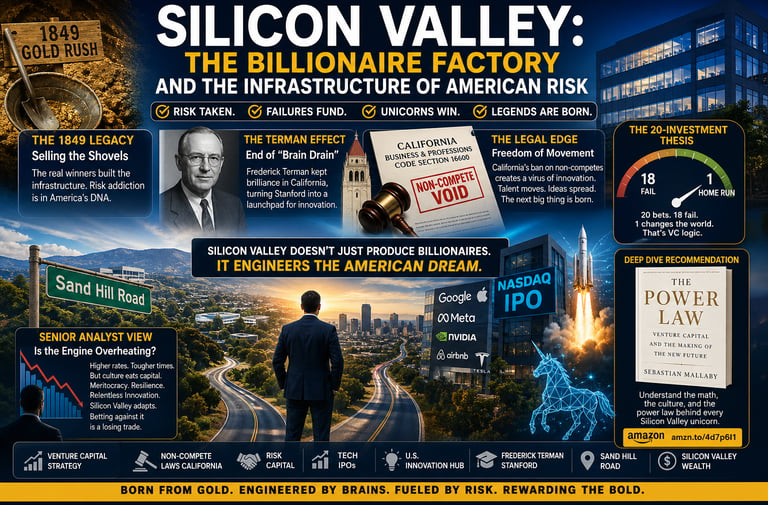
Silicon Valley: The Billionaire Factory and the Infrastructure of American Risk
While global competitors attempt to replicate the "magic" of Palo Alto, Silicon Valley remains an uniquely American phenomenon. It is not merely a cluster of tech companies; it is a sophisticated engineering of social, legal, and financial systems that incentivizes extreme risk and rewards it with unparalleled scale.
The 1849 Legacy: Selling the Shovels
The American West was built on a "shovels-and-pans" business model during the Gold Rush. The true winners were the infrastructure providers—those who built the banks, hotels, and tools for the seekers. This created a demographic of "risk addicts" who abandoned the safety of the East Coast for a chance at fortune. When the gold dried up, this mindset didn't vanish; it evolved into the modern venture capital industry, where "digging for gold" simply became "coding for equity".
The Terman Effect and the End of "Brain Drain"
The shift from a resource-based economy to a knowledge-based one was engineered by Frederick Terman at Stanford. By persuading students like Bill Hewlett and David Packard to stay in California, he essentially stopped the intellectual "Brain Drain" to New York or Boston. He transformed the university into a pragmatic incubator, forcing the brightest minds in the country to become founders rather than just employees. This bridge between elite academia and aggressive industry is what continues to fuel the American technological edge.
The Legal Edge: Freedom of Movement
A critical, often overlooked pillar of the Valley’s success is California Business and Professions Code Section 16600. While much of the U.S. and the world still allow "non-compete" clauses that stifle talent, California made them void. This legal freedom allowed the "Traitorous Eight" to leave Shockley and eventually birth Intel. In the Valley, knowledge isn't a trade secret kept in a vault; it’s a virus that spreads, competes, and evolves. This fluidity prevents the stagnation of talent and ensures that "The Next Big Thing" is always being built by former employees of the "Current Big Thing".
The 20-Investment Thesis: Mastering the Home Run
On Sand Hill Road, the financial logic of Venture Capital (VC) is centered on the "Home Run". A typical VC will make 20 bets, expecting 18 to fail or break even. However, the 20th investment—the unicorn—covers all losses and creates a legend. This tolerance for failure is the fuel of the Valley; it allows for the kind of ambitious experimentation that traditional banking simply cannot fund.
Senior Analyst View: Is the Engine Overheating?
From an analyst's perspective, we must ask: Is the Valley’s model sustainable in a higher-interest-rate environment? For the past decade, "Smart Money" was often just "Cheap Money". The Silicon Valley ecosystem was built on the premise of endless growth and the ability to burn cash to dominate markets.
However, my human take is this: Betting against Silicon Valley has historically been a losing trade. The region's greatest asset isn't its capital, but its culture of meritocracy and resilience. Even as tech hubs emerge in Austin or Miami, the concentrated "risk addiction" of the Valley—rooted in that 1849 survivalist DNA—is something that cannot be easily exported. The Valley doesn't just produce billionaires; it produces a version of the American Dream that is faster, colder, and more efficient than anywhere else on Earth.
Deep Dive: Master the Logic of Venture Capital
To truly grasp the forces that engineered the billionaire factory we’ve explored today, I highly recommend reading "The Power Law" by Sebastian Mallaby. This isn't just a history book; it is a masterclass on the mathematical and cultural realities of the U.S. tech ecosystem. Mallaby breaks down exactly how "The Power Law" dictates that a single outlier can redefine the global economy, and how the visionaries on Sand Hill Road learned to hunt for these rare unicorns. If you want to understand the high-stakes game of American innovation and the unique marriage between elite talent and aggressive capital, this is the most important book you will read this year.
Link: https://amzn.to/4d7p6I1
Keywords: Silicon Valley Wealth, Venture Capital Strategy, Sand Hill Road, Non-Compete Laws California, Tech IPOs, Frederick Terman Stanford, Risk Capital, U.S. Innovation Hub.