
Russia’s Fuel Crisis Deepens: How Ukraine Is Quietly Targeting the Engine of Moscow’s War Machine
Ukraine’s long-range drone campaign is exposing a critical weakness in Russia’s war effort: fuel logistics. Discover how refinery strikes, supply-chain disruptions, and mounting economic pressure could reshape the future of the conflict.
6/19/20265 min read
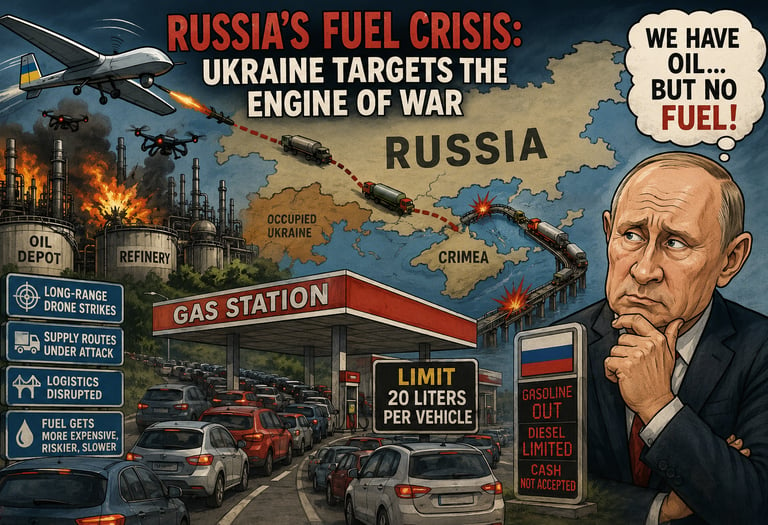
Russia’s Fuel Crisis Is No Accident: Ukraine’s New Strategy Targets the Engine of War
The Battlefield Has Moved Beyond the Front Lines
For much of the war, analysts focused on tanks, artillery, missiles, and territorial gains. Yet the evidence suggests that one of the most consequential battles of 2026 is unfolding far from the trenches. It is taking place inside Russia’s fuel infrastructure.
Long lines at gas stations, fuel rationing, restrictions on cash purchases, and supply disruptions across occupied Crimea are not isolated incidents. They are symptoms of a broader strategic campaign designed to attack the logistical foundation of Russia’s military machine.
Ukraine appears to have recognized a fundamental reality of modern warfare: armies do not run on courage alone. They run on fuel.
A boots-on-the-ground perspective reveals that Kyiv is increasingly focused not on destroying every Russian tank, but on making every kilometer traveled by that tank more expensive, slower, and riskier.
This shift could have consequences extending far beyond the battlefield, potentially influencing Russian public sentiment, military effectiveness, and even the long-term sustainability of Moscow’s war effort.
Why an Energy Superpower Can Still Face Fuel Shortages
At first glance, reports of fuel stress inside Russia seem paradoxical.
Russia remains one of the world's largest energy producers, possessing vast reserves of crude oil and natural gas. However, possessing hydrocarbons underground is fundamentally different from delivering gasoline and diesel to consumers and military units.
The critical issue is not extraction.
The critical issue is logistics.
The Difference Between Oil and Usable Fuel
A modern fuel supply chain depends on several interconnected systems:
Refineries that transform crude oil into usable products
Storage facilities and fuel terminals
Rail networks and trucking fleets
Pipelines and distribution hubs
Bridges, highways, and transportation corridors
Security infrastructure protecting critical assets
When any of these links become vulnerable, the entire chain weakens. Ukraine appears to understand this dynamic exceptionally well.
Ukraine’s Two-Front Attack on Russian Logistics
Front One: Strategic Strikes on Energy Infrastructure
Over the past year, Ukraine has dramatically expanded its long-range drone capabilities. Refineries, fuel depots, storage terminals, and energy facilities hundreds of miles from the battlefield are increasingly becoming targets.
The strategic logic is straightforward. When a refinery is damaged, the consequences extend far beyond the immediate physical destruction.
Refineries are among the most complex industrial facilities in existence. Repairs can take weeks or months. Specialized components are expensive, difficult to replace, and often harder to obtain under Western sanctions.
The result is a reduction in Russia’s refining capacity, directly impacting:
Gasoline production
Diesel availability
Aviation fuel supplies
Military transportation capabilities
Industrial operations
Every successful strike forces Moscow to allocate additional resources toward defense and reconstruction rather than offensive military operations.
Front Two: Attacking the Distribution Network
The second component of Ukraine’s strategy may be even more significant. Rather than focusing exclusively on production, Ukrainian forces are increasingly targeting transportation routes that move fuel from Russia into occupied territories.
These attacks include:
Drone strikes on fuel trucks
Attacks against rail infrastructure
Pressure on transportation corridors
Repeated threats to critical bridges
Operations targeting storage facilities closer to the front
The objective is not total disruption. The objective is friction. Military planners often understand that creating uncertainty can be nearly as valuable as creating destruction.
If transportation becomes unpredictable, every logistical calculation becomes more difficult.
Crimea: Russia’s Most Vulnerable Logistics Hub
Among all occupied territories, Crimea may represent the weakest point in Russia’s fuel distribution network.
Geography creates vulnerability. he peninsula relies on a limited number of supply routes connecting it to mainland Russia.
For years, the Kerch Bridge served as both a logistical artery and a political symbol of Russian control. Yet symbols often become obvious targets.
As pressure on traditional supply routes increases, Russia has relied more heavily on the so-called land corridor through occupied southern Ukraine.
The challenge is that this corridor remains under constant threat. A single disrupted route may not create a crisis. Multiple disrupted routes simultaneously can. This distinction matters.
Military logistics functions much like a supply chain in the corporate world. Resilience exists when multiple alternatives are available. When alternatives shrink, risk grows exponentially.
The Economics of Attrition
What makes Ukraine’s strategy particularly interesting from an economic perspective is its asymmetry. A relatively inexpensive drone can force the protection of infrastructure worth billions of dollars. The economics are striking.
Consider the imbalance:
A low-cost drone may cost thousands of dollars.
Air defense interceptors often cost hundreds of thousands or millions.
Refineries represent multibillion-dollar assets.
Supply disruptions generate additional economic losses.
This creates a classic cost-imposition strategy.
Ukraine does not need to completely halt Russian fuel flows. It only needs to increase costs faster than Russia can comfortably absorb them.
For investors, this concept is familiar. The goal is not necessarily bankruptcy. The goal is margin compression. Ukraine appears to be applying the same principle to warfare.
The Political Risk Facing the Kremlin
Military shortages can be managed. Public frustration is more complicated.
For much of the conflict, the Kremlin successfully insulated ordinary citizens from the direct costs of war. State media narratives, censorship, and geographic distance helped maintain a degree of separation between the battlefield and everyday life.
Fuel shortages threaten that separation. When war appears on television, it remains abstract. When war appears at a gas station, it becomes personal.
Potential consequences include:
Higher transportation costs
Increased consumer prices
Delayed deliveries
Reduced tourism activity
Public frustration with local authorities
Growing skepticism toward official narratives
Russia's political system is unlikely to experience immediate large-scale protests as a result of fuel shortages alone.
However, political erosion rarely begins with revolutions. More often, it begins with frustration. Then cynicism. Then declining trust. Those pressures accumulate over time.
What This Means for the Battlefield
The military implications are substantial. Even if Russian armed forces continue receiving priority access to fuel, shortages elsewhere create stress throughout the system.
Operational consequences may include:
Slower resupply operations
Reduced logistical flexibility
Increased transportation costs
Greater dependence on vulnerable routes
Higher requirements for infrastructure protection
Reduced operational tempo
Modern warfare is fundamentally a contest of sustainability.
A military that cannot reliably predict tomorrow’s fuel availability becomes less capable of planning large-scale operations today.
This does not necessarily produce immediate battlefield collapse. But it can steadily reduce efficiency and increase costs. In a prolonged war, that matters enormously.
The Bigger Picture: A War of Endurance
The evidence suggests that Ukraine is pursuing a long-term strategy designed to make Russian occupation increasingly expensive and increasingly difficult to sustain.
This is not simply a military campaign. It is an economic campaign. It is a logistics campaign.
It is a political campaign. Most importantly, it reflects a broader evolution in modern warfare where critical infrastructure often becomes as important as frontline positions.
The central question is no longer whether Russia possesses enough oil. The central question is whether Russia can efficiently transform that oil into reliable military power under constant pressure.
That distinction may define the next phase of the conflict.
For readers seeking a deeper understanding of how logistics, resources, and economic pressure shape military outcomes, one of the most relevant books is "The Prize" by Daniel Yergin. The book explores how energy resources have repeatedly influenced global conflicts, geopolitical power balances, and the strategic decisions of nations. Few works explain the connection between fuel and power more effectively.