
Russia, Taiwan, and Iran: Why Global Geopolitical Fragmentation Is Becoming Permanent
Russia’s missile escalation, China’s Taiwan pressure, and Iran negotiations are reshaping inflation, energy, and global markets.
5/24/20264 min read
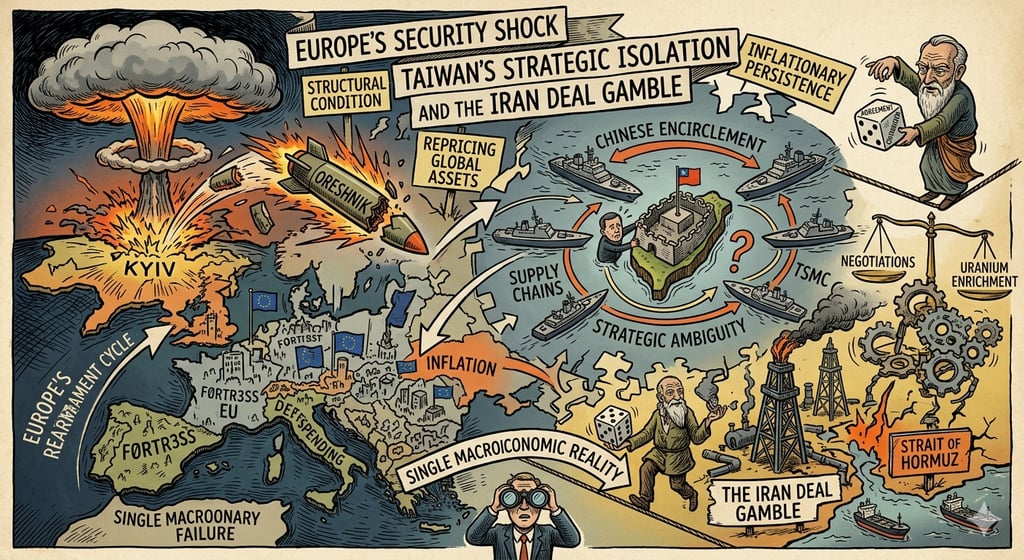
Europe’s Security Shock, Taiwan’s Strategic Isolation, and the Iran Deal Gamble
The latest escalation in Ukraine, China’s expanding pressure campaign around Taiwan, and renewed U.S.-Iran negotiations are converging into a single macroeconomic reality: geopolitical fragmentation is no longer a tail risk for global markets — it is becoming a structural condition.
For investors, the issue is no longer whether geopolitical instability matters. The question is how long energy markets, defense spending, supply chains, and inflation expectations can absorb repeated shocks without triggering a broader repricing across global assets.
The recent Russian strike on Kyiv using the nuclear-capable Oreshnik ballistic missile — even without a nuclear payload — was not merely a battlefield event. It was strategic signaling directed at NATO and European policymakers. Simultaneously, China’s naval encirclement of Taiwan and the fragile framework emerging between Washington and Tehran suggest that all three major geopolitical theaters are now increasingly interconnected.
Russia’s Oreshnik Missile Strike Signals Strategic Escalation
Russia launched one of its largest aerial assaults on Kyiv in recent years, reportedly deploying approximately:
600 drones
90 missiles
Multiple advanced missile systems, including:
Zircon hypersonic missiles
Kinzhal missiles
Iskander systems
The Oreshnik intermediate-range ballistic missile
Ukraine claimed to have intercepted a substantial portion of the attack, though damage and casualties still occurred from debris and impacts.
Why the Oreshnik Matters
The Oreshnik missile represents more than another weapons platform. It belongs to Russia’s broader strategic nuclear-capable arsenal.
While the missile reportedly carried neither nuclear warheads nor high-explosive payloads during this strike, the symbolic message was unmistakable:
Russia is signaling escalation dominance
Moscow wants NATO to understand its capacity for rapid strategic escalation
The Kremlin is reinforcing deterrence against deeper European military involvement
In practical terms, the use of a nuclear-capable delivery system without nuclear payloads creates ambiguity — one of the most dangerous dynamics in modern deterrence theory.
Europe Is Entering a Long-Term Rearmament Cycle
The timing of the strike is critical.
Several developments have accelerated European security concerns:
Germany increasingly discussing the possibility of direct confrontation with Russia
NATO members expanding defense budgets
U.S. discussions about additional troop deployments into Eastern Europe
Rising tensions in the Baltic region
Reports of drones entering NATO airspace near Finland and the Baltics
The broader implication is that Europe is transitioning from a post-Cold War peace-dividend model toward sustained militarization.
Macro Implications for Europe
This shift carries major consequences for European markets:
Fiscal Expansion Through Defense Spending
Higher military expenditures are likely to become structurally embedded in EU budgets.
Potential beneficiaries include:
European defense contractors
Aerospace manufacturers
Cybersecurity firms
Energy infrastructure providers
However, this also introduces:
Larger fiscal deficits
Greater sovereign debt issuance
Pressure on already fragile EU fiscal frameworks
Inflationary Persistence
Defense-driven industrial demand historically contributes to sticky inflation, particularly in:
Metals
Energy
Logistics
Advanced semiconductors
Aerospace supply chains
This complicates the policy path for the European Central Bank, especially if economic growth remains weak while defense spending accelerates.
Taiwan: Strategic Ambiguity Is Becoming Strategic Vulnerability
The Taiwan situation may represent the most consequential long-term geopolitical risk for global markets.
According to Taiwanese sources, China has positioned more than 100 vessels around the island, including:
Naval ships
Research vessels
Maritime support units
Trump’s Comments Increased Market Sensitivity
The geopolitical significance intensified following remarks interpreted as signaling reduced U.S. commitment to Taiwan’s defense.
The implication was not explicit abandonment, but rather a reinforcement of “strategic ambiguity” — a doctrine increasingly viewed in Asia as less credible than in previous decades.
At the same time:
U.S. weapons transfers to Taiwan reportedly slowed
Taiwan’s domestic political divisions complicated military spending increases
China continued normalizing military pressure around the island
Why Markets Cannot Ignore Taiwan
Taiwan is not merely a geopolitical hotspot.
It is central to the global technology supply chain, particularly through Taiwan Semiconductor Manufacturing Company and advanced semiconductor manufacturing.
A prolonged Taiwan crisis would threaten:
AI infrastructure expansion
Data-center investment cycles
Consumer electronics production
Automotive supply chains
U.S. and European industrial policy objectives
For Wall Street and European investors, Taiwan represents both:
A geopolitical flashpoint
A systemic supply-chain dependency
This is why markets continue to react sharply to even symbolic Chinese military maneuvers.
The Iran-U.S. Negotiations Reveal a Strategic Contradiction
While tensions escalate in Eastern Europe and East Asia, Washington appears simultaneously pursuing de-escalation in the Middle East.
Reports surrounding negotiations between the United States and Iran suggest a potential framework involving:
A phased ceasefire
Gradual reopening of the Strait of Hormuz
Partial sanctions relief
Renewed nuclear negotiations
International oversight of uranium enrichment
Oil Markets Remain the Core Issue
The most important macroeconomic dimension is energy.
The Strait of Hormuz remains one of the world’s most critical energy chokepoints. Any credible reduction in tensions could:
Increase Iranian oil exports
Ease supply concerns
Reduce upward pressure on crude prices
Help contain inflation globally
This is particularly relevant for the Federal Reserve and the ECB, both of which remain highly sensitive to energy-driven inflation shocks.
The Strategic Paradox
The proposed framework reportedly resembles elements of the nuclear arrangement abandoned by Washington in 2018.
That creates a difficult political narrative:
Years of regional instability
Sanctions escalation
Supply-chain disruption
Energy volatility
Military confrontation
…may ultimately result in a revised version of a prior agreement.
This does not necessarily mean negotiations are irrational. It highlights how geopolitical cycles often destroy economic value before returning to diplomatic equilibrium.
Inflation Damage Does Not Disappear Overnight
Even if a formal agreement emerges, markets should not assume immediate normalization.
The economic damage from recent disruptions may persist for quarters, not weeks.
Likely Areas of Continued Pressure
Global shipping costs
Energy transportation insurance
Food prices
Fertilizer markets
Industrial input costs
Freight volatility
The lag effect matters.
Even if oil prices stabilize, broader supply-chain distortions can continue feeding inflation into year-end and beyond.
The Bigger Picture: Fragmentation Is Becoming Structural
The core takeaway is not simply that geopolitical tensions are rising.
It is that the world economy is increasingly operating under simultaneous strategic conflicts:
Russia vs. NATO in Eastern Europe
China vs. Taiwan/U.S. in Asia
Iran-Israel-U.S. tensions in the Middle East
This creates a structurally different macro environment from the globalization era that dominated the 1990s and 2000s.
The Emerging Investment Regime
Markets are gradually repricing toward:
Higher defense spending
Persistent geopolitical risk premiums
Strategic industrial policy
Supply-chain regionalization
Energy security prioritization
Increased commodity volatility
For investors, the challenge is that geopolitical fragmentation tends to be inflationary, capital-intensive, and fiscally expansionary — a combination that can keep interest rates structurally higher than markets became accustomed to during the ultra-globalization era.
Final Takeaway
The Russia-Ukraine war, China’s pressure on Taiwan, and the Iran negotiations should not be analyzed as isolated events.
Together, they point toward a world where:
Military deterrence increasingly shapes economic policy
Supply chains become instruments of national security
Inflation risks remain structurally elevated
Markets face recurring geopolitical repricing cycles
The geopolitical era of “temporary disruptions” may be ending. Investors increasingly need to treat geopolitical fragmentation itself as a permanent macroeconomic variable.
Recommended Reading
A highly relevant book for understanding the intersection of geopolitics, supply chains, and macroeconomic fragmentation is:
The End of the World Is Just the Beginning — particularly useful for analyzing deglobalization, energy security, demographics, and the reshaping of global trade systems.
Link: https://amzn.to/4u4hH2E