
Russia–Baltic Tensions Rise: NATO Hybrid Warfare Risk and Market Implications Explained
Analysis of rising Russia–Baltic tensions, NATO deterrence risks, hybrid warfare strategy, and implications for global markets and geopolitics.
5/26/20263 min read
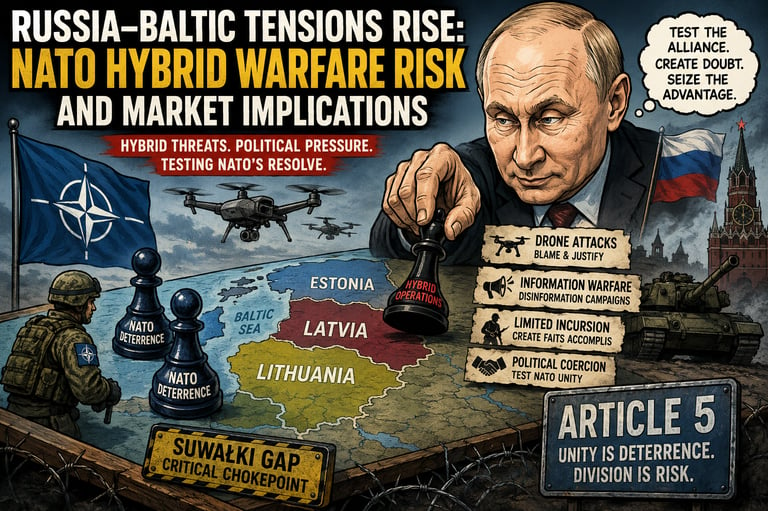
Russia–Baltic Information Escalation: Hybrid Warfare Signaling and NATO’s Deterrence Stress Test
Executive Overview
The narrative presented centers on a potential escalation in Russia’s rhetoric and information operations toward the Baltic region—particularly Latvia—and the possibility that this signaling is part of a broader hybrid warfare strategy aimed at probing NATO cohesion.
The core thesis is not a conventional invasion scenario, but a calibrated escalation ladder: narrative construction → attribution of hostile activity → justification for limited military or hybrid actions. This approach is framed as a strategic attempt to test alliance response thresholds under ambiguity.
From a macro-risk perspective, the key issue is not battlefield capacity, but political credibility: whether NATO’s Article 5 mechanism functions as an automatic deterrent or becomes a negotiated variable under stress.
1. Factual Claims Presented in the Narrative
The source material highlights several reported developments:
Increased rhetorical specificity from Moscow toward the Baltic states, shifting from general hostility to targeted accusations
Allegations by Russian intelligence (SVR) that Ukraine is using Baltic territory for drone operations
Claims of Ukrainian drone strikes on Russian energy infrastructure in the Leningrad region
A reported NATO interception of a drone entering Estonian airspace
Political instability in Latvia following government resignation amid scandals and external pressure narratives
Strategic geography concerns: Latvia borders both Russia and Belarus. The Latgale region has a higher Russian-speaking population share
These elements are presented as the factual backbone of a broader escalation narrative.
2. Interpretive Framework: Hybrid Warfare Logic
The analysis frames Russia’s approach as consistent with hybrid warfare doctrine: combining military pressure, intelligence activity, and information operations.
Narrative escalation pattern described:
Accusation (e.g., Ukraine using Baltic territory)
Threat amplification (warnings of retaliation)
Justification building (defensive framing of potential action)
This mirrors prior hybrid conflict environments where attribution ambiguity is used to delay coordinated response from adversaries. Key interpretation: The shift is less about immediate military preparation and more about shaping decision space in Western capitals.
3. Strategic Geography: Why the Baltic States Matter
Latvia as a pressure point
The narrative identifies Latvia as structurally more exposed due to:
Geographic adjacency to Russia and Belarus
The Latgale region’s demographic composition
Perceived lower domestic trust in NATO compared to regional peers
From a deterrence perspective, these factors are framed as “exploitation vectors” in hybrid scenarios—where internal political or social fragmentation becomes as relevant as external military balance.
4. NATO’s Deterrence Structure Under Stress
The discussion focuses heavily on the operational and political constraints of NATO.
Key structural elements:
Forward presence forces in the Baltics are deterrent, not war-fighting formations
Reinforcement timelines depend on trans-European logistics
The Suwałki Gap remains a critical chokepoint between the Baltics and broader NATO reinforcement routes
Article 5 dilemma (central risk mechanism)
The thesis emphasizes a potential “gray-zone trap”:
A limited incursion could be designed to avoid triggering automatic consensus
Article 5 activation requires political unanimity
Any hesitation—especially from major stakeholders such as the United States—could delay or dilute response coordination
Interpretation: The vulnerability is not military incapacity, but political friction under ambiguity.
5. Speculative Scenario: Limited Incursion Strategy
The narrative outlines a high-risk hypothetical scenario:
Hypothesis: “small, fast, localized operation”
Objective is not territorial conquest
Goal is temporary occupation or control of a narrow border zone
Likely justification: “buffer zone” or defensive response to drone threats
Strategic logic attributed to Russia:
Create faits accomplis before NATO mobilization
Force negotiation under pressure
Extract concessions indirectly linked to Ukraine policy
This is presented as a coercive bargaining strategy rather than expansionist occupation logic.
6. Counterarguments and Strategic Constraints
The source also acknowledges major constraints on escalation:
Russian limitations
Significant military resources remain committed to Ukraine
Opening a second front would strain operational capacity
Alliance cohesion effects
Historically, direct pressure on Baltic states tends to:
Strengthen NATO unity
Increase defense integration
Accelerate accession or alignment processes (as seen with Finland and Sweden after 2022 dynamics)
7. Macro-Financial and Market Implications
From a US/EU macro perspective, the key transmission channels are not immediate conflict probability, but risk premia and policy response expectations.
Potential market impacts:
European defense equities: upward repricing under sustained hybrid tension
Energy markets: elevated volatility risk due to proximity to Baltic Sea infrastructure routes
EUR risk premium: modest widening if escalation narrative intensifies
NATO defense spending trajectory: further acceleration, particularly in Eastern Europe
Federal Reserve / ECB relevance:
Limited direct inflation impact unless energy infrastructure is disrupted
Indirect tightening bias via risk sentiment channels (USD strength episodes, flight-to-safety flows)
ECB more exposed to confidence channels in peripheral eurozone bond spreads
8. Investor Takeaways
The primary risk is “threshold uncertainty,” not full-scale war probability
Hybrid escalation increases volatility asymmetry (tail risk pricing matters more than baseline probability)
Baltic states function as geopolitical option value: low-cost pressure point, high strategic signaling impact
NATO cohesion remains the central variable determining escalation ceilings
9. Conclusion
The central analytical tension is between capability and credibility. While Russia’s conventional capacity constraints reduce the likelihood of a large-scale Baltic invasion, the information environment described suggests a strategy focused on ambiguity, attribution manipulation, and alliance stress testing.
For markets, this is less a binary war/no-war scenario and more a persistent geopolitical volatility regime, where risk is periodically repriced through signaling events rather than kinetic escalation.
Recommended Reading
A highly relevant framework for understanding this type of conflict dynamic is:
The Strategy of Denial: American Defense in an Age of Great Power Conflict by Elbridge Colby
It provides a structural view of deterrence, escalation thresholds, and gray-zone competition relevant to NATO–Russia friction and Baltic security dynamics.
Link: https://amzn.to/4e4KIpS