
Palantir and the Rise of AI Surveillance: Why Wall Street, Governments, and NATO Are Betting on Algorithmic Power
From the CIA and Pentagon to Wall Street and Ukraine, Palantir is quietly becoming the operating system of modern power. Discover how AI, surveillance, defense technology, and geopolitical instability are reshaping markets — and why investors should pay close attention.
5/17/20265 min read

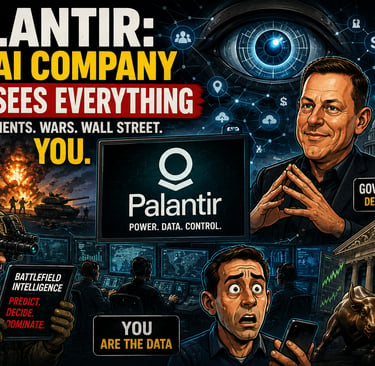
Palantir and the Rise of Algorithmic Power: The Company Quietly Rewiring Governments, Wars, and Wall Street
There are moments in history when technology stops being a tool and starts becoming infrastructure for power itself.
Railroads did it. Oil did it. The internet did it.
Now artificial intelligence is doing it — and few companies embody that shift more aggressively than Palantir Technologies.
Most retail investors still think of Palantir as “that government AI contractor with weird executives and volatile earnings.” That interpretation misses the bigger picture entirely.
The evidence suggests Palantir is evolving into something far more consequential: an operating layer connecting military intelligence, corporate logistics, financial forecasting, border surveillance, cybersecurity, and geopolitical decision-making into one integrated data ecosystem.
This is not merely a software company anymore.
It is becoming digital infrastructure for the Western power structure.
And markets may still be dramatically underpricing what that means.
From the Ashes of 9/11 to the Age of Permanent Surveillance
To understand Palantir, investors need to understand the psychological environment that created it.
After the September 11 attacks, Washington faced an uncomfortable realization: the United States did not fail because it lacked intelligence data. It failed because the intelligence community could not connect fragmented information spread across dozens of agencies.
The problem was not collection. The problem was integration.That distinction changed modern intelligence forever.
Into that vacuum stepped Peter Thiel, the PayPal co-founder who believed anti-fraud algorithms used in fintech could also identify terrorist networks.
The concept was brutally simple:
Aggregate massive amounts of fragmented data
Connect hidden relationships
Predict threats before humans can recognize them
Turn intelligence into actionable decisions in real time
Palantir was born from that philosophy.
Its earliest backer was not traditional venture capital.
It was In-Q-Tel — the CIA’s own venture investment arm.
That fact alone tells you everything about Palantir’s DNA.
This company was never built for social media advertising or consumer apps.
It was built for statecraft.
The Real Product Was Never Software — It Was Certainty
Silicon Valley loves to sell efficiency.
Palantir sells certainty.
That difference matters enormously.
A boots-on-the-ground perspective reveals why military commanders became obsessed with the company’s Gotham platform during the Iraq and Afghanistan wars.
Commanders drowning in spreadsheets suddenly had:
Real-time battlefield visualization
Integrated satellite intelligence
Social network mapping
Financial transaction tracing
Predictive insurgency analysis
Operational logistics forecasting
In practical terms, Palantir transformed disconnected information into a coherent battlefield narrative.
For soldiers facing IED attacks daily, that capability was not theoretical.
It meant survival.
And unlike many Pentagon technology initiatives, troops reportedly pushed for adoption from the ground up because the software actually worked.
That created a rare dynamic in Washington:
the bureaucracy resisted the software while operators demanded more of it.
Palantir eventually sued the U.S. Army over procurement exclusion — and won.
That legal victory became a turning point not only for the company but for the broader relationship between Silicon Valley and the national security state.
Why Wall Street Still Misunderstands Palantir
Most analysts continue valuing Palantir like a conventional SaaS company.
That framework is increasingly obsolete. This is not simply another enterprise software vendor competing with CRM platforms or cloud dashboards.
Palantir sits at the intersection of:
AI infrastructure
Defense technology
Predictive analytics
Supply chain optimization
Geopolitical intelligence
Autonomous decision systems
In other words, Palantir is monetizing complexity itself. And in an unstable world, complexity is exploding.
Consider the macro backdrop:
NATO militarization is accelerating
U.S.-China tensions are deepening
Supply chain fragmentation is increasing
Cyber warfare is becoming permanent
Governments are rebuilding industrial policy
Border security spending is surging
AI-driven military systems are scaling rapidly
Every one of those trends expands Palantir’s addressable market. This is why the company increasingly resembles defense infrastructure rather than traditional tech.
Markets may eventually price it more like a hybrid of:
Lockheed Martin
Microsoft
Snowflake
NVIDIA
And an intelligence agency
That combination sounds absurd until you realize the geopolitical environment increasingly demands exactly this type of platform.
The Ukraine War Changed Everything
The Russia-Ukraine war marked a critical transition in modern warfare.
Data became weaponized at industrial scale.
Palantir reportedly assisted Ukraine with:
Battlefield intelligence integration
Supply chain mapping
Drone targeting optimization
Predictive strike analysis
Real-time operational coordination
This matters because the future battlefield is no longer centered solely on tanks or aircraft.
It is centered on information dominance. The side that processes information faster gains asymmetric advantages across every military layer. The evidence suggests modern warfare is evolving toward AI-assisted command structures where software increasingly influences tactical and strategic decisions. That changes defense economics permanently. Countries are no longer buying only missiles. They are buying cognition.
The Ethical Problem Nobody Wants to Solve
Here is where the story becomes uncomfortable.
Palantir’s defenders argue the company protects democratic nations against terrorism, cyber threats, authoritarian adversaries, and geopolitical instability. Its critics argue the company is building the architecture for algorithmic surveillance states. Both arguments contain truth. That is precisely why the company matters.
Palantir’s systems have reportedly been connected to:
Immigration enforcement
Predictive policing
Border surveillance
Pandemic logistics
Social network analysis
Threat profiling systems
The core issue is not whether the technology works.
It clearly does. The real issue is accountability. When governments outsource decision-making infrastructure to private AI systems, power becomes increasingly opaque.
Who audits the algorithms?
Who validates the datasets?
Who determines acceptable error rates?
Who becomes accountable when predictive systems incorrectly flag innocent individuals?
Those questions are no longer philosophical. They are becoming institutional.
Why Investors Should Take This Seriously
Most investors still analyze AI through the narrow lens of chatbots and productivity software. That misses the deeper transformation underway. AI is rapidly becoming geopolitical infrastructure.
The companies controlling that infrastructure may become some of the most strategically important entities on Earth.
Palantir sits directly inside that shift. And unlike many AI startups chasing consumer hype cycles, Palantir already possesses:
Deep government integration
Military relationships
Classified operational experience
Massive proprietary datasets
Institutional trust inside Western defense systems
Long-duration contracts
Geopolitical relevance
That combination creates extremely high barriers to entry.
A startup cannot casually replicate two decades of embedded relationships with intelligence agencies, NATO structures, and defense institutions.
This is why many institutional investors increasingly view Palantir less as speculative tech and more as strategic infrastructure.
The Bigger Picture: The Privatization of State Power
The most important takeaway is not about one company.It is about the direction of the Western system itself. Governments increasingly depend on private technology firms to perform functions once controlled internally by states:
Intelligence analysis
Satellite infrastructure
Cybersecurity
Battlefield logistics
AI computation
Cloud architecture
Digital surveillance
Communications systems
The line separating Big Tech from state power is becoming almost impossible to distinguish.
A boots-on-the-ground perspective reveals something deeper: the 21st century may not be dominated by nation-states alone. It may be dominated by alliances between states and AI infrastructure corporations and Palantir is positioning itself at the center of that transition.
Final Thoughts
Palantir is not simply another controversial technology company. It is a case study in what happens when AI, geopolitics, military strategy, and financial capitalism merge into one ecosystem.
The company emerged from post-9/11 fear. It matured through endless war. It scaled during global instability.
And now it is entering the AI era with governments and corporations increasingly dependent on algorithmic systems they barely understand. That should excite investors and terrify them at the same time.
For readers wanting a deeper understanding of surveillance, power, and technological control, one essential recommendation is The Age of Surveillance Capitalism by Shoshana Zuboff. It remains one of the clearest frameworks for understanding how data evolved from a business asset into a mechanism of systemic influence.
Link: https://amzn.to/4tHGXeN