
OPEC’s Civil War: Why the UAE Exit Changes Everything for Wall Street
Global order is fracturing: from OPEC’s decay with the UAE’s strategic exit to the final siege in Mali and NATO’s institutional fatigue. We analyze why the modern investor must ignore diplomatic noise and prepare for a post-alliance world, where oil volatility and Middle Eastern realignment will dictate the new cost of capital.
4/28/20263 min read
The Geopolitical Fracture: OPEC Decay, NATO Fatigue, and the Iranian Brink
The global chessboard is being upended. While mainstream media clings to outdated narratives of institutional stability, a boots-on-the-ground perspective reveals a reality characterized by the rapid erosion of multilateralism and the resurgence of aggressive national interests. From the corridors of Mar-a-Lago to the strategic bottlenecks of the Strait of Hormuz, the "old guard" of international relations is failing.
As investors with skin in the game, we must look past the diplomatic posturing. The exit of the UAE from OPEC and the rumored "sunset" of NATO summits are not mere administrative shifts—they are systemic tremors.
The "Iranian Collapse" Narrative vs. Kinetic Reality
The Trump administration continues to signal that Tehran is on the verge of structural implosion. According to high-level briefings, the Iranian leadership is purportedly desperate for the reopening of the Strait of Hormuz, a vital artery through which roughly 20% of the world’s petroleum flows.
The Propaganda Gap: While the White House claims internal collapse, intelligence—including insights shared by Secretary of State Marco Rubio—indicates the Iranian military remains a formidable threat.
Tactical Capacity: Tehran still retains approximately 50% of its missile capabilities. A cornered regime with a functional arsenal is often more dangerous than a stable one.
The Failed Pakistan Summit: A recent proposal funneled through Pakistani intermediaries—offering to clear the Strait in exchange for delayed nuclear negotiations—was flatly rejected by Washington. The U.S. goal is no longer just "containment"; it is a total overhaul of the regional power structure.
OPEC's Death Knell? The UAE’s Great Escape
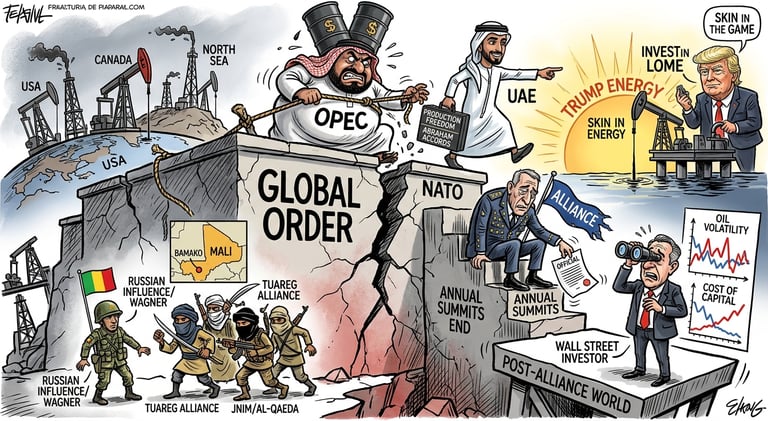
The most significant tectonic shift for global energy markets is the United Arab Emirates (UAE) withdrawing from OPEC. This isn't just about oil quotas; it's a declaration of sovereignty over the Saudi-led "cartel" model.
Why the UAE Walked Away
Production Shackles: Abu Dhabi has invested billions in expanding capacity. Being told to "throttle back" by Riyadh to support a price floor no longer serves their national ROI.
Geopolitical Alignment: The UAE is a signatory of the Abraham Accords. Their recognition of Israel puts them in a different ideological orbit than the traditional Arab bloc, favoring Western integration over regional "unity."
Security Frustration: The UAE has faced direct missile and drone attacks on critical infrastructure (like the Fujairah terminal). The perceived lack of a coordinated military response from their Gulf neighbors has signaled that the GCC is a paper tiger.
The Bottom Line for Wall Street: A weakened OPEC means more volatility but also more supply. If the UAE pumps at will, the Saudi "monopoly" on price-setting effectively ends. This is a massive victory for the Trump doctrine of "Energy Independence" and lower domestic costs.
NATO and the "Sunset" of Globalism
Reports from Reuters suggest that the era of grand, annual NATO summits may be coming to an end after 2027. This reflects a growing fatigue within the alliance and a shift toward ad-hoc military coordination rather than performative diplomacy.
Internal Friction: Recent summits have become arenas for mutual embarrassment rather than strategic planning.
The Trump Factor: Washington’s increasingly transactionalist view of defense means the U.S. is less interested in subsidizing European security without significant concessions.
Operational Shift: Expect NATO to move toward a "Rapid Response" model—meeting only when a kinetic threat demands it—rather than maintaining a bloated schedule of diplomatic galas.
The Sahel Inferno: Russia’s Retreat and the Rise of Jihadist Alliances
While the West focuses on the Middle East, Mali is on the brink of total state failure. The military junta, which expelled French and U.S. forces in favor of Russian Wagner Group "protection," is being systematically dismantled.
The Unholy Alliance: In a bizarre but effective turn, Tuareg separatists have formed a tactical partnership with Al-Qaeda-linked insurgents (JNIM).
Territorial Loss: Estimates suggest that the opposition now controls 70% of the country, with the capital, Bamako, currently under a tightening siege.
The Contagion Risk: This failure marks a disastrous blow to Russian influence in Africa. For global markets, this means continued instability in a region rich in gold and uranium, potentially forcing a Western "re-intervention" under much more hostile conditions.
Keywords: OPEC UAE Withdrawal, Iran Strait of Hormuz Geopolitics, Marco Rubio Iran Missile Intel Trump Energy Policy 2026, NATO Summit Ending Reuters, Mali Coup Tuareg Al-Qaeda Energy Market Volatility, Gulf Cooperation Council Fracture, Sahel Resource Security