Nuclear Primacy 2026: Is Russia’s 5,580-Warhead Arsenal Still the World’s Biggest Threat?
As of 2026, the global nuclear hierarchy is shifting from 'quantity' to 'survivability.' While Russia maintains the world’s largest stockpile with 5,580 warheads, the U.S. is spending $2 trillion to ensure its 'Triad' remains untouchable. Meanwhile, China’s rapid silo expansion in the desert signals a move toward nuclear parity. We break down the 2026 nuclear balance of power and what it means for global stability.
4/26/20262 min read
Nuclear Primacy in 2026: Why Warheads Count Less Than Hypersonic Delivery Systems
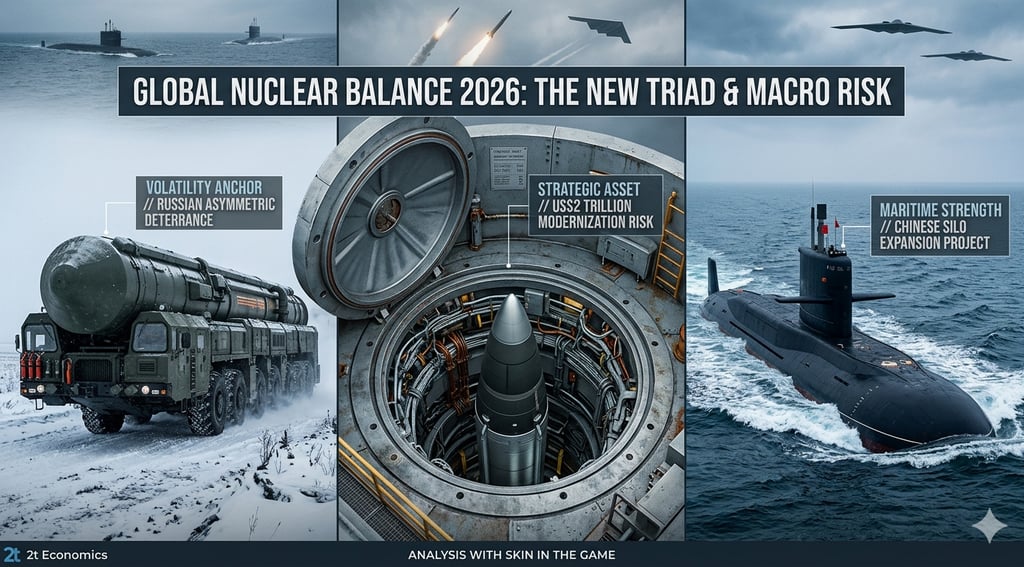
The evidence suggests we have entered a "Second Nuclear Age." It’s no longer just about the Cold War math of Mutual Assured Destruction (MAD); it’s about Stealth, Speed, and Survivability. From a boots-on-the-ground perspective, the 2026 landscape shows three giants prepared for a war no one can win, but each with a dangerously different strategy.
1. Russia: The King of Raw Mass and the 'Satan' Factor
Russia remains the world’s largest nuclear power with 5,580 warheads. However, a senior macro audit reveals a paradox: while they have the numbers, much of the arsenal is a legacy of the Soviet era.
The RS-28 Sarmat (Satan 2): This is the ultimate deterrent. With an 18,000 km range and the ability to carry 24 hypersonic gliders, it bypasses traditional missile defenses by attacking through the South Pole.
The Arctic Fortress: Russian Borei-class submarines hide under the Arctic ice, making them nearly impossible to track.
The Risk: Russia spends less ($8B/year) than the U.S., focusing on "asymmetric destruction" rather than high-tech maintenance.
2. The United States: The $2 Trillion Modernization Bet
The U.S. doesn't want the most bombs; it wants the most reliable bombs. With 5,244 warheads, Washington is in the middle of a massive $2 trillion overhaul of its "Nuclear Triad."
The Silent Killers: The Ohio-class (and soon Columbia-class) submarines are the backbone of U.S. strategy. A single sub can vanish for months and reappear to level 160 targets.
Invisible Reach: The B-2 Spirit (and the new B-21) provides a "stealth" nuclear option that can loiter near enemy airspace undetected.
Strategic Depth: 400 Minuteman III missiles are buried in 30-meter deep silos across Montana, Wyoming, and North Dakota. For an investor, this represents the ultimate "insurance policy" for Western hegemony.
3. China: The Rising Wildcard
China is the fastest-growing nuclear power, increasing its arsenal by 10% annually. Officially, they hold a "No First Use" policy, but their actions in the desert suggest otherwise.
Decoy Strategy: Satellite imagery has revealed hundreds of new silos in the Chinese desert. The catch? Many are empty decoys designed to bleed an enemy's intelligence resources.
The DF-41: A mobile ICBM that can hit 10 different targets simultaneously. China is moving away from a "minimal deterrent" to a "major power" posture.
As an analyst monitoring capital flows into the defense sector, I view the $60B annual U.S. nuclear budget not just as a military necessity, but as a non-negotiable revenue floor for firms like Lockheed Martin. We aren't just looking at silos; we are looking at the long-term anchors of industrial volatility.
Strategic Intelligence: The Logic of Global Hegemony
Navigating the 2026 macro landscape requires more than just monitoring ticker symbols; it demands an understanding of the brutal logic of global power. If our analysis of the nuclear triad and the shifting balance of power has caught your attention, John Mearsheimer’s 'The Tragedy of Great Power Politics' is the deep-dive intelligence you need. Mearsheimer strips away the diplomatic fluff to reveal the raw, structural competition that forces giants like the U.S., Russia, and China into a permanent state of high-stakes friction. This is mandatory reading for any strategist who wants to understand the inevitable collision course of the coming decade and protect their interests in a world of escalating volatility. Secure your copy and support our research at 2t Economics through the link below:
👉 Get 'The Tragedy of Great Power Politics' on Amazon here
Keywords: Global Nuclear Arsenal 2026, Russia vs US Nuclear Power, China Nuclear Expansion, RS-28 Sarmat Satan 2, Ohio Class Submarine Retaliation, Hypersonic Missile Defense