
NATO, Taiwan, and Europe’s Defense Shift: The New Era of Geopolitical Fragmentation
Analysis of U.S. troop deployments in Poland, Europe’s defense buildup, Taiwan tensions, and the growing fragmentation of global geopolitics shaping markets and macro strategy.
5/24/20265 min read
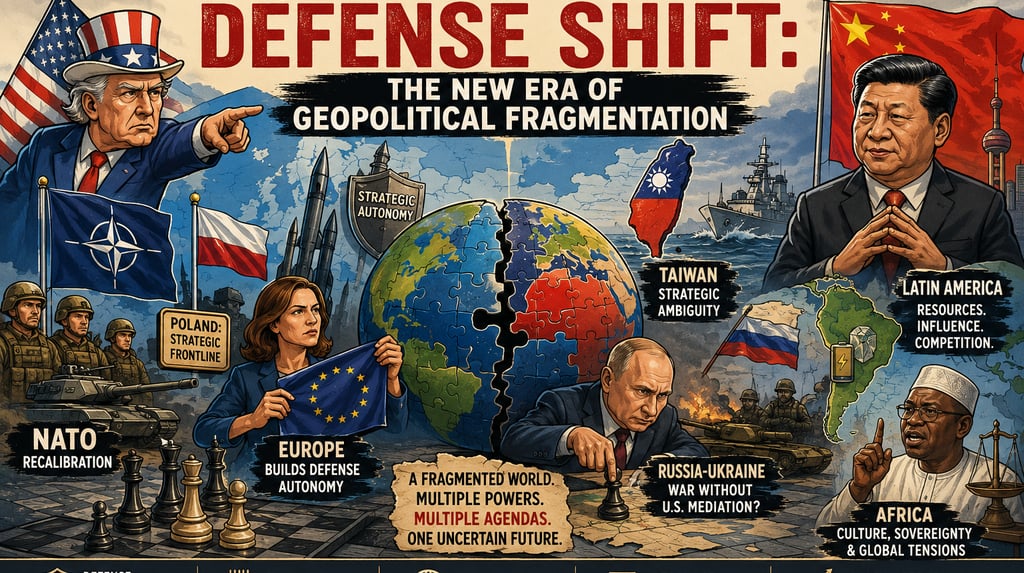
NATO Recalibration, Taiwan Ambiguity, and the Fragmentation of Western Strategic Coherence
The latest sequence of U.S., European, and Indo-Pacific policy signals reveals a broader pattern increasingly visible across global markets: Western strategic coordination is becoming more transactional, less predictable, and more politically fragmented. For investors, this matters far beyond geopolitics. Defense spending, semiconductor security, energy autonomy, commodity supply chains, and reserve-currency politics are all becoming interconnected macro variables.
At the center of the current cycle is a contradiction increasingly associated with the second Trump-era foreign policy posture: Washington simultaneously pressures allies to become more strategically autonomous while preserving American leverage over the architecture of global security.
The result is growing uncertainty across NATO, Europe’s industrial defense base, and the Taiwan deterrence framework.
U.S. Expands Troop Presence in Poland After Pentagon Mixed Signals
Washington announced the deployment of roughly 5,000 additional troops to Poland shortly after earlier indications that the Pentagon was considering reducing portions of its Eastern European military footprint.
The move highlights internal inconsistencies between:
Pentagon strategic planning
White House political messaging
NATO coordination mechanisms
Why Poland Matters
Poland has become one of NATO’s most strategically committed members:
Defense spending approaching 5% of GDP
Major procurement of U.S. military systems
Geographic proximity to Russia and Belarus
Growing role as NATO’s eastern logistics hub
This creates an important distinction often overlooked in broader NATO burden-sharing debates. While several Western European states remain below long-term defense targets, Poland and the Baltic states have aggressively expanded military investment.
The new deployment therefore appears less like a generalized NATO commitment and more like a selective reinforcement of highly aligned allies.
Strategic Implications
The decision also reflects a structural concern inside Washington:
Germany remains essential as America’s logistical anchor in Europe
But Berlin’s political and economic divergence from Washington has increased in recent years
Poland increasingly functions as an alternative strategic platform
This matters because U.S. military infrastructure in Europe is not purely defensive. It underpins:
Power projection into Eastern Europe
Middle East logistics
NATO operational integration
Intelligence coordination
The broader implication is that Washington may be reorganizing its European security architecture around politically reliable partners rather than traditional Western European leadership.
Europe Accelerates Strategic Autonomy in Missile Production
France joining Germany and the United Kingdom in the development of a long-range cruise missile reflects another accelerating trend: Europe no longer fully trusts long-term U.S. strategic continuity.
Key Drivers Behind European Defense Reindustrialization
Several developments pushed Europe toward deeper defense autonomy:
Russia’s expanding missile capabilities
The war in Ukraine
U.S. unpredictability under Trump
Concerns over future NATO reliability
Dependence on U.S. weapons systems
European policymakers increasingly recognize that outsourcing defense and energy security created systemic vulnerabilities.
France’s Unique Position
Among European powers, France occupies a distinct role because it maintains:
Independent nuclear capabilities
Domestic defense manufacturing capacity
Strategic military doctrine less dependent on Washington
This gives Paris disproportionate influence in shaping a future European defense identity.
For markets, this trend has major implications:
Likely Beneficiaries
European defense contractors
Aerospace manufacturers
Missile systems producers
Cybersecurity firms
Rare-earth supply chains linked to military production
Macro Effects
Higher long-term European fiscal spending
Greater industrial policy intervention
Expanded EU defense coordination
Pressure on sovereign debt dynamics
Taiwan: Strategic Ambiguity Becomes More Explicit
The apparent suspension or delay of certain U.S. arms transfers to Taiwan is one of the most consequential signals in the broader U.S.-China relationship.
Official explanations referenced inventory management and Middle East operational priorities. However, the timing strongly suggests linkage to broader negotiations with Beijing.
The Emerging Framework
The current U.S. posture increasingly suggests:
Economic stabilization with China remains a priority
Washington wants to avoid near-term military escalation over Taiwan
Strategic ambiguity is being widened intentionally
Trump’s public comments reinforce this interpretation by emphasizing:
China’s overwhelming scale relative to Taiwan
Geographic distance from the U.S.
Reluctance to guarantee unconditional intervention
This does not mean Washington would abandon Taiwan. But it likely signals a transition from deterrence certainty toward calibrated ambiguity.
Why Markets Care
Taiwan remains central to the global semiconductor ecosystem.
Any perceived weakening of U.S. commitment affects:
Semiconductor supply chains
AI infrastructure investment
Big Tech capital expenditure assumptions
U.S.-China trade expectations
Defense sector positioning
The geopolitical premium embedded in semiconductor valuations may therefore become increasingly volatile.
U.S. Withdrawal From Russia-Ukraine Mediation
Secretary of State Marco Rubio’s indication that the United States may reduce its mediation role in the Russia-Ukraine conflict reflects growing frustration with stalled negotiations.
Potential Consequences
If Washington steps back diplomatically:
European states may assume larger negotiation responsibilities
Turkey, China, or Gulf states could gain influence
NATO cohesion may face additional stress
Ukraine may pursue more asymmetric escalation strategies
The risk of horizontal escalation also remains significant.
Ukraine’s concerns over Belarusian military coordination with Russia highlight fears of renewed northern pressure against Kyiv.
At the same time, discussions around “preventive strikes” raise legal and geopolitical risks under international norms.
U.S. Influence in Latin America and the Resource Competition Thesis
The discussion surrounding possible meetings between Trump allies and Brazilian opposition figures reflects a larger strategic issue often underestimated in Western analysis: Latin America is re-emerging as a geopolitical battleground centered on commodities, energy, and digital infrastructure.
Why the Region Matters Again
The U.S. increasingly views Latin America through three lenses:
Rare earth minerals
Food security
Data center and AI infrastructure expansion
Brazil, in particular, possesses:
Critical mineral potential
Large-scale renewable energy capacity
Strategic agricultural production
Growing relevance for AI-related electricity demand
This creates a difficult balancing act for Brasília between:
Chinese trade dependence
U.S. strategic expectations
Domestic industrial ambitions
BRICS alignment pressures
The broader issue is not ideological alignment alone. It is supply-chain control in an era of economic fragmentation.
Senegal and the Limits of Cultural Globalization
The controversy surrounding Senegal’s harsher penalties against same-sex relationships reflects another increasingly important geopolitical dynamic: resistance to Western cultural influence.
The Emerging Divide
Across parts of Africa, the Middle East, and Asia, political leaders increasingly frame Western liberal norms as:
External ideological pressure
Neo-colonial cultural influence
A threat to national sovereignty
This creates growing friction between:
Human rights frameworks
Sovereignty arguments
Western aid relationships
International institutions
For Europe and the United States, this presents a difficult policy dilemma:
How far should liberal democracies condition partnerships on social norms?
At what point do sanctions become counterproductive?
Can strategic alliances survive deep cultural divergence?
These tensions are likely to intensify as multipolarity expands.
Key Macro Takeaways for Investors
The Global System Is Becoming More Fragmented
The dominant trend across all developments is fragmentation rather than bloc unity.
Defense Spending Is Structurally Rising
Expect continued upward pressure on:
NATO military budgets
European industrial subsidies
Aerospace investment
Strategic commodity demand
Strategic Ambiguity Is Increasing
From Taiwan to Ukraine, Washington is signaling flexibility rather than absolute guarantees.
Markets historically struggle with ambiguity more than confrontation itself.
Resource Nationalism Is Returning
Rare earths, semiconductors, energy systems, and digital infrastructure are becoming geopolitical assets rather than purely economic goods.
Final Assessment
The current geopolitical environment is no longer defined by stable post-Cold War assumptions. Instead, it reflects a transition toward negotiated spheres of influence, selective alliances, and transactional security guarantees.
The United States remains the central global power, but its strategic posture is becoming increasingly conditional and politically personalized. Europe is responding by accelerating defense autonomy. China is testing the limits of American deterrence. Emerging economies are leveraging resource relevance for geopolitical bargaining power.
For investors, the key insight is clear: Geopolitical volatility is no longer a tail risk. It is becoming a structural component of the macroeconomic cycle.