
NATO Rearmament, Taiwan Tensions, and Trump’s Strategic Reversal Shake Global Markets
Trump’s Poland troop deployment, Taiwan tensions, and Europe’s military buildup are reshaping global markets and geopolitical risk.
5/23/20265 min read
NATO’s Strategic Recalibration: Trump’s Mixed Signals, Europe’s Rearmament, and the New Geopolitical Risk Premium
The geopolitical landscape is entering another phase of strategic fragmentation. In a matter of days, Washington signaled both a potential drawdown of its Eastern European posture and a renewed military commitment to Poland. Simultaneously, Europe accelerated efforts toward strategic military autonomy, while US-China tensions over Taiwan exposed growing inconsistencies inside the American security apparatus.
For investors, the implications go beyond diplomacy. These developments directly affect:
Defense spending trajectories
Energy security premiums
Supply-chain localization
Semiconductor risk exposure
US-China trade negotiations
NATO cohesion
Long-duration inflation risks tied to geopolitical fragmentation
The broader message is increasingly clear: the post-Cold War security architecture is being renegotiated in real time.
Trump’s Poland Pivot Reveals Internal Frictions Inside Washington
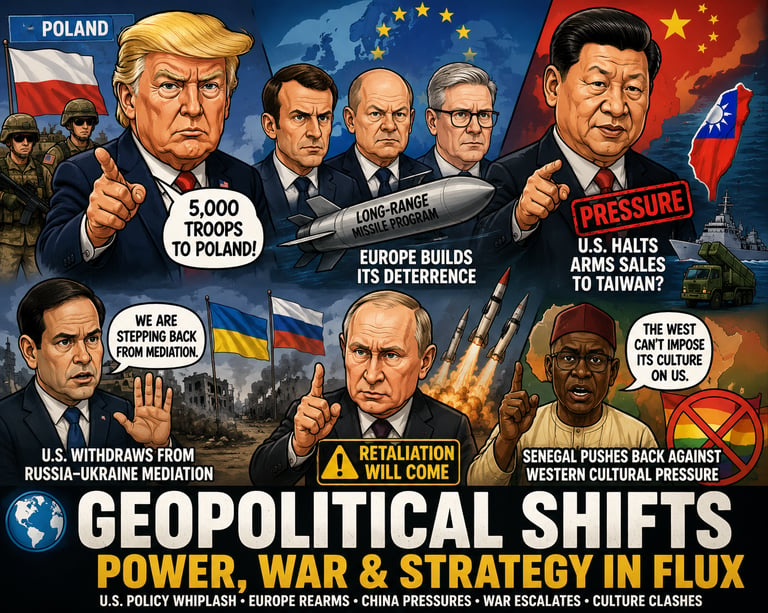
Earlier in the week, Pentagon-linked discussions suggested a possible reduction of US troop presence in Eastern Europe, particularly in Poland and neighboring NATO territories. Shortly afterward, Donald Trump publicly announced the deployment of approximately 5,000 additional US troops to Poland.
The reversal surprised both NATO allies and reportedly elements inside the Pentagon itself.
Why Poland Matters
Poland has emerged as one of NATO’s most strategically important members:
Defense spending is approaching 5% of GDP
Warsaw has aggressively expanded procurement of US weapons systems
Poland increasingly functions as NATO’s eastern logistics hub
The country hosts roughly 10,000 US troops already
Unlike several Western European economies criticized by Washington for underinvesting in defense, Poland aligns closely with US strategic demands.
This suggests Trump’s frustrations may not be directed at NATO as a whole, but rather at specific European powers — particularly Germany.
Germany’s Strategic Importance Cannot Be Easily Replaced
Germany remains the backbone of America’s military infrastructure in Europe.
Key realities include:
Germany hosts one of the largest concentrations of US military assets outside North America
US Middle East logistics operations heavily rely on German bases
Berlin functions as a critical transportation and command hub for NATO
However, Washington’s increasingly transactional approach toward European security is forcing European policymakers to reconsider long-term dependence on the United States. That recalibration is now accelerating.
Europe Moves Toward Strategic Military Autonomy
France’s decision to join Germany and the United Kingdom in developing a long-range cruise missile marks another step toward European defense independence.
The timing is significant. Recent Russian military exercises involving Belarus, combined with renewed discussions surrounding advanced missile systems and nuclear deterrence capabilities, have intensified security concerns across Europe.
Europe’s Core Strategic Realization
European policymakers increasingly recognize that outsourcing critical national security functions carries structural risks.
The two sectors now viewed as non-negotiable pillars of sovereignty are:
Energy security
Defense manufacturing
The US refusal to deploy certain long-range missile systems on German territory appears to have accelerated European urgency around indigenous weapons production.
France’s Unique Position
France occupies a particularly important role because it remains the EU’s only fully sovereign nuclear power with an independent domestic nuclear deterrent infrastructure.
The UK maintains nuclear capabilities, but parts of its delivery systems remain integrated with US technology and operational support.
This distinction matters as Europe debates “strategic autonomy” in a world where US political leadership may become less predictable.
Taiwan Becomes a Bargaining Chip in US-China Negotiations
Another major development involves the apparent suspension or delay of certain US military equipment sales to Taiwan.
Officially, Washington framed the move as a logistical prioritization issue tied to Middle East inventory management and potential Iran-related contingencies. However, the explanation raises questions.
The Contradiction in Washington’s Messaging
US officials have repeatedly argued that military inventories remain sufficient despite ongoing geopolitical pressures.
At the same time:
Previously approved Taiwan-related military packages remain stalled
Congressional approval processes continue without execution
Beijing has intensified diplomatic pressure around Taiwan policy
The sequence strongly suggests Taiwan may be increasingly embedded within broader US-China trade and diplomatic negotiations.
Trump’s Strategic Ambiguity
Trump’s recent comments reinforced deliberate uncertainty:
He avoided explicitly committing US military intervention in defense of Taiwan
He emphasized the geographic distance between Taiwan and the United States
He implied reluctance for the US to act as guarantor of Taiwanese independence
This strategic ambiguity is highly consequential for markets.
Taiwan remains central to:
Global semiconductor production
AI infrastructure supply chains
Advanced computing manufacturing
Western technological competitiveness
Any perceived weakening of US commitments increases geopolitical risk premiums across technology and manufacturing sectors.
The US Steps Back From Russia-Ukraine Mediation
Secretary of State Marco Rubio indicated that Washington is reducing its direct mediation role in the Russia-Ukraine conflict unless negotiation conditions materially change. This marks a meaningful diplomatic shift.
Potential Implications
If the United States reduces active mediation efforts:
European actors may assume greater diplomatic responsibility
Turkey, China, or Gulf states could seek larger negotiating roles
Ukraine may gain slightly more operational flexibility absent direct US pressure
The announcement also comes amid escalating rhetoric surrounding Belarus. Ukraine increasingly views joint Belarus-Russia military exercises as preparation for possible northern offensive operations near Kyiv. Discussions around “preventive strikes” further raise escalation risks.
For markets, prolonged conflict duration reinforces:
Elevated defense expenditures
Energy market volatility
European fiscal expansion
Commodity supply uncertainty
Political Signaling and US Influence in Latin America
Reports surrounding a potential meeting between Trump and Brazilian conservative figures highlight another strategic layer: Washington’s renewed focus on Latin America amid intensifying competition with China.
At the center of these discussions are:
Rare earth minerals
Data-center infrastructure
Trade alignment
Dollar-based financial systems
Rare Earths Become Strategic Assets
The United States is actively seeking alternatives to Chinese dominance in critical minerals.
Latin America represents a major opportunity because of:
Untapped rare-earth reserves
Growing energy infrastructure
Expanding digital capacity needs
This aligns with broader US industrial policy objectives focused on:
Supply-chain resilience
Strategic decoupling from China
Semiconductor and AI infrastructure security
For investors, this trend supports continued capital allocation toward:
Mining infrastructure
Industrial commodities
Grid modernization
Energy-intensive data-center ecosystems
Cultural Fragmentation and the Rise of Political Sovereignty Narratives
The comments from Senegal’s leadership criticizing Western cultural influence illustrate another underappreciated macro trend: the growing rejection of Western liberal norms by parts of the Global South.
This matters economically because geopolitical fragmentation is no longer limited to trade and military alliances.
It increasingly extends into:
Regulatory systems
Human rights frameworks
Digital governance
Financial institutions
Cultural sovereignty
The world economy is gradually moving away from a fully globalized liberal order toward a more fragmented multipolar framework.
That transition likely implies:
Higher transaction costs
Greater geopolitical volatility
Increased regionalization of trade
Persistent inflationary pressures tied to deglobalization
Key Investor Takeaways
Defense and Aerospace
The structural bull case for defense spending remains intact across both the US and Europe.
Key drivers include:
NATO rearmament
European strategic autonomy
Persistent Russia-related tensions
Indo-Pacific military competition
Energy Security
Europe’s reassessment of strategic dependencies reinforces long-term investment themes in:
LNG infrastructure
Nuclear energy
Grid resilience
Domestic energy production
Semiconductors and Taiwan Risk
Taiwan remains one of the largest unresolved geopolitical risks for global markets.
Any deterioration in US deterrence credibility could materially impact:
Semiconductor equities
AI infrastructure valuations
Supply-chain stability
Advanced manufacturing investment flows
Deglobalization Continues
The broader macro direction remains consistent:
More regional blocs
Higher strategic competition
Increased industrial policy intervention
Reduced efficiency in global capital allocation
The era of frictionless globalization continues to fade.
Final Thought
Markets continue to underestimate how deeply geopolitics is reshaping macroeconomic fundamentals. What once appeared as isolated diplomatic disputes increasingly represents a structural transformation of the global order.
The result is a world defined less by efficiency and more by resilience, sovereignty, and strategic control.
That transition will likely define capital markets throughout the next decade.
Recommended Reading
A highly relevant book for understanding the intersection of geopolitics, trade fragmentation, and strategic competition is The Revenge of Geography by Robert D. Kaplan.
The book offers a strong framework for understanding how geography, military positioning, energy corridors, and regional power dynamics continue to shape global economic outcomes despite globalization narratives.
Link: https://amzn.to/4tNfJ6n