
Japan Interest Rates 2026: What Happens If the Yen Strengthens?
What would happen if Japan raises interest rates in 2026? Explore the impact on the yen, global liquidity, carry trade unwinds, and financial markets.
5/1/20262 min read
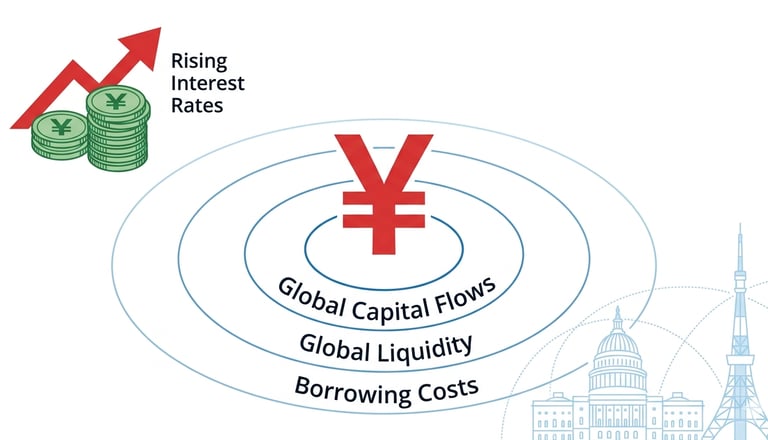
Why Japan Interest Rates Matter in 2026
Japan’s monetary policy has long played a unique role in global financial markets. For decades, ultra-low interest rates helped shape global liquidity conditions through capital flows and currency strategies.
In 2026, however, even a gradual shift in Japan interest rates could have wide-reaching consequences.
The Yen and Global Financial Stability
The Japanese yen is one of the most important funding currencies in global markets. Because of historically low borrowing costs, it has been widely used in cross-border investment strategies.
If the yen strengthens due to rising interest rates, it could signal a major shift in global capital flows.
Key effects may include:
Reduced appetite for risk assets
Changes in currency-hedged investments
Repricing of global liquidity conditions
How the Yen Carry Trade Could Unwind
The yen carry trade has been one of the most influential mechanisms in global finance.
To understand it simply:
Investors borrow in yen at low interest rates
They invest in higher-yielding foreign assets
Profits come from the interest rate difference
However, if Japan interest rates rise:
Borrowing in yen becomes more expensive
Existing positions become less attractive
Investors may begin unwinding trades
This process could create gradual pressure on global markets rather than an immediate shock.
Impact on Global Liquidity
A strengthening yen combined with higher interest rates in Japan could reduce global liquidity.
Potential consequences include:
Tighter financial conditions globally
Higher volatility in equity markets
Increased funding costs for leveraged investors
This is especially relevant for markets that have benefited from years of abundant liquidity.
Connection to U.S. Treasury Markets
Japan remains one of the largest foreign holders of U.S. Treasury securities.
If Japanese investors shift capital back home:
Demand for foreign bonds may decrease
Treasury yields could rise
Global borrowing costs may increase
This highlights how closely Japan’s monetary policy is tied to global interest rate dynamics.
Bank of Japan Policy Constraints
The Bank of Japan faces a difficult policy environment.
If rates rise too quickly:
Economic growth could slow
Debt servicing costs increase significantly
Financial stability risks may emerge
If rates remain too low:
The yen may weaken further
Import costs and inflation pressures could rise
This balancing act makes policy decisions particularly complex.
What Investors Should Watch
Investors monitoring Japan’s economy in 2026 should focus on:
Interest rate decisions and forward guidance
Yen exchange rate movements
Changes in global carry trade positioning
Treasury yield reactions
These indicators can provide early signals of shifts in global liquidity.
Final Thoughts
Japan’s monetary policy changes are unlikely to create sudden disruption. However, gradual adjustments in interest rates could reshape global capital flows over time.
The key risk is not a crisis — but a transition.
As the yen and interest rates evolve, global markets may need to adjust to a new liquidity environment.
Related Reading
If you want to understand how rare and high-impact financial events can reshape global markets, The Black Swan by Nassim Nicholas Taleb is highly recommended. The book explores how unpredictable events can influence economic systems and investor behavior — a useful framework for understanding complex global dynamics like those discussed in this article.
Link: https://amzn.to/4eRQRXh