
Japan Economy 2026: How Interest Rates and the Yen Could Impact Global Markets
Japan’s economy may be entering a critical phase. Understand how interest rates, the yen carry trade, and rising debt could impact global markets.
5/1/20262 min read
Japan’s Economy in 2026: Why It Matters
Japan’s economy is entering a critical phase in 2026, with potential implications for global interest rates, liquidity, and investor behavior.
While global attention often focuses on geopolitical tensions and elections, structural shifts in Japan may quietly influence financial markets worldwide.
As one of the largest economies and a major holder of foreign assets, changes in Japan’s monetary policy can ripple across global markets.
Japan’s Demographic Problem and Economic Growth
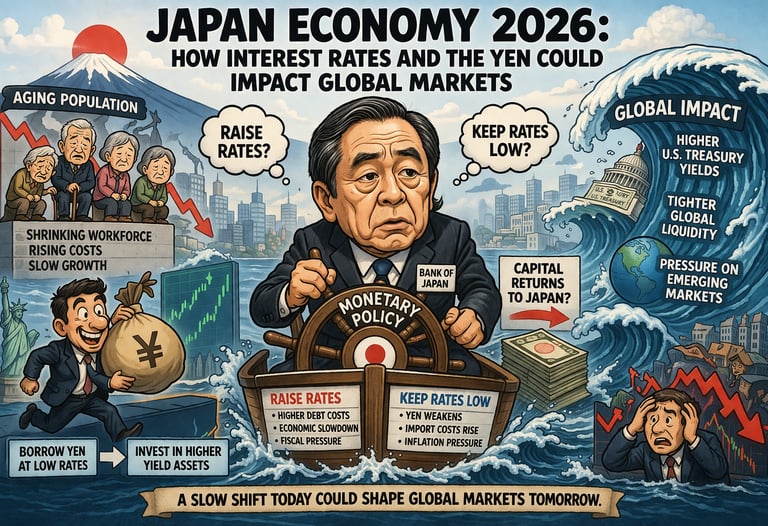
One of the biggest long-term challenges facing the Japan economy is its aging population.
Key structural pressures include:
A shrinking workforce
Rising pension and healthcare costs
Slower domestic consumption
This demographic trend has contributed to decades of low inflation and weak economic growth, limiting Japan’s flexibility in responding to new economic shocks.
Japan Interest Rates: Is Ultra-Loose Policy Ending?
For years, the Bank of Japan has maintained ultra-low interest rates to support economic activity.
In fact, it has been one of the last major central banks to keep such an accommodative stance.
However, recent developments suggest a potential shift:
Inflation has started to rise
The yen has weakened significantly
Pressure is building to normalize monetary policy
If Japan raises interest rates — even gradually — the effects could extend far beyond its domestic economy.
Yen Carry Trade Explained: A Key Driver of Global Liquidity
The yen carry trade has long been a major driver of global liquidity.
In simple terms:
Investors borrow money in yen at low interest rates
They invest in higher-yielding assets abroad
This strategy has supported investments in stocks, real estate, and bonds worldwide.
However, if Japan interest rates increase:
Borrowing in yen becomes more expensive
Investors may unwind global positions
Global liquidity could tighten
This shift could have significant implications for asset prices and risk appetite.
Impact on U.S. Treasury Yields and Global Markets
Japan is one of the largest foreign holders of U.S. Treasury securities.
If Japanese investors begin reallocating capital domestically:
U.S. Treasury yields could rise
Borrowing costs may increase globally
Emerging markets could face additional pressure
This highlights how closely connected global capital flows have become.
Japan Debt Levels: A Structural Risk?
Japan’s public debt is among the highest in the world relative to GDP.
This creates a difficult policy trade-off:
If interest rates remain low:
The yen may weaken further
Import costs could rise
If interest rates increase:
Debt servicing becomes more expensive
Fiscal pressure intensifies
Given the scale of Japan’s debt, even small increases in interest rates can have significant consequences.
What This Means for Investors
Japan is unlikely to face a sudden financial crisis. Instead, the more realistic scenario is a gradual economic shift with global ripple effects.
Investors should monitor:
Interest rate decisions in Japan
Currency movements, particularly the yen
Changes in global liquidity conditions
Understanding these dynamics can help anticipate shifts in asset prices and broader market trends.
Key Takeaways
Japan’s economy faces long-term demographic challenges
Interest rate changes could impact global liquidity
The yen carry trade may become less attractive
Global markets could experience second-order effects
Final Thoughts: A Slow but Important Transition
The story of the Japan economy in 2026 is not about sudden collapse — it is about structural transition.
As monetary policy evolves, the effects may be gradual but meaningful over time.
For investors paying attention, these changes could provide valuable insight into the next phase of global market dynamics.
Further Reading
If you’re interested in understanding how rare, high-impact events shape global markets and economic systems, a highly recommended read is The Black Swan by Nassim Nicholas Taleb. The book explores how unpredictable events can have massive consequences on financial markets and helps investors think more critically about risk, uncertainty, and global instability — themes that are closely connected to the dynamics discussed in this article.