
Italy's Rise and Fall: How Rome, the Renaissance, and Luxury Brands Still Shape the Global Economy
Discover how Rome built the first scalable empire, how Renaissance Italy invented modern finance, and why Italian cultural power continues to influence global markets, luxury brands, and Western civilization today.
6/16/20265 min read
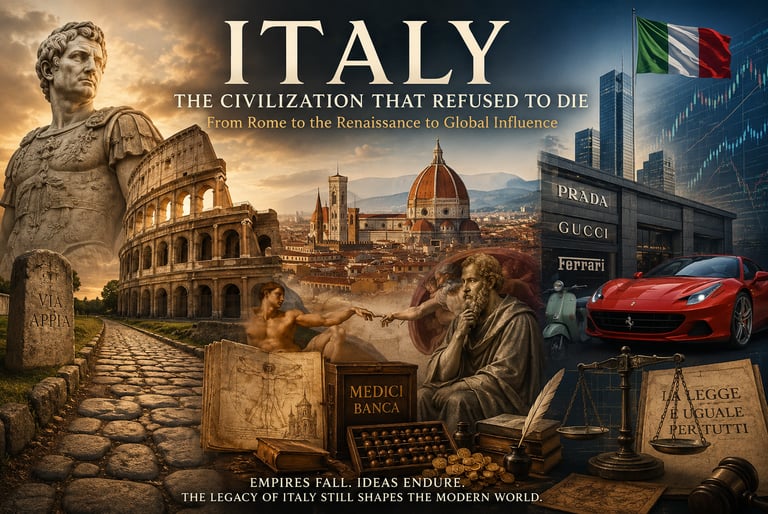
Italy: The Civilization That Refused to Die
How Rome, Renaissance Capitalism, and Cultural Power Shaped the Modern West
Few nations have influenced the modern world as profoundly as Italy.
Long before Wall Street, Silicon Valley, or even the concept of nation-states existed, the Italian peninsula served as the laboratory where many of Western civilization's defining institutions were first tested. From Roman law and republican governance to Renaissance banking and luxury branding, Italy repeatedly transformed local innovation into global influence.
A boots-on-the-ground perspective reveals something even more remarkable: Italy's story is not one of uninterrupted success. It is a story of collapse, fragmentation, reinvention, and resilience.
The evidence suggests that civilizations do not necessarily disappear when their political structures fall. Instead, their ideas migrate, adapt, and often become more powerful than the empires that originally created them.
Today, as investors debate sovereign debt sustainability, demographic decline, and geopolitical fragmentation, Italy offers an extraordinary case study in how cultural capital can outlast economic and military dominance.
The Geographic Advantage That Started Everything
The Italian peninsula was uniquely positioned to become a crossroads of civilizations.
Protected by the Alps to the north and surrounded by the Mediterranean Sea, it became a natural hub connecting Europe, North Africa, and the Middle East.
Several advantages shaped its destiny:
Fertile agricultural regions
Strategic maritime access
Mild climate conditions
Natural trade routes
Easy connectivity between coastal and inland regions
These factors created conditions similar to what investors today would call a structural competitive advantage.
Geography gave Italy an edge before institutions even existed.
Rome's Greatest Innovation Was Not Military Power
Most people assume Rome conquered the world because of superior armies. That is only partially true. Rome's real breakthrough was institutional.
Unlike many ancient empires that relied solely on extraction and oppression, Rome developed a scalable system of citizenship and integration. Conquered populations were gradually incorporated into the Roman system, creating incentives for loyalty rather than endless rebellion.
This was perhaps history's first truly scalable governance model.
Rome Built the World's First Network Effect
Modern investors understand the power of network effects.
The more participants join a network, the more valuable the network becomes.
Rome applied this principle nearly two thousand years before Silicon Valley.
Its strategy included:
Citizenship expansion
Legal protections
Infrastructure development
Trade integration
Military participation opportunities
Roman roads connected the empire much like modern internet infrastructure connects the global economy.
Every newly connected region increased the value of the entire system.
This created a self-reinforcing cycle of growth that few competitors could match.
The Pax Romana: The First Globalized Economy
During the Pax Romana, roughly from 27 BC to 180 AD, the Mediterranean became the closest thing the ancient world had ever seen to a unified economic zone.
Merchants could move goods across vast distances with relative safety.
A common legal framework facilitated commerce.
A stable currency system improved economic efficiency.
For investors, the lesson is straightforward.
Economic prosperity rarely emerges from chaos. It emerges from predictability, trust, and infrastructure.
The same principles continue to drive markets today.
Whether examining the U.S. interstate highway system, the dollar's reserve currency status, or global shipping networks, the pattern remains remarkably similar.
Why Rome Actually Fell
The fall of Rome remains one of history's most misunderstood events. Popular narratives focus on barbarian invasions. Reality was more complicated.
The Western Roman Empire faced:
Political instability
Fiscal stress
Military overstretch
Demographic pressures
Institutional decay
The empire became increasingly difficult to govern as its scale expanded.
Sound familiar?
Many modern investors draw parallels between late-stage empires and today's highly indebted developed economies.
While history never repeats perfectly, it often rhymes. The evidence suggests that institutional deterioration tends to occur gradually before becoming suddenly visible.
The Church Filled the Power Vacuum
After Rome's political collapse, a different institution emerged as the dominant force in Europe. The Catholic Church inherited many functions previously performed by the Roman state. It preserved elements of Roman administration, language, law, and organizational structure.
Yet this period remains highly controversial. Critics argue that centralized religious authority often restricted intellectual freedom and slowed scientific progress.
Supporters counter that monasteries preserved crucial knowledge during periods of instability.
Both perspectives contain elements of truth. For investors and historians alike, the key lesson is that institutions rarely disappear without replacement. Power simply migrates.
Fragmentation Became Italy's Secret Weapon
After Rome's collapse, Italy spent centuries divided into competing city-states. At first glance, this appears to have been a weakness. In reality, it became one of the greatest engines of innovation in European history.
Competition among cities such as Venice, Florence, Milan, and Genoa created a marketplace of ideas.
Political fragmentation generated economic experimentation. Different cities pursued different models. The result was extraordinary.
Venice: The Medieval Version of a Global Trade Platform
Venice was arguably one of history's greatest commercial achievements. Built on islands that seemed unsuitable for human settlement, it evolved into a maritime superpower.
Its merchants connected Europe to Asian and Middle Eastern trade routes. Its naval capabilities protected commercial interests.
Its governance structure prioritized stability and economic growth. In many ways, Venice resembled a modern multinational corporation more than a traditional state.
The city understood something modern investors appreciate deeply: Control the trade routes, and you control the profits.
Florence Invented Financial Capitalism
Long before investment banks dominated Manhattan, Florence pioneered many aspects of modern finance.
The Medici family transformed banking into a geopolitical force. Their institutions financed governments, religious authorities, and major commercial enterprises.
But perhaps their most important contribution was recognizing that capital could be deployed beyond commerce. They invested heavily in culture. This transformed Florence into the epicenter of the Renaissance.
The Renaissance Was an Investment Boom
Leonardo da Vinci.
Michelangelo.
Raphael.
These names are often viewed through an artistic lens.
Yet from an economic perspective, they represented investments in human capital. The wealthy elite of Florence and Rome competed to attract exceptional talent.
Patronage became a form of venture capital. Money flowed toward innovation, creativity, and intellectual advancement. The resulting explosion of knowledge permanently altered Western civilization.
The Rise of the Luxury Economy
Italy's influence did not end with the Renaissance. The country later became synonymous with luxury, craftsmanship, and design.
Brands such as:
Ferrari
Lamborghini
Prada
Gucci
demonstrated a powerful economic principle. When manufacturing becomes commoditized, brand value becomes the moat. Italy excelled at transforming craftsmanship into global pricing power.
This remains one of the country's greatest economic strengths.
Italy's Modern Challenges
Despite its extraordinary legacy, modern Italy faces significant headwinds. Among the most important are:
Demographic Decline
Italy has one of the oldest populations in the developed world.
A shrinking workforce creates long-term pressure on growth, productivity, and public finances.
Sovereign Debt
Government debt remains elevated compared to many advanced economies. As interest rates fluctuate, debt sustainability becomes an increasingly important issue.
Regional Economic Imbalances
The economic gap between northern and southern Italy continues to influence national performance.
Global Competition
Manufacturing and luxury industries face growing competition from emerging markets and digital disruption.
These challenges are not unique to Italy. Many developed economies across Europe and North America are confronting similar structural issues.
What Investors Should Learn From Italy
Italy offers a lesson that extends far beyond economics. Military power fades. Political systems change. Empires collapse. But ideas endure.
Roman law still influences modern legal systems. Renaissance finance still shapes global banking. Italian design still commands premium pricing worldwide.
The evidence suggests that the most durable form of wealth creation is not physical infrastructure or military strength.
It is intellectual capital. Nations, companies, and investors who continuously generate valuable ideas tend to outperform over the long term. That may be the deepest lesson Italy has to offer.
Final Thoughts
Italy's story is ultimately a reminder that civilizations are not judged solely by their GDP, military spending, or stock market capitalization.
They are judged by the institutions, innovations, and cultural frameworks they leave behind. Rome's empire disappeared.
Its influence did not. The Renaissance ended. Its ideas did not. Modern Italy faces serious economic challenges. Yet the country continues to exert an outsized influence on global culture, luxury markets, design, tourism, and historical consciousness.
For investors looking beyond quarterly earnings reports and central bank meetings, Italy provides a powerful reminder that the longest-lasting assets are often intangible.
Recommended Reading
For readers interested in understanding how civilizations rise, decline, and leave lasting economic legacies, one of the most valuable books on the subject is "The Rise and Fall of the Great Powers" by Paul Kennedy.
The book explores how economic strength, military power, demographics, and institutional quality interact over centuries, making it an excellent companion to Italy's remarkable historical journey.