
Iran–U.S. Deal Risks: Why Markets See a Hidden Geopolitical Shock in the Strait of Hormuz and Gulf Energy Trade
A deep macro analysis of the Iran–U.S. agreement, Gulf state reactions, and the Strait of Hormuz risk premium. Explore how sanctions relief, energy flows, and geopolitical fragmentation are reshaping global markets and investor positioning.
6/23/20264 min read
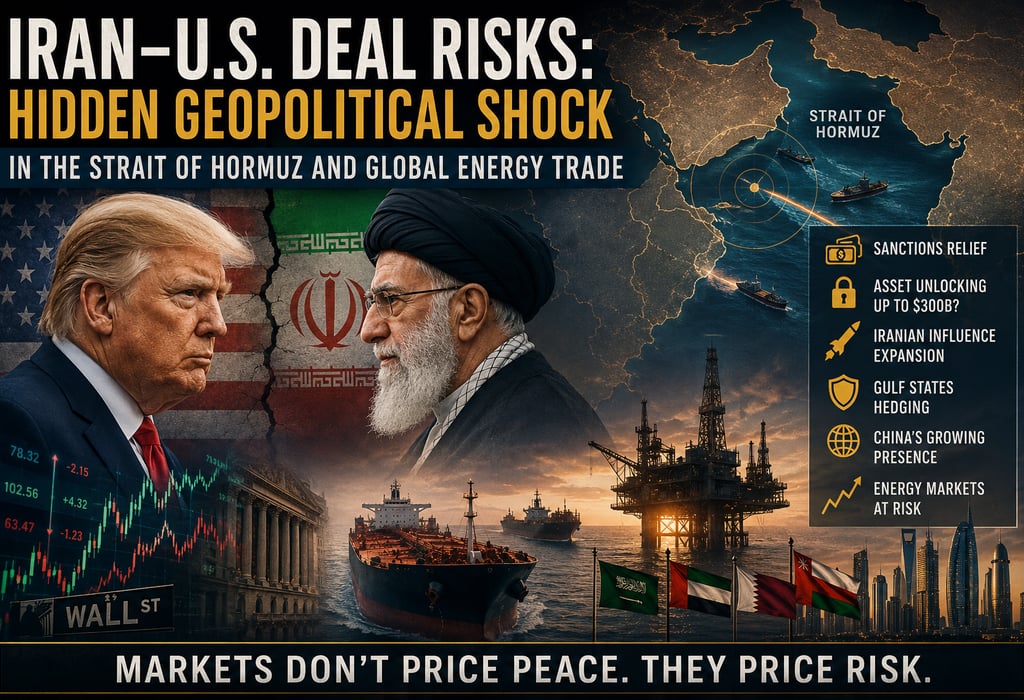
The Iran–U.S. “Peace Trade” That Markets Don’t Trust: Geopolitics, Energy Chokepoints, and the Return of Risk Premia
The emerging framework between the United States and Iran is being sold in Washington as de-escalation. But in the pricing desks of Wall Street, the story reads differently: a geopolitical trade-off where short-term calm is being purchased with long-term uncertainty.
From a boots-on-the-ground perspective, this is not “peace.” It is a managed confrontation with shifting incentives, fragile enforcement, and a growing probability that key actors are misreading each other’s red lines.
A Deal Without Anchors: Why Markets Are Not Pricing “Stability”
The core problem is not the existence of an agreement, but its lack of credible enforcement.
The evidence suggests that both sides are narrating different versions of the same deal:
The U.S. administration, led by Donald Trump, signals:
Partial sanctions relief
Conditional unlocking of Iranian assets
Limited oversight of nuclear activity
Tehran’s response:
Denies restrictions on how funds are used
Rejects externally defined constraints on its nuclear and military programs
Frames the agreement as economic normalization, not strategic containment
This divergence is the first major risk premium generator. In markets, when two counterparties cannot agree on what the contract means, volatility is not a possibility—it is the baseline.
The Strait of Hormuz: The Real Asset Being Repriced
The real center of gravity is not diplomacy. It is energy logistics.
Strait of Hormuz remains one of the most important chokepoints in global oil flows. Even marginal disruption here historically triggers immediate risk-off behavior in equities, shipping, and energy markets.
Key structural facts embedded in the situation:
Roughly a third of global seaborne oil passes through adjacent Gulf routes
Recent reports suggest partial normalization of shipping activity, but still far below pre-conflict volumes
Any perceived Iranian leverage over maritime traffic directly translates into:
Higher Brent crude volatility
Elevated insurance premiums for shipping
Tactical hedging flows into energy majors
From a trading desk perspective: this is not a peace dividend. It is a compressed volatility regime waiting for a catalyst.
Gulf States: Quiet Resistance Behind Public Diplomacy
The diplomatic push by Marco Rubio across Gulf capitals is revealing a deeper structural tension. Countries like Saudi Arabia, Bahrain, Kuwait, Qatar, and Oman are publicly engaging—but privately hedging.
Their concern is not ideological. It is balance-of-power arithmetic.
What Gulf capitals are actually worried about:
Iranian financial relief strengthening regional military capacity
Expansion of proxy influence in fragmented states
Loss of U.S. deterrence credibility
Strategic ambiguity around missile program constraints
A boots-on-the-ground perspective reveals a simple truth: Gulf monarchies are not convinced this is de-escalation. They see it as reallocation of risk.
The $300 Billion Question: Liquidity, Leverage, and Strategic Intent
One of the most controversial elements of the arrangement is the scale of potential asset unlocking—reported in political discourse as large-scale frozen asset releases potentially reaching hundreds of billions over time.
Even if partially overstated, the directional impact matters more than precision:
Potential inflows to Iran:
Oil revenue re-entry (estimated up to ~$10B/month in optimistic scenarios)
Sovereign liquidity restoration
Expanded fiscal room for domestic stabilization
But here is the market concern: Liquidity is fungible. Constraints are not.
Once capital enters a sovereign system, external actors lose visibility over allocation between:
civilian imports
domestic subsidies
military procurement
regional influence operations
This is why defense contractors like Lockheed Martin and RTX Corporation often become indirect beneficiaries of “peace agreements.” Markets hedge narratives, not headlines.
Washington’s Internal Split: Hawks, Doves, and Media Fragmentation
Inside the U.S., the political consensus is fractured.
Even traditionally aligned voices in conservative media ecosystems—figures like Tucker Carlson—have expressed skepticism toward sustained overseas military entanglements framed as “America First.”
The contradiction is structural:
“America First” logic implies retrenchment
Middle East stability operations imply forward engagement
Energy market exposure forces continuous involvement regardless of ideology
Wall Street’s interpretation is blunt: ideology does not price oil. Geography does.
The Pentagon Reality: Inventory Burn and Industrial Refill Cycle
Another under-discussed angle is the material cost of recent regional escalation cycles.
Defense procurement signals suggest:
Elevated drawdown of missile defense systems
Accelerated replenishment requests from the Pentagon
Increased coordination with defense primes:
Boeing
Lockheed Martin
RTX Corporation
This is not just geopolitical theater. It is industrial throughput.
In markets, sustained defense utilization tends to create:
Earnings visibility for contractors
Sticky federal procurement cycles
Secondary inflationary pressure in aerospace supply chains
The China Optionality: The Silent Third Player
While Washington negotiates, Beijing observes.
China’s strategic position is straightforward:
Expand energy partnerships in the Gulf
Deepen infrastructure financing
Normalize defense-adjacent cooperation indirectly through trade corridors
If U.S. credibility weakens even marginally, China’s optionality increases asymmetrically.
From a macro portfolio standpoint, this is a classic multipolar shift:
U.S.: security provider under fiscal strain
Gulf states: hedge providers of capital and energy
China: long-duration industrial allocator
The Brazil Side Signal: Secondary Trade Pressure as Policy Leverage
The extension of tariff discussions involving Brazil illustrates a broader U.S. pattern: trade policy is increasingly being used as geopolitical signaling rather than purely economic optimization.
Even though Brazil is peripheral to the Iran issue, the structural message is consistent:
Washington is expanding the scope of trade enforcement tools
Section-based investigations (like Section 301 frameworks) are becoming geopolitical instruments
Agricultural, digital payments, and environmental claims are bundled into broader negotiation leverage
Markets tend to underestimate how quickly secondary economies get pulled into primary geopolitical conflicts.
Final Market Take: This Is Not Peace, It Is Repricing
Strip away the political rhetoric, and the structure is clear:
Iran is gaining liquidity and strategic breathing room
The U.S. is attempting controlled de-escalation without full verification mechanisms
Gulf states are hedging rather than endorsing
Energy chokepoints remain structurally exposed
Defense and shipping risk premia are mispriced if optimism persists
A boots-on-the-ground perspective reveals the uncomfortable truth: this is not a resolution. It is a transition phase with asymmetric downside tails.
And in macro markets, transition phases are where capital is made—or lost—depending on how seriously risk is priced.
Recommended Book (for deeper understanding)
For readers trying to understand how energy, geopolitics, and state power intersect in markets, a strong reference is:
“The Prize” by Daniel Yergin
It remains one of the clearest frameworks for understanding how oil chokepoints, state strategy, and financial markets continuously reshape global power balances.