
How Rockefeller’s Legacy Still Shapes Education, Medicine, and Modern Power Structures
A deep macroeconomic analysis of how concentrated capital and philanthropy may have influenced the development of modern education, healthcare, media, and institutional systems. Exploring the Rockefeller era as a case study in long-term structural power, incentive design, and the evolution of modern capitalism.
5/17/20264 min read
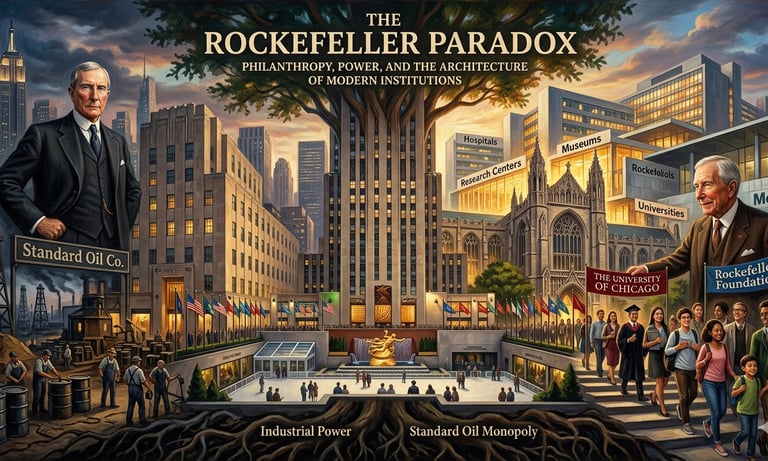
The Rockefeller Paradox: Philanthropy, Power, and the Architecture of Modern Institutions
Introduction: When Capital Outlives Markets
At the turn of the 20th century, John D. Rockefeller stood at the apex of American capitalism. Standard Oil controlled a dominant share of U.S. refining capacity, and even after the 1911 antitrust breakup, his wealth remained unmatched for the era.
But beyond the balance sheet, a deeper question emerges—one that still matters for Wall Street, Washington, and Silicon Valley today:
What happens when concentrated capital stops optimizing for profit alone and starts optimizing for institutional design?
A boots-on-the-ground perspective reveals a pattern that repeats across centuries: wealth doesn’t just buy assets—it buys structure.
The video transcript you provided presents a highly critical narrative: that Rockefeller’s philanthropy helped shape education, medicine, media, and even scientific direction in ways that embedded long-term structural influence over society. While many of these claims are debated or interpreted differently by historians, the underlying macro theme is worth analyzing seriously: the power of philanthropy and capital to shape institutions.
The Breakup of Monopoly and the Rise of Structural Influence
From Standard Oil to Institutional Capital
Rockefeller’s Standard Oil was dismantled in 1911 into dozens of successor companies. Paradoxically, his influence did not decline with the breakup—it diversified.
From a macro lens, this is a familiar pattern:
Monopoly power fragments into networks
Networks evolve into institutional influence
Institutional influence compounds over generations
The evidence suggests that the real transformation was not industrial dominance, but capital reallocation into long-duration institutional vehicles—especially foundations, universities, and medical research funding bodies.
Philanthropy as a Capital Deployment Strategy
Beyond Charity: Long-Horizon Control of Incentives
The Rockefeller Foundation, established in 1913, is often cited as a turning point in modern philanthropic structure.
Regardless of intent, large-scale philanthropy introduces a structural reality:
Capital is allocated without market discipline
Funding priorities shape research agendas
Institutions adapt to donor incentives over time
A Wall Street analogy is useful here: Philanthropy at scale behaves less like charity and more like sovereign wealth capital deployed without redemption pressure. This creates what economists sometimes call “agenda-setting power”—not direct control, but directional influence.
Education: Standardization vs. Decentralized Learning
The Industrial Logic of Modern School Systems
The transcript argues that early Rockefeller-linked funding helped standardize education into a factory-like model: structured schedules, standardized curricula, and uniform evaluation systems.
Even if one disputes the conspiracy framing, the macro trend is real and observable:
Mass industrialization required standardized labor skills
Governments scaled public education systems for workforce alignment
Testing and credentialing became central mechanisms of social mobility
Key structural features of modern schooling:
Age-based cohort progression
Standardized testing regimes
Centralized curriculum design
Credential gatekeeping for labor markets
From an investor perspective, this resembles supply-chain optimization applied to human capital.
The tension today is visible in the U.S. education debate:
Traditional schooling vs. homeschooling
Standardized testing vs. skills-based hiring (Big Tech increasingly prefers the latter)
Rising dissatisfaction with ROI of higher education
Medicine and the Institutionalization of Healthcare
From Fragmented Practices to Centralized Medical Systems
The transcript highlights the Flexner Report (1910), which did play a major role in reshaping medical education in North America by standardizing accreditation and scientific methodology.
The macro impact is undeniable:
Closure of many non-standardized medical schools
Expansion of university-affiliated hospitals
Rise of pharmaceutical-driven treatment models
Consolidation of licensing power through medical boards
However, framing this as purely a coordinated monopolistic design oversimplifies a more complex reality: the shift was also driven by rising scientific standards, germ theory, and the need to eliminate unsafe medical practices.
From an investor lens, the outcome is what matters:
Healthcare became capital-intensive
Drug development became patent-driven
Regulatory barriers increased dramatically
Long-duration revenue streams emerged for pharmaceutical firms
This is structurally similar to other regulated industries (utilities, banking, defense).
Big Pharma, Incentives, and the Patent Economy
Where Medicine Meets Industrial Capital
The modern pharmaceutical system is built on three pillars:
Intellectual property (patents)
Regulatory approval (FDA-style frameworks)
Institutional distribution (hospitals, insurers)
This creates predictable incentives:
High ROI on patentable compounds
Underinvestment in non-patentable prevention strategies
Strong alignment between research funding and commercial viability
A boots-on-the-ground perspective reveals a key tension:
Patients expect health optimization
Markets reward treatable conditions, not cured ones
This is not necessarily conspiracy—it is incentive architecture.
Media, Funding, and Narrative Gatekeeping the Structural Reality of Information Flow
The transcript claims centralized control of media narratives through financial and institutional ties. While direct control claims are widely contested, the structural insight is more grounded:
Media companies rely heavily on advertising revenue
Institutional investors hold significant media equity
PR and corporate communications shape information ecosystems
In modern terms, the influence mechanism is not ownership alone—it is dependency:
Advertising dependence
Platform algorithm dependency
Regulatory dependency
Access dependency (press credentials, institutional sourcing)
This creates bounded narratives, even without centralized coordination.
The Modern Parallel: Silicon Valley and Institutional Capture Risk
For investors today, the Rockefeller narrative is less about history and more about pattern recognition.
Modern analogues include:
Big Tech shaping information ecosystems (search, social media, AI)
Venture capital influencing education (online universities, credential disruption)
Pharma-Tech convergence (biotech + data platforms)
ESG frameworks influencing capital allocation priorities
The key question is not “who controls what,” but: Which institutions are becoming too large to be purely market-disciplined?
Conclusion: Power Does Not Disappear, It Changes Form
Whether one accepts the strongest claims in the transcript or not, the macro lesson is consistent across economic history:
Capital accumulates
Institutions form around capital
Institutions outlive original actors
Incentives persist long after narratives change
Rockefeller—like other industrial-era magnates—represents a broader transition point in capitalism: from visible ownership of assets to invisible shaping of systems.
The modern investor should focus less on personalities and more on structural feedback loops between capital, regulation, and institutional design.
Because in markets, the deepest risk is rarely what is obvious—it is what becomes normalized.
Recommended Book
f you want to go deeper into how institutions evolve and how power interacts with capital over time, a strong starting point is:
The Prize by Daniel Yergin
It provides a detailed, historically grounded view of the oil industry, industrial monopolies, and how energy markets shaped modern geopolitical and economic systems.
Link: https://amzn.to/4faDMZB