
How Infrastructure Defeated the Mongols: The Forgotten Lesson in Resilience, Power, and Long-Term Strategy
The Mongols built history's greatest conquest machine. Europe responded with infrastructure. Discover how stone fortresses stopped the Mongol Empire and why the lesson still matters for investors, AI, semiconductors, and geopolitics today.
6/25/20266 min read
How Infrastructure Defeated the Mongols: The Strategic Lesson Investors Still Ignore
The Day the World's Most Powerful Military Machine Failed
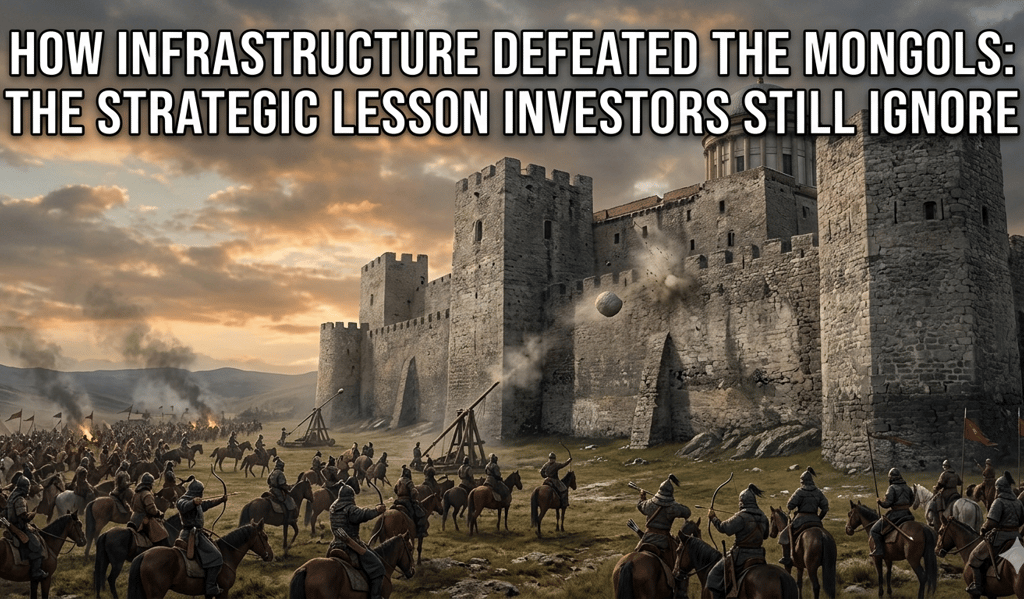
Thirty siege engines fired in unison.
The projectiles slammed into the walls of Esztergom, one of the wealthiest cities in medieval Europe. Batu Khan, grandson of Genghis Khan and commander of the Mongol invasion of Europe, expected another victory. For decades, cities had fallen before his armies. Kingdoms had collapsed. Empires had been reduced to ash.
Instead, the stones bounced. Not shattered. Not breached. Not even cracked in any meaningful way. They bounced.
At that moment, something extraordinary happened. The most successful conquest machine in human history collided with a force it had never truly encountered before: resilient infrastructure.
History often remembers great victories as stories of heroes, brilliant generals, and decisive battles. But the evidence suggests something far less dramatic—and far more important.
The Mongols were not stopped by superior warriors. They were stopped by systems and that lesson matters just as much in the age of artificial intelligence, semiconductor shortages, and geopolitical competition as it did in the thirteenth century.
The Greatest Growth Story in Human History
To understand why Europe survived, we must first understand what was coming toward it.
The Mongol Empire was not simply a military power. It was the medieval world's equivalent of a hyper-scaling technology company.
Between the rise of Genghis Khan and the European campaigns of 1241, the Mongols conquered more territory than Rome acquired over centuries. Their expansion stretched from China to Eastern Europe, creating the largest contiguous empire ever assembled.
Their advantages were overwhelming:
A highly disciplined command structure.
Superior intelligence gathering.
Rapid communication systems.
Exceptional mobility.
Advanced psychological warfare.
Data-driven military planning centuries ahead of its time.
Long before modern militaries adopted concepts such as intelligence-led operations, the Mongols were already practicing them.
Merchants acted as information networks.
Scouts gathered strategic data years before invasions began.
Commanders studied geography, supply routes, political divisions, and local weaknesses.
Subutai, the military architect behind the European campaign, spent more than a decade gathering intelligence before launching his invasion.
This was not medieval chaos.
This was operational excellence.
And operational excellence created a dangerous illusion.
The illusion was that the Mongols were unstoppable.
History repeatedly shows that whenever a system appears unstoppable, investors should immediately begin looking for its hidden constraints.
Why Every Dominant System Eventually Finds Its Limit
The Mongols did not win because they were stronger.
They won because they forced every opponent to fight on terms favorable to them.
European warfare in the early thirteenth century revolved around heavily armored knights and decisive battles in open terrain.
The Mongols rewrote the rules.
Their famous feigned retreat became one of the most effective military tactics ever developed. Enemy forces pursued what appeared to be a fleeing army, only to discover they had walked directly into a carefully constructed trap.
The results were devastating.
On April 11, 1241, Mongol armies destroyed major European forces at both Legnica and Mohi.
Two battles.
Two crushing victories.
One terrifying conclusion.
Nothing in Europe seemed capable of stopping them.
But there is a fundamental difference between winning battles and sustaining expansion.
Wall Street often confuses the two.
A company can dominate a market and still fail.
A nation can achieve military superiority and still lose strategic momentum.
Growth is not the same thing as durability.
The Mongols were about to learn this lesson firsthand.
The Real Reason the Mongols Turned Back
Most history books offer a simple explanation for the Mongol withdrawal from Europe.
The Great Khan Ögedei died in late 1241, triggering a succession crisis that supposedly forced Mongol leaders to return east.
It is a convenient explanation.
It is also incomplete.
Batu Khan did not immediately withdraw.
His armies remained active in Europe for months after the news arrived.
If politics alone determined the decision, the timing makes little sense.
A deeper analysis reveals a more important factor.
Logistics.
Every Empire Is Built on an Assumption
The Mongol military system depended on one critical resource: open grassland.
Each warrior traveled with multiple horses.
Each army required enormous grazing capacity.
The entire model was optimized for the vast steppes of Eurasia.
Europe was different.
As the Mongols pushed westward, they encountered:
Dense forests.
Mountain ranges.
River networks.
Fragmented pastures.
More complex terrain.
The environment itself began attacking the efficiency of the Mongol system.
Horses lost condition.
Supply lines stretched.
Mobility declined.
Operational costs increased.
The same military machine that had conquered continents suddenly faced diminishing returns.
The lesson extends far beyond warfare.
Every successful system is built upon assumptions.
When those assumptions change, dominance can disappear surprisingly fast.
The Infrastructure Wall Nobody Talks About
Logistics weakened the Mongols.
Infrastructure stopped them.
This distinction matters.
The Mongols had spent decades perfecting siege warfare.
Against wooden fortifications and earthen defenses, their methods were devastatingly effective.
Cities surrendered.
Walls collapsed.
Campaigns moved forward.
Europe presented a different challenge.
Stone.
Not merely stone walls.
Entire defensive ecosystems built around stone.
The significance of this cannot be overstated.
The Mongols brought siege equipment optimized for speed and mobility.
European fortifications were optimized for endurance.
The result was a strategic mismatch.
At Esztergom, one of the richest cities in Hungary, Batu Khan deployed an enormous concentration of siege equipment.
The walls remained standing.
Days of bombardment produced little more than superficial damage.
The issue was not tactical.
It was physical.
The technology available to the Mongols in 1242 simply lacked the power necessary to reliably destroy Europe's strongest stone fortifications.
For perhaps the first time in their expansion, operational excellence met a hard engineering limit.
Why Stone Walls Were the Data Centers of the Thirteenth Century
Modern readers often underestimate the significance of infrastructure because they imagine castles as relics.
They were not relics.
They were strategic assets.
In the thirteenth century, a stone fortress served the same role that semiconductor fabrication plants, power grids, data centers, and critical logistics hubs serve today.
Infrastructure determines what is possible.
Infrastructure determines resilience.
Infrastructure determines survival.
When investors discuss national competitiveness today, they often focus on innovation.
Innovation matters.
But innovation without infrastructure rarely survives a major shock.
The evidence from history is remarkably consistent.
The systems that endure are almost always supported by physical assets that are expensive, difficult to replicate, and strategically indispensable.
Stone walls were exactly that.
The CEO Who Rebuilt a Kingdom
When King Béla IV returned to Hungary after the Mongol invasion, he faced a devastated country.
Cities had been destroyed.
Populations displaced.
Entire regions depopulated.
Many leaders would have focused on rebuilding what had been lost.
Béla chose something far more important.
He redesigned the system.
A boots-on-the-ground perspective reveals that Béla behaved less like a medieval monarch and more like a turnaround CEO confronting a catastrophic business failure.
He asked a simple question: What survived?
The answer was obvious. The stone fortifications. Not field armies. Not heroic cavalry charges.Not battlefield courage. The walls. So he invested accordingly.
Between 1242 and the end of the century, Hungary launched one of the most ambitious infrastructure programs in medieval Europe.
Historians estimate that between 147 and 172 new stone castles were constructed. This was not reconstruction. It was strategic adaptation.
The Birth of Defense in Depth
The castles built after the invasion reflected a revolutionary concept. Defense in depth. Instead of relying on a single decisive line of defense, Hungary created a network of mutually supporting strongholds.
These fortifications incorporated:
Multiple defensive walls.
Artificial moats.
Elevated firing positions.
Interlocking support networks.
Carefully controlled access routes.
An attacker might bypass one fortress. But bypassing dozens created an entirely different problem. Supply lines became vulnerable. Movement became restricted.
Operational freedom disappeared. For a military machine dependent on speed and mobility, this was devastating. The Mongols had mastered offensive maneuver warfare. Hungary responded by redesigning the environment itself.
The Second Invasion Proved Everything
History rarely provides controlled experiments.
This is one of the exceptions. In 1285, the Mongols returned. The circumstances were fundamentally different. There was no succession crisis. No political distraction.
No convenient excuse for failure. The Mongols came back to finish what they had started. What they encountered was not the Hungary of 1241. It was the Hungary built by four decades of infrastructure investment.
The invasion collapsed. Fortresses held. Supply lines failed. Mobility disappeared. Winter intensified the crisis. The invading force suffered catastrophic losses.
Most importantly, after this failure, the Mongols never again launched a major invasion of Central Europe. The comparison is impossible to ignore. Same geography. Same opponent. Different infrastructure. Different outcome.
Why This Matters More Than Ever
The story of the Mongol invasions is not fundamentally about medieval warfare.
It is about resilience.
Today, nations compete over:
Artificial intelligence.
Semiconductor manufacturing.
Energy independence.
Cybersecurity.
Supply chain security.
Data infrastructure.
These may appear to be modern issues. They are not. The underlying principle is ancient. Nations survive disruption not because they react faster after a crisis begins.
They survive because they invested before the crisis arrived. Taiwan's semiconductor industry functions as a strategic fortress. Data centers function as strategic fortresses. Electrical grids function as strategic fortresses.
Critical supply chains function as strategic fortresses. The technologies change. The logic does not.
Wall Street Celebrates Growth. History Rewards Resilience.
Genghis Khan created the greatest expansion machine of the medieval era.
His successors inherited a system that appeared unstoppable.
For decades, it was.
Then it encountered a civilization that learned from failure faster than the empire could adapt.
King Béla IV did not defeat the Mongols on a battlefield.
He defeated them through capital allocation.
He invested in resilience.
He invested in infrastructure.
He invested in systems that would remain standing when everything else failed.
Four decades later, the results were undeniable.
The Mongols returned.
The walls remained.
That is the uncomfortable lesson history leaves us with.
The future rarely belongs to whoever grows the fastest.
More often, it belongs to whoever remains standing when growth becomes impossible.
For readers interested in exploring the relationship between power, infrastructure, national strategy, and long-term resilience, few books are more relevant than The Rise and Fall of the Great Powers. Kennedy's work demonstrates how economic capacity, strategic investment, and infrastructure ultimately determine the fate of nations far more often than battlefield victories alone.