How Germany Became Europe’s Economic Powerhouse: The History Behind Its Industrial Dominance
Discover how Germany evolved from fragmented tribal regions into Europe’s leading economic powerhouse. Explore centuries of trade, industrial growth, Prussian discipline, post-war recovery, and modern innovation that shaped one of the world’s strongest export-driven economies.
5/11/20265 min read
How Germany Became Europe’s Economic Powerhouse: From Tribal Forests to Industrial Giant
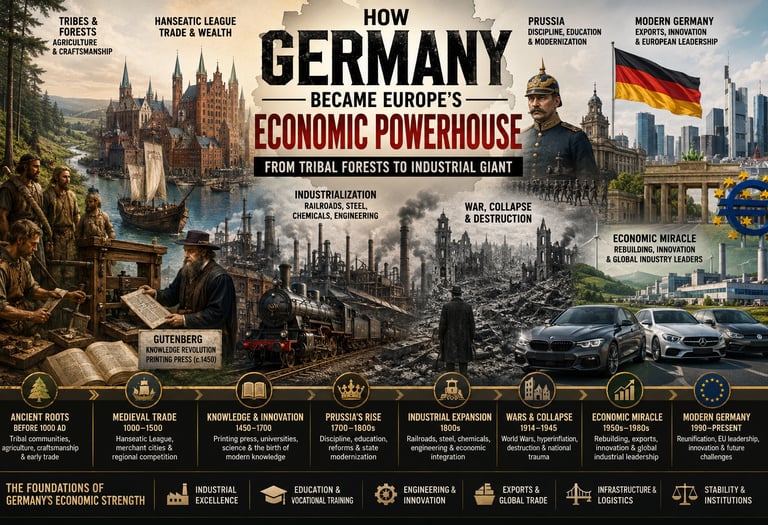
For centuries, the land we now call Germany was not a unified nation. It was a fragmented region of tribes, kingdoms, merchants, inventors, philosophers, and industrial cities constantly reshaping Europe’s balance of power.
Yet somehow, after invasions, economic collapse, hyperinflation, and two world wars, Germany emerged as the largest economy in Europe and one of the most industrialized nations on Earth.
That transformation did not happen overnight. Germany’s rise was built through centuries of trade networks, engineering culture, industrial expansion, education reforms, and economic discipline. Understanding this history helps explain why Germany still plays such a dominant role in global manufacturing, finance, exports, and European geopolitics today.
The Early Foundations of German Economic Culture
Long before modern borders existed, the region that became Germany was home to Germanic tribes living near forests, rivers, and trade routes across Central Europe.
Unlike the highly urbanized Romans, these societies were decentralized and heavily connected to agriculture, craftsmanship, and local cooperation. While Rome built massive cities and imperial bureaucracy, Germanic communities developed strong traditions around:
land ownership
village production
craftsmanship
trade exchange
regional autonomy
This decentralized structure would later become one of Germany’s defining economic characteristics.
Even during ancient times, trade already connected Germanic tribes with the Roman Empire. Amber, animal pelts, metals, and agricultural goods moved across Europe through growing commercial routes along the Rhine River.
These early exchanges helped establish something that would define Germany for centuries:
a culture deeply tied to production and commerce.
The Holy Roman Empire and the Birth of Commercial Germany
After the fall of Rome, Central Europe became politically fragmented. The region eventually evolved into the Holy Roman Empire, a massive collection of kingdoms, duchies, bishoprics, and free cities. At first glance, this fragmentation looked like a weakness. But economically, it created something unique.
Instead of one centralized capital dominating everything, hundreds of independent cities competed economically. Many developed their own:
trade systems
manufacturing sectors
taxation policies
merchant guilds
banking structures
This competition encouraged innovation and regional specialization.
Cities like:
Lübeck
Hamburg
Cologne
Frankfurt
Nuremberg
became powerful commercial centers.
One of the most important developments was the rise of the Hanseatic League, a massive trade network connecting Northern Europe through maritime commerce.
German merchants transported:
salt
timber
grain
metals
textiles
spices
across the Baltic and North Seas.
This period helped create Germany’s long-standing export mentality — something still visible today in its industrial economy.
Gutenberg, Knowledge, and Economic Transformation
One of the most important economic revolutions in European history began in Germany. Around 1450, Johannes Gutenberg developed the movable-type printing press in Mainz. This invention transformed Europe.
Books suddenly became cheaper and accessible to ordinary people. Knowledge spread faster than ever before. Literacy expanded. Universities grew. Scientific ideas circulated rapidly across borders.The economic impact was enormous.
The printing press accelerated:
education
commerce
legal systems
scientific development
financial administration
It helped create the intellectual foundations for capitalism, industrialization, and modern finance.
Centuries later, Germany would become one of the world’s strongest centers for engineering, chemistry, philosophy, and industrial science partly because knowledge became more accessible earlier than in many other regions.
Prussia and the Rise of Discipline, Education, and Industry
By the 1700s, the Kingdom of Prussia emerged as one of the most organized and disciplined states in Europe.
Prussia invested heavily in:
bureaucracy
military organization
infrastructure
education
agricultural efficiency
This mattered economically. Modern industrial economies do not emerge only from natural resources. They emerge from organization, education, logistics, and productivity. Prussia understood this earlier than many European powers.
Leaders like Frederick the Great encouraged agricultural reforms and modernization. Even simple policies — like promoting potato farming to reduce famine — helped stabilize population growth and labor productivity.
At the same time, German-speaking regions became increasingly associated with:
engineering precision
scientific research
technical education
manufacturing quality
These cultural foundations later became essential during industrialization.
Railroads and the Unification of Germany
During the 1800s, the Industrial Revolution transformed Europe.
Railroads connected cities, factories, ports, and workers at unprecedented speed. German states rapidly industrialized through:
steel production
coal mining
railway expansion
chemical manufacturing
machine engineering
For the first time, fragmented German regions began operating as a connected economic system. This economic integration helped fuel political unification under Otto von Bismarck in 1871.The creation of the German Empire changed Europe permanently.
Germany quickly became:
an industrial superpower
a scientific leader
a manufacturing giant
a global exporter
By the late 19th century, Germany was competing directly with the United Kingdom in industrial production.
German companies became world leaders in:
chemicals
steel
pharmaceuticals
machinery
engineering
This industrial growth created enormous wealth, but it also intensified geopolitical competition across Europe.
World War I and Economic Collapse
The rapid rise of Germany disrupted Europe’s balance of power. Tensions between European empires eventually exploded into World War I.
When the war ended in 1918, Germany faced:
massive debt
territorial losses
political instability
social unrest
economic devastation
The situation became even worse during the hyperinflation crisis of the early 1920s.
The German government printed excessive amounts of money to manage debt and reparations.
The result was catastrophic. At its peak, prices changed so quickly that workers were paid multiple times per day. Savings disappeared. Middle-class families lost everything.
This period remains one of the most famous examples of hyperinflation in economic history.
For many historians, the psychological damage caused by this economic collapse helped create the instability that extremist political movements later exploited.
Hitler, Authoritarianism, and the Destruction of Europe
During the economic chaos of the 1920s and 1930s, Adolf Hitler rose to power by exploiting fear, anger, nationalism, and economic desperation.
Germany rebuilt industrially under authoritarian rule, but at a horrific cost.
The Nazi regime transformed the economy into a militarized system focused on war production and territorial expansion.
This eventually led to World War II, the deadliest conflict in human history.
By 1945, Germany was physically and economically destroyed.
Cities were in ruins.
Factories were destroyed.
Infrastructure collapsed.
Millions were dead or displaced.
Very few countries in modern history have experienced destruction on that scale.
The German Economic Miracle
After World War II, Germany was divided into East and West. West Germany, supported by the United States and Western Europe, adopted a capitalist economic model focused on:
free markets
industrial recovery
manufacturing exports
infrastructure rebuilding
The results were extraordinary.
During the 1950s and 1960s, West Germany experienced the “Wirtschaftswunder” — the German Economic Miracle.
Factories reopened.
Exports exploded.
Living standards improved rapidly.
German companies became global industrial leaders, including:
Volkswagen
BMW
Mercedes-Benz
Porsche
Siemens
Meanwhile, East Germany operated under Soviet-style central planning, creating a major economic contrast between the two systems.
The division of Berlin became one of the defining symbols of the Cold War.
The Fall of the Berlin Wall and Modern Germany
In 1989, the Fall of the Berlin Wall changed Europe forever. Germany reunified and eventually became the economic engine of the European Union.
Today, Germany remains:
Europe’s largest economy
one of the world’s biggest exporters
a global manufacturing leader
a major force in automotive engineering
a central player in European geopolitics
German economic strength is built on:
industrial exports
engineering quality
vocational education
infrastructure
productivity
advanced manufacturing
However, modern Germany also faces serious challenges:
aging demographics
energy dependency
industrial competition from China
electric vehicle disruption
migration pressures
rising geopolitical tensions
Even so, Germany continues to play a critical role in shaping Europe’s economic future.
Why Germany’s Economic History Still Matters Today
Germany’s story is not just about wars or empires. It is about how geography, education, industry, trade, engineering, and political systems shape economic power over centuries. Modern Germany did not become wealthy by accident.
Its rise was built gradually through:
trade networks
industrial specialization
scientific advancement
infrastructure
manufacturing excellence
long-term institutional development
That is why Germany still matters globally today. Understanding German history helps explain:
the strength of the European Union
the future of European industry
global manufacturing competition
NATO politics
energy security
the future of Western economies
And perhaps most importantly, Germany’s history also serves as a reminder that even the strongest economies can collapse when political extremism, economic instability, and social division spiral out of control.
If you want to understand Germany beyond headlines and war documentaries, one of the best books to start with is Iron Kingdom: The Rise and Downfall of Prussia, 1600–1947 by Christopher Clark. The book explains how Prussia shaped German discipline, military organization, industrial culture, education, and state-building — foundations that later influenced the rise of modern Germany itself. It is especially valuable for readers interested in geopolitics, European power structures, industrial growth, and the historical roots of Germany’s economic dominance.
Link: https://amzn.to/42nxMFd