
Global Fertility Collapse: The Hidden Macro Shock Reshaping the US, Europe, and Financial Markets
A deep macroeconomic analysis of global fertility decline, its impact on US and European economies, Social Security, labor markets, Wall Street pricing, and long-term sovereign risk. An investor-focused breakdown of the demographic slowdown reshaping global growth.
6/24/20263 min read
The Global Fertility Collapse: The Macro Shock Wall Street Is Still Underestimating
A boots-on-the-ground perspective reveals a structural force quietly reshaping developed economies: fertility collapse. This is not a cyclical trend. It is a multi-decade demographic unwind that is already embedded in the fiscal trajectory of the United States, Europe, and Japan.
The evidence suggests that markets are still mispricing the second and third-order effects of aging societies—especially on labor supply, sovereign debt sustainability, and long-duration asset valuations.
The Demographic Time Bomb Markets Are Pricing Wrong
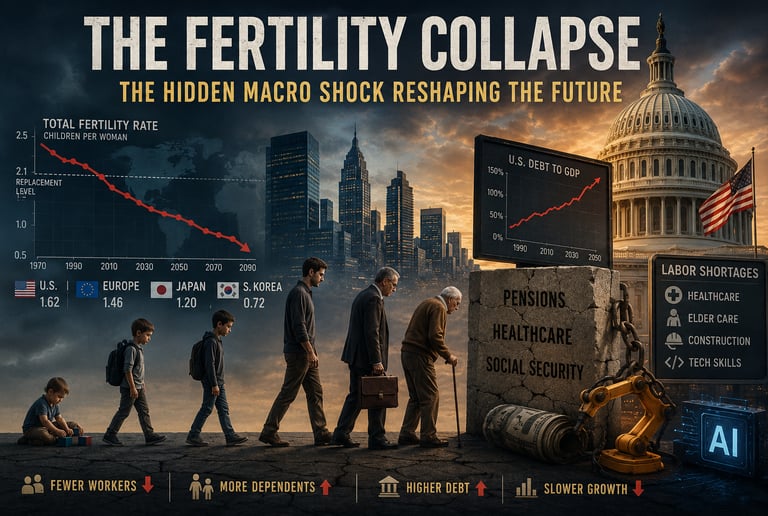
The core issue is simple but brutal: developed economies are no longer replacing themselves. Fertility rates across the US and Europe are persistently below the replacement threshold (~2.1 children per woman), and in many cases collapsing toward 1.2–1.6.
What this means in practice:
Fewer workers entering the labor force each year
A rapidly expanding retiree cohort drawing on public systems
Shrinking tax bases supporting expanding entitlement obligations
Rising dependency ratios (fewer workers per retiree)
In the United States specifically:
Social Security and Medicare are increasingly funded on an unsustainable pay-as-you-go model
The labor market depends more heavily on immigration and automation to maintain growth
Real GDP growth becomes structurally harder to sustain without productivity shocks
This is not a future problem. It is already embedded in fiscal projections.
Why Fertility Collapse is a Sovereign Balance Sheet Problem
At its core, this is not a “social trend.” It is a sovereign balance sheet deterioration.
Governments were built on an implicit assumption: A growing population of workers finances a smaller retired population. That assumption is breaking.
Key macro pressures:
Entitlement systems (US Social Security, Medicare) face long-term funding gaps
Defense spending rises as a share of GDP without expanding tax bases
Interest costs compound faster as debt rolls into a slower-growth economy
Bond markets begin to reprice “growth scarcity risk”
The bond market implication is critical: lower structural growth does not automatically mean lower yields if fiscal deficits widen faster than the demographic drag.
The Failed Playbook: Cash Incentives Don’t Reverse Demographics
Governments have tried to fight fertility decline with financial incentives. The pattern is consistent: temporary bumps, no structural reversal.
A boots-on-the-ground perspective from multiple developed economies suggests the same outcome:
Short-term fertility increases when subsidies are introduced
Long-term decline resumes once incentives lose marginal impact
Most programs simply accelerate timing of births, not total births
Hungary is a frequently cited case:
Aggressive family subsidies and tax incentives
Short-term rise in fertility rates from extremely low levels
Partial reversal later as structural forces reasserted themselves
The key takeaway for US/EU policymakers is uncomfortable: fiscal incentives can shift timing, but they do not override deep behavioral and cultural constraints.
Why Money Doesn’t Fix It: The Structural Drivers
The evidence suggests fertility decline is not primarily a financial constraint. It is a lifestyle equilibrium shift.
Key drivers in the United States and Europe:
Housing costs in major cities (NYC, San Francisco, London) distort family formation
Career acceleration penalties for early parenthood, especially for women in high-skill labor markets
Increased opportunity cost of time in knowledge economies
Delayed adulthood milestones (marriage, home ownership, financial stability)
Cultural redefinition of fulfillment away from family-centric models
Put simply:
In modern urban economies, children are no longer an economic necessity—they are an optional, high-cost life choice competing with career and consumption.
Market Implications Wall Street Is Not Fully Pricing In
This demographic shift is not just a social issue. It is a multi-asset macro driver. Where the impact shows up:
Labor markets
Structural wage pressure in low-skill sectors
Increased reliance on immigration policy cycles
Persistent shortages in healthcare, elder care, and logistics
Equity markets
Automation beneficiaries (robotics, AI, industrial software)
Healthcare and senior services expansion plays
Underperformance risk for domestic consumer growth models
Fixed income
Higher long-term fiscal risk premiums
Volatility in long-duration sovereign bonds
Potential for “growth scarcity” to replace inflation as the dominant macro narrative
Real estate
Aging societies shift demand from expansion to replacement
Secondary cities may outperform global mega-cities in relative affordability terms
The Real Constraint: Culture, Not Capital
The key misunderstanding in policy circles is the belief that fertility is a financial engineering problem.
It is not. The evidence suggests that fertility behavior is now driven by:
Identity and lifestyle preferences
Institutional incentives embedded in education and labor markets
Perceived geopolitical and economic uncertainty
The psychological cost of long-term responsibility in unstable systems
Even strong fiscal incentives tend to attract:
Couples already planning children
Timing shifts rather than net increases
Regional effects (rural > urban response)
Urban centers in the US and Europe remain structurally resistant to fertility recovery because they maximize opportunity cost of childbearing.
Policy Direction in Washington and Europe
Expect policy convergence in three areas:
Expanded child tax credits and family subsidies
Immigration normalization as a labor force stabilizer
Heavy investment in automation and productivity offsets
However, the underlying tension remains unresolved:
Immigration solves labor shortages, but creates political friction
Subsidies are fiscally expensive and only partially effective
Automation offsets labor decline but does not restore population-driven demand growth
This is a system being managed, not fixed.
Final Investor Take
From an investor’s perspective, this is one of the most important slow-moving macro trends of the century.
The portfolio implications are not theoretical—they are already emerging in sector rotation, fiscal behavior, and long-term growth expectations.
The key question is not whether fertility will recover in developed markets. It is whether markets are correctly pricing a world where it does not.
Right now, the answer is likely no.