Global Debt Crisis Explained: The Hidden Engine Powering the World Economy and Why It Could Break
Global debt has surpassed $350 trillion. Discover who finances governments, why debt keeps growing, how the U.S. and China became dependent on borrowing, and what happens if the global debt machine finally stalls.
6/7/20266 min read
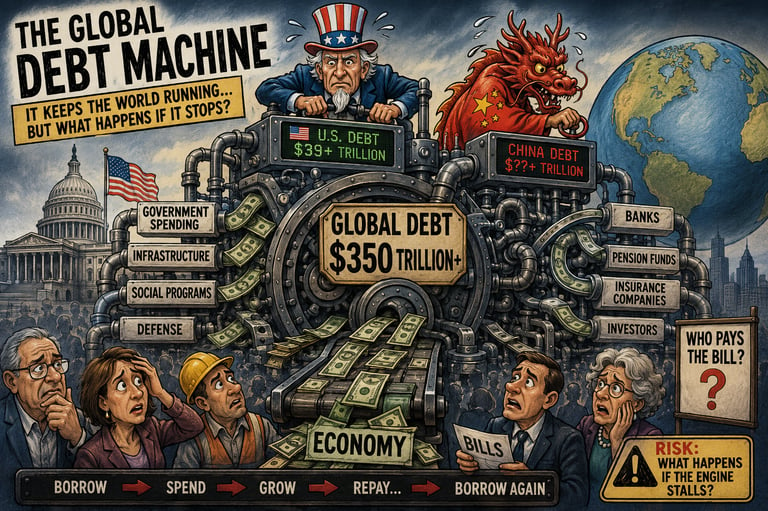
The Global Debt Machine: What Happens If the World's Biggest Economic Engine Finally Stalls?
The modern global economy rests on a foundation that few politicians openly discuss and even fewer investors fully understand. Governments borrow. Corporations borrow. Consumers borrow. Entire financial systems are built upon credit expansion. The uncomfortable reality is that if this process suddenly stopped, the consequences would be far more severe than most people imagine.
Today, global debt has surpassed $350 trillion. The United States alone carries more than $39 trillion in federal debt, while China, despite its image as a financial powerhouse, is itself drowning under an enormous mountain of obligations spread across local governments, state-owned enterprises, corporations, and financial institutions.
The evidence suggests that the world's economic model is no longer simply using debt as a tool. Debt has become the system itself.
The Question Nobody Asks: Who Is Lending All This Money?
When people hear about America's debt burden, they often assume there must be a powerful foreign creditor controlling the system from behind the scenes.
China is usually the first suspect. But this narrative collapses under closer examination.
China owns significant amounts of U.S. Treasury securities, yet China itself is one of the most indebted major economies on Earth. This immediately creates a fascinating paradox:
If China owes trillions, who finances China? The answer reveals the true nature of the modern financial system.
A Giant Web of Mutual Dependence
The global economy operates through an interconnected network where virtually everyone is both a borrower and a lender simultaneously.
Consider the chain:
American pension funds buy U.S. Treasury bonds.
Chinese banks hold American assets.
European financial institutions invest in sovereign debt worldwide.
Governments issue debt to fund spending.
Financial institutions use deposits to purchase government securities.
Insurance companies and retirement funds rely on those securities for stable returns.
There is no single lender sitting atop the system.
Instead, the system functions as a vast circular network of claims and obligations.
A boots-on-the-ground perspective reveals that your retirement account may indirectly finance government borrowing, while government spending simultaneously supports the economic activity that sustains your retirement investments.
The relationship is deeply interconnected.
Debt Is Older Than Money
Many investors view the debt explosion as a modern phenomenon. History tells a different story. Long before central banks, stock exchanges, or fiat currencies existed, debt emerged as a mechanism of trust.
Farmers lent grain with the expectation of repayment after harvest. Communities survived difficult seasons through promises of future payment. Debt originally served as a bridge between present needs and future productivity.
Over time, governments adopted the same principle.
Kings borrowed to fund wars. Empires borrowed to build fleets. States borrowed to construct infrastructure.
Eventually, financing requirements became so large that traditional lenders could no longer meet demand. This led to one of the most important financial innovations in history.
How Government Bonds Changed Civilization
In the late 17th century, England pioneered a revolutionary concept: allowing ordinary citizens to lend money directly to the government in exchange for interest payments.
The modern government bond market was born. This innovation transformed public finance forever.
Governments no longer relied solely on taxation or wealthy aristocrats. They gained access to vast pools of capital from the broader population.
The model spread rapidly throughout the world. Then came the major accelerants:
The World Wars
The First and Second World Wars forced governments to borrow on an unprecedented scale.
Entire nations financed military operations through debt issuance. After the wars ended, borrowing remained.
The infrastructure, welfare programs, and reconstruction efforts that followed continued expanding public balance sheets.
Bretton Woods and the Rise of the Dollar
In 1944, the Bretton Woods system placed the U.S. dollar at the center of global finance.
For a time, the dollar maintained a direct connection to gold. The arrangement created stability. But there was a problem. The global economy expanded much faster than gold reserves.
As international trade grew, the number of dollars in circulation increasingly exceeded the amount of gold backing them.
The 1971 Turning Point
Everything changed in 1971. President Richard Nixon suspended the convertibility of the dollar into gold. This moment may be one of the most important financial events in modern history.
Money was no longer directly constrained by a physical asset.
From that point forward, monetary systems depended primarily on confidence, economic output, and institutional credibility.
Governments gained significantly greater flexibility to expand spending and increase liquidity. Critics argue that this decision opened the door to the debt supercycle that continues today.
Supporters counter that modern economic growth would have been impossible under the constraints of a gold-backed system.
Regardless of which side is correct, one fact is difficult to dispute: Global debt accelerated dramatically after the transition to fiat money.
Debt Stopped Being an Emergency Tool
Historically, governments borrowed during wars, crises, and exceptional circumstances. Today, borrowing is routine.
Debt finances:
Transportation infrastructure
Healthcare systems
Education programs
Social benefits
Defense spending
Economic stimulus initiatives
Financial crisis interventions
What was once extraordinary became standard operating procedure.
Since the 1980s, most developed economies have increasingly embraced a simple formula: Spend today. Pay tomorrow. The result is the largest accumulation of debt in human history.
Why Governments Rarely Pay Down Debt
This is where many people misunderstand how sovereign finance actually works.
Most governments do not eliminate debt in the way households pay off mortgages. Instead, they refinance. Old debt matures. New debt is issued. The cycle continues.
At first glance, this may appear reckless.
In reality, it has become a foundational mechanism of the global economy. The reason is straightforward. When governments borrow and spend, that money enters circulation.
Businesses receive contracts. Workers receive wages. Consumers spend income. Economic activity expands. Tax revenues increase. Growth improves.
The debt cycle and the growth cycle have become deeply intertwined.
What Happens If the Borrowing Stops?
This is the question that should concern investors. The modern economy has become extraordinarily dependent on credit creation.
The United States finances a substantial portion of federal spending through borrowing. Similar dynamics exist across Europe, Japan, and China.
If investors suddenly stopped financing governments, the consequences could be severe. History provides a warning.
The Greek Debt Crisis
Following the 2008 financial crisis, investor confidence in Greek government debt collapsed.
The results were devastating:
Public-sector employment contracted sharply.
Wages fell significantly.
Economic output declined by roughly 25%.
Austerity measures reshaped society.
The lesson was clear.
When financing disappears, economic adjustment becomes brutally painful.
This is one reason politicians rarely campaign on aggressive spending cuts. Voters expect growth, stability, public services, and economic opportunity. Debt often acts as the mechanism used to deliver those outcomes.
The COVID Shock Exposed the System
The pandemic offered perhaps the clearest demonstration of debt's role in the modern economy.
As businesses closed and economic activity collapsed, governments intervened on a historic scale. In 2020 alone, the United States borrowed approximately $3.8 trillion.
Europe, China, Japan, and other major economies implemented similar measures. For policymakers, borrowing was not viewed as optional. It was viewed as necessary.
Without massive intervention, many economists believe the economic contraction would have been significantly worse.
But every emergency response creates a future obligation. The debt burden expanded and now the bill is gradually arriving.
The Fragility Beneath the Surface
The greatest weakness of the current system is not necessarily the size of the debt itself. It is the assumption that refinancing will always remain possible. As long as investors trust governments, debt can be rolled forward.
As long as economies grow faster than financing costs, the system remains manageable.
As long as central banks maintain credibility, markets stay relatively stable. But if confidence weakens, borrowing costs rise. If borrowing costs rise faster than economic growth, debt sustainability becomes increasingly difficult.
This is the challenge now confronting many developed economies. The question is no longer whether debt matters.
The question is how long the global debt machine can continue operating without a fundamental restructuring.
For investors, ignoring that question may become one of the most expensive mistakes of the coming decade.
Final Thoughts
The modern financial system is often described as a machine powered by productivity, innovation, and entrepreneurship.
That description is only partially true. A deeper examination reveals another engine operating beneath the surface: debt.
For decades, expanding credit has fueled consumption, investment, asset appreciation, and government spending. The system works remarkably well when confidence remains intact.
But confidence is not a tangible asset. It cannot be mined, manufactured, or printed. It exists only as long as participants continue believing the cycle can continue.
Whether that belief proves justified may become one of the defining economic questions of the 21st century.
Recommended Reading
For readers seeking a deeper understanding of how debt cycles shape economies and financial markets, one of the most valuable books available is Principles for Dealing with the Changing World Order by Ray Dalio. The book explores the long-term relationship between debt accumulation, monetary systems, reserve currencies, and shifts in global economic power, offering historical context highly relevant to today's debt-driven world.