
Geopolitical Fragmentation Is Reshaping Global Markets and the World Economy
Iran, Ukraine, NATO, and Europe’s demographic crisis are reshaping inflation, energy markets, and global macro strategy.
5/27/20265 min read
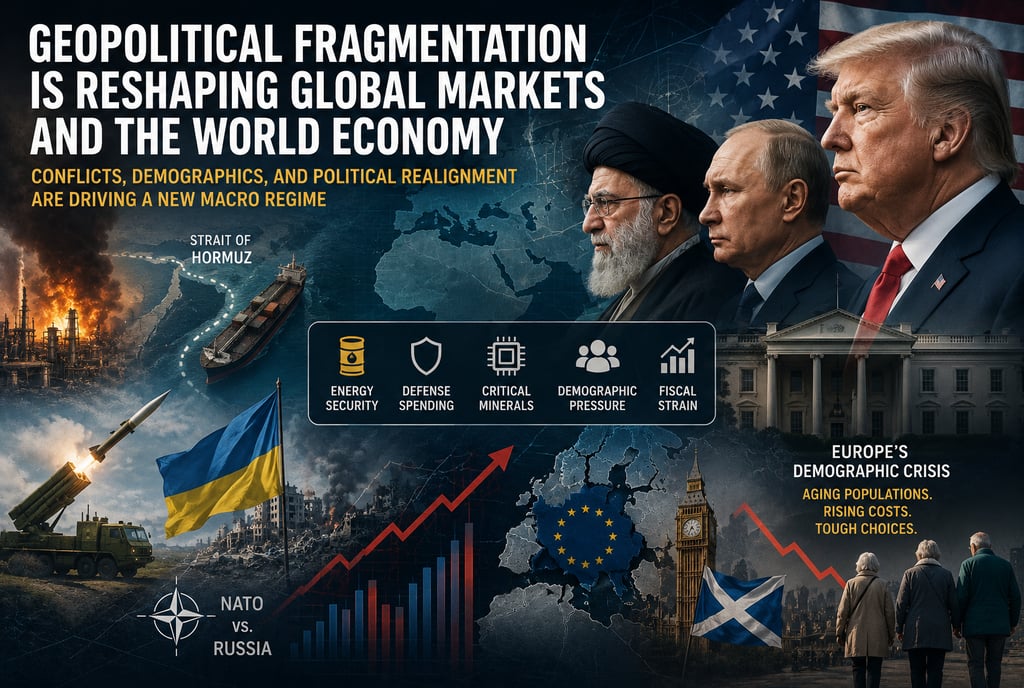
Geopolitics Is Repricing Global Risk Premia Again
The latest developments across the Middle East, Eastern Europe, and the transatlantic political sphere point to a broader structural shift: geopolitics is once again becoming a primary macroeconomic driver rather than a secondary market variable.
Markets spent much of the post-2008 era pricing liquidity, central bank credibility, and growth differentials. That framework is breaking down. Today, investors are increasingly forced to price military escalation risk, commodity chokepoints, strategic supply chains, demographic decline, and political fragmentation simultaneously.
The emerging pattern is clear:
Energy security is replacing globalization efficiency.
Defense spending is becoming structurally embedded in fiscal policy.
Strategic autonomy is now central to both US and European policymaking.
Political alliances are increasingly organized around security and industrial policy rather than free trade alone.
Against that backdrop, several recent developments deserve closer attention.
Iran–US Negotiations Reveal a Deep Strategic Disconnect
According to statements released through Iranian state channels, Tehran outlined a draft framework for de-escalation with the United States, allegedly brokered through Pakistani mediation. Washington, however, has reportedly refused to formally recognize the proposal. Even if partially accurate, the proposal reveals how far apart both sides remain strategically.
Key Reported Elements of the Proposal
Iran allegedly requested:
A reduction or withdrawal of US military presence near Iranian territory
Joint Iranian-Omani oversight of the Strait of Hormuz
International recognition through the UN Security Council
Gradual normalization of commercial transit through Hormuz
Meanwhile, Washington reportedly maintained:
Existing sanctions pressure
Demands involving enriched uranium transfers
A hard-line posture toward Iran’s nuclear capabilities
The contradiction is substantial. Tehran is signaling demands consistent with regional power recognition, while Washington continues to frame negotiations around containment and nonproliferation.
Why Markets Should Care
The Strait of Hormuz remains one of the most systemically important energy chokepoints globally.
Any disruption would immediately affect:
Brent crude pricing
European energy costs
Shipping insurance rates
LNG trade flows
Global inflation expectations
This matters especially for Europe, where the ECB remains trapped between weak growth and sticky geopolitical inflation pressures. The market implication is straightforward: even without full-scale war, persistent instability in the Gulf structurally raises the geopolitical risk premium embedded in energy markets.
Strategic Significance Beyond Oil
The discussion also touched on strategic minerals and industrial inputs, including helium and semiconductor-related supply chains.
That reflects a broader reality: modern geopolitical competition is no longer only about oil. It increasingly revolves around:
Rare earths
Semiconductor ecosystems
Critical logistics corridors
Industrial sovereignty
This aligns closely with ongoing US and EU industrial policy shifts, including strategic reshoring initiatives and subsidy-driven manufacturing programs.
Ukraine Is Becoming a Long-Duration Fiscal and Industrial War
At the same time, Ukraine continues to expose growing contradictions inside the Western alliance structure.
President Volodymyr Zelenskyy has intensified public pressure on Washington regarding air defense systems, particularly Patriot missile infrastructure.
The Emerging US Position
The evolving US stance appears increasingly transactional:
Washington may continue supplying weapons
But allies are expected to finance procurement
Europe is gradually assuming a larger share of the financial burden
This matters because it represents a structural shift in NATO burden-sharing dynamics. The United States remains the backbone of Western military production capacity, but political appetite for unlimited direct financing is weakening.
Europe’s Defense Repricing Cycle
Meanwhile, Poland and the United Kingdom expanded defense cooperation involving:
Air defense systems
Cybersecurity coordination
Military technology integration
The macro implication is critical: Europe is entering a sustained defense investment cycle that may persist for a decade or longer. That has several second-order consequences:
Likely Beneficiaries
European defense contractors
Cybersecurity firms
Aerospace manufacturers
Critical infrastructure providers
Likely Fiscal Pressures
Larger structural deficits
Higher sovereign borrowing needs
Reduced fiscal flexibility for welfare systems
Germany, Poland, France, and the Nordic countries are increasingly treating defense spending not as cyclical expenditure, but as permanent strategic infrastructure.
NATO and Russia Are Entrenched in a Self-Reinforcing Security Spiral
Statements from EU foreign policy officials and Russian leadership continue reinforcing a familiar Cold War dynamic.
Both sides increasingly justify military expansion through the threat posed by the other.
The Resulting Dynamic
NATO argues:
Russia poses a long-term threat to Eastern Europe
Defense expansion is necessary deterrence
Russia argues:
NATO encirclement justifies mobilization
Western military expansion validates Kremlin security narratives
From a macro perspective, this creates a durable military-industrial expansion cycle across Eurasia.
The consequences include:
Higher structural defense budgets
Persistent commodity volatility
Greater cyber conflict exposure
Fragmentation of global trade architecture
This environment favors industrial policy, domestic manufacturing resilience, and strategic stockpiling over the hyper-globalization model that dominated the 1990s and 2000s.
Trump’s Parallel Diplomatic Architecture Signals Institutional Fragmentation
Another noteworthy development is Donald Trump’s proposed “Peace Council” initiative tied initially to Gaza reconstruction efforts.
The proposal reportedly includes:
A reconstruction framework for Gaza
Alternative diplomatic structures outside traditional UN channels
Large-scale private and sovereign funding proposals
However, early reports indicate minimal actual financial commitments so far.
Why This Matters Beyond Politics
Whether successful or not, the initiative reflects a broader trend: Institutional fragmentation in global governance.
The post-1945 architecture — centered around the UN, Bretton Woods institutions, and multilateral consensus — is increasingly challenged by:
Bilateral power politics
Leader-centric diplomacy
Regional security blocs
Ad hoc coalitions
This trend increases uncertainty for markets because institutional predictability historically reduced geopolitical volatility.
A fragmented global order tends to produce:
More sanctions regimes
More trade restrictions
More currency weaponization
More investment uncertainty
Scotland’s Independence Debate Highlights Europe’s Fragmentation Risk
Scotland’s parliament approving a new independence referendum proposal reopens one of Europe’s most politically sensitive post-Brexit fault lines.
Although London may reject the referendum request, the issue itself highlights a broader structural tension inside Europe: Brexit did not resolve sovereignty debates — it amplified them.
Core Economic Drivers
The Scottish argument increasingly centers around:
EU market access
Economic integration
Energy policy
Fiscal autonomy
Meanwhile, London continues facing:
Weak productivity growth
Fiscal stress
Post-Brexit trade friction
Political fragmentation
The United Kingdom remains investable, but political fragmentation risk is now structurally embedded in long-term UK macro analysis.
Germany’s Demographic Crisis Is Becoming a Fiscal Crisis
Perhaps the most economically important issue discussed was Germany’s demographic deterioration. Germany’s aging population is no longer a long-term theoretical problem. It is becoming an immediate fiscal challenge.
The Structural Problem
Germany faces:
Rising healthcare costs
Expanding pension obligations
Shrinking labor force participation
Weak productivity growth
Discussions around higher contributions for childless citizens reflect growing political urgency.
The Real Macro Question
The debate is not fundamentally about culture or family policy. It is about the sustainability of the European welfare state under demographic contraction.
Modern pension systems require:
Expanding working-age populations
Stable tax bases
Productivity growth
Europe increasingly lacks all three simultaneously.
Why Investors Should Watch This Closely
Demographic decline affects:
Long-term GDP growth
Sovereign debt sustainability
Housing demand
Labor costs
Consumption patterns
This is especially important because aging Europe may struggle to simultaneously fund:
Defense expansion
Green transition programs
Social welfare systems
Industrial subsidies
The fiscal arithmetic becomes increasingly difficult.
Final Takeaway: Markets Are Entering a New Geopolitical Macro Regime
The common thread across these developments is not ideology. It is structural fragmentation. The world economy is moving toward:
Regionalized trade systems
Strategic industrial blocs
Persistent military spending
Politicized supply chains
Higher sovereign intervention
For investors, that means the old low-volatility globalization framework is unlikely to fully return. The next decade may instead be defined by:
Higher fiscal activism
Structural inflation volatility
Commodity-driven geopolitical shocks
Greater divergence between regions
A permanent geopolitical risk premium across global assets
This is no longer a temporary cycle. Increasingly, it looks like a regime change.
Recommended Reading
A highly relevant book for understanding this evolving geopolitical-economic landscape is The End of the World Is Just the Beginning by Peter Zeihan.
The book explores how deglobalization, demographic decline, supply chain fragmentation, and shifting security structures could reshape the global economy over the coming decades.
Link: https://amzn.to/4agQzGj