From China to AI: Why Strategy Matters More Than Predictions in 2026
Discover why strategy beats predictions in today’s volatile global economy. From China’s property crisis and Eurozone stagnation to AI hype and OPEC shifts, learn how smart investors build resilient portfolios and outperform market noise.
5/3/20263 min read
Beyond the Crystal Ball: Why Strategy Trumps Predictions in a Volatile Global Economy
In the financial capitals of New York, London, and Frankfurt, the air is thick with "expert" predictions. Whether it is the looming shadow of a Chinese property collapse or the frantic debate over an AI bubble, the market is obsessed with the next "big call." At 2t Economics, we take a different view. As the global landscape shifts—from the stagnation of the Eurozone to the strategic realignment of OPEC—the most successful investors aren't those with the best crystal ball, but those with the most resilient strategy.
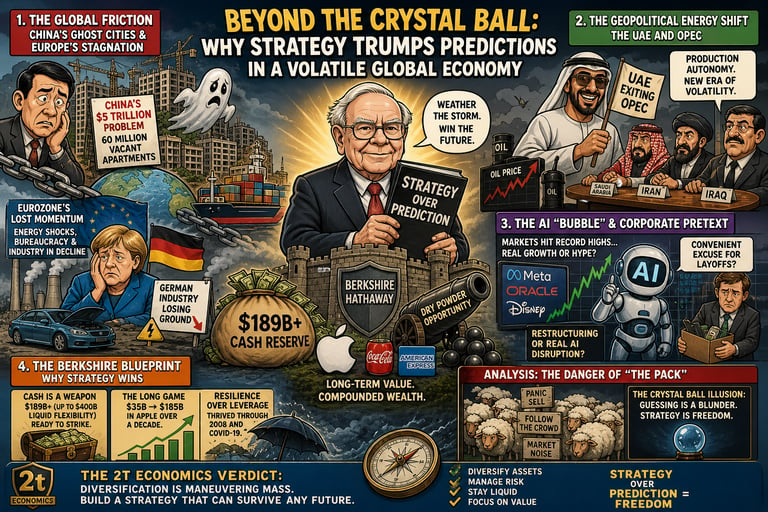
1. The Global Friction: China’s Ghost Cities and Europe’s Stagnation
The interconnectedness of modern markets means that a ripple in the East can become a wave in the West.
China’s $5 Trillion Problem: With approximately 60 million vacant apartments, the Chinese property sector is a ticking clock. Because the global supply chain and countless U.S. and European multinationals depend on Chinese growth, this domestic crisis is a direct risk to Western portfolios.
The Eurozone’s Lost Momentum: While the U.S. markets hit record highs, the Eurozone is stuck in the mud. A combination of war-induced energy shocks and stifling bureaucracy has brought the German industrial engine to a crawl. Germany, once the world’s automotive leader, is now losing ground as high energy costs and the rise of Chinese electric vehicles (EVs) erode its competitive edge.
2. The Geopolitical Energy Shift: The UAE and OPEC
Energy remains the primary driver of global inflation, and the recent announcement that the United Arab Emirates (UAE) plans to exit OPEC is a tectonic shift for the "petrodollar".
Production Autonomy: The UAE no longer wants its output dictated by a cartel. By regaining the freedom to set its own daily extraction limits, the UAE is challenging the traditional dynamics of oil supply and pricing.
Strategic Volatility: With major players like Saudi Arabia, Iran, and Iraq remaining in the fold, the UAE’s departure adds a new layer of volatility to energy assets, directly impacting the cost of living and inflation hedges across the Atlantic.
3. The AI "Bubble" and the Corporate Pretext
The American markets, specifically the S&P 500 and NASDAQ, recently defied all "bubble" predictions to hit record highs.
Real Growth vs. Hype: Many investors missed out on the tech surge because they feared a repeat of the dot-com crash. However, the growth in tech has been backed by actual earnings rather than just speculation.
The IA Layoff Myth: Interestingly, while Big Tech firms like Meta, Oracle, and Disney have announced layoffs, the narrative that "AI is taking the jobs" might be a corporate smoke screen. In many cases, companies appear to be using AI as a convenient PR justification for traditional restructuring and cost-cutting, even when the eliminated roles have no direct link to intelligent tools.
4. The Berkshire Blueprint: Why Strategy Wins
The most universal lesson in today’s market comes from Warren Buffett and Berkshire Hathaway. Buffett’s success isn't about timing the market; it’s about Strategy over Prediction.
Cash is a Weapon: Buffett maintains a staggering cash reserve—recently hitting $189 billion (with some estimates reaching nearly $400 billion in liquid flexibility)—allowing him to strike when opportunities arise, regardless of the macro chaos.
The Long Game: His investment in Apple transformed $35 billion into $185 billion over a decade. He identifies consolidated value (Apple, Coca-Cola, American Express) and ignores the noise of daily price fluctuations.
Resilience Over Leverage: By avoiding dangerous leverage and speculative bets, Buffett built a structure that thrived through the 2008 crisis and the COVID-19 pandemic.
Analysis: The Danger of "The Pack"
The greatest danger to wealth is the "Crystal Ball Illusion". Attempting to guess interest rates or the exact bottom of a currency is a fundamental financial blunder. When investors abandon solid assets to chase a trend—whether panic-selling U.S. stocks or over-exposing to volatile assets based on a "feeling"—they surrender their autonomy to the emotions of the crowd.
The 2t Economics Verdict: Diversification is not just a safety net; it is maneuvering mass. By holding a balanced portfolio, an investor gains the resilience to survive a crisis and the liquidity to profit from it. Success in 2026 requires moving past the need for predictions and building a strategy that can survive any future.