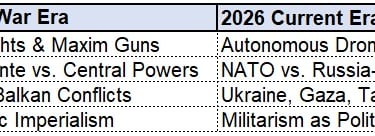
$2.9 Trillion Warning: Are We Reliving the 1914 Armament Spiral?
With global military spending hitting a record $2.9 trillion in 2025, the world crosses a fiscal redline. Is the current rearmament spiral a necessary hedge or a repeat of the 1914 miscalculations?
4/28/20262 min read
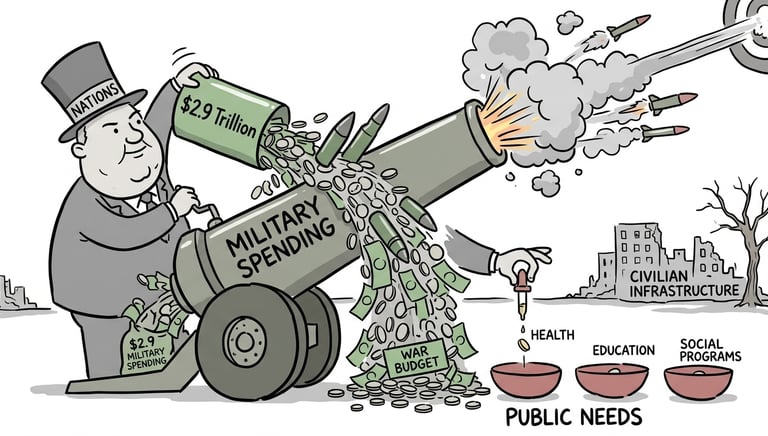
The $2.9 Trillion Redline: Why the Global Arms Race is No Longer Just "Precautionary"
A boots-on-the-ground perspective of the current geopolitical landscape reveals a chilling reality: the world is no longer just hedging against risk; it is actively preparing for a systemic breakdown of peace. In 2025, global defense spending hit a staggering $2.887 trillion. This isn't just a "line item" in national budgets—it is a $2.9 trillion redline that signals a historic shift in the global order.
As an investor with skin in the game, you need to understand that we are witnessing the 11th consecutive year of growth in military expenditures. At 2.5% of global GDP, we are at the highest level of militarization since 2009, surpassing any point during the late Cold War.
Europe’s Strategic Awakening: The 1953 Parallel
For decades, Europe relied on the "Peace Dividend," underinvesting in hard power while focusing on economic integration. That era is officially dead. The evidence suggests that the invasion of Ukraine was the ultimate wake-up call, forcing a rearmament pace not seen since the early days of the Cold War.
German Rebirth: Berlin has overtaken France and the UK as Europe’s top military spender, with a 24% surge to $114 billion.
The 2% Threshold: Spain jumped 50% to $40.2 billion, finally hitting the NATO target for the first time in 30 years.
The Eastern Flank: Poland and the Baltic states are arming at a rate that suggests they view a direct kinetic conflict with Russia not as a possibility, but as an eventual certainty.
The Pacific Powder Keg and the New Naval Race
While Europe reacts to immediate threats, the Indo-Pacific is engaged in a long-term structural buildup. Beijing’s military modernization is the fastest naval expansion since the Anglo-German naval race of the early 1900s.
China’s Shadow: With an official $336 billion budget (and likely much more in "hidden" R&D), China has marked 31 years of uninterrupted growth.
Japan & Taiwan: Tokyo’s 9.7% increase and Taiwan’s 14% jump reflect a desperate attempt to maintain the balance of power in the Strait.
The U.S. Response: Congress is pushing toward a $1 trillion annual budget, with projections for 2027 reaching an unprecedented $1.5 trillion under proposed strategic shifts.
A Classic "Security Dilemma"
We are trapped in a textbook Security Dilemma: each nation increases its capabilities to feel secure, which in turn makes its neighbors feel insecure, triggering a feedback loop of escalation.
The "Slight Margin of Error"
The real danger for the markets isn't necessarily a cold, calculated decision by a superpower to start World War III. The risk is miscalculation. In a world where AI-driven defense systems make decisions in milliseconds and drones are abated over sensitive corridors like the Baltic or Taiwan, the margin for error has never been thinner.
We aren't in an inevitable pre-war phase, but we are certainly in a possible one. The $2.9 trillion spent last year is the price tag of lost trust. For the 2t Economics reader, this means the defense sector is no longer a niche play—it is a core pillar of the new global "War Economy."
Keywords: Global Defense Spending 2026, SIPRI Military Expenditure Report, Macroeconomic Impact of Rearmament Geopolitics of NATO vs Russia-China Axis, Defense Sector Investment Analysis, Military AI Risk Indo-Pacific Naval Race, European Rearmament Trends, 2t Economics Market Analysis