DCA vs Market Timing: The Ultimate Guide to Consistent Wealth
Stop waiting for the dip. Learn why Dollar Cost Averaging (DCA) and ETFs like VOO and QQQ outperform market timing for long-term investors.
5/8/20263 min read
The Math of Consistency: Why DCA Beats Market Timing Every Single Time
In the world of investing, the quest for the "perfect entry" is where wealth goes to die. The anxiety of hitting a market bottom or the fear of buying at an all-time high often paralyzes investors, causing them to miss out on the most powerful force in finance: time.
At 2t Economics, we analyze why the Dollar Cost Averaging (DCA) strategy and passive indexing are not just "safe" choices—they are statistically the most effective tools for long-term wealth creation.
1. The Fallacy of Waiting: The Truth About All-Time Highs
Many investors hesitate when the S&P 500 hits a new record, fearing an imminent bubble. However, historical data from 1950 to 2022 reveals a counterintuitive reality: the market reached all-time highs an average of 21 times per year.
Stock markets in developed economies are designed to grow as companies innovate and earnings expand. Treating a new high as a signal to exit, rather than a signal of strength, is a strategic error that disrupts the flow of compound interest.
2. The High Cost of Market Timing
Attempting to predict the market's best days is a loser's game. Data shows that a decade’s worth of returns can be drastically reduced if an investor misses just the 10 or 20 best trading days.
Since these "best days" typically occur immediately after sharp downturns, those who try to "protect capital" by exiting the market often miss the rapid recovery, permanently damaging their portfolio’s performance.
The Golden Rule: Time in the market beats timing the market.
3. Stock Picking vs. Indexing: The Boeing Lesson
Individual stock picking requires an analytical rigor that most people cannot maintain. The case of Boeing is a masterclass in idiosyncratic risk: while the broader U.S. market delivered an average annual return of 13% over the last decade, Boeing shares dropped approximately 4% over the last five years.
To mitigate the risk of backing a "giant" in decline, ETFs provide a logical solution:
VOO (Vanguard S&P 500 ETF): Direct exposure to the 500 largest U.S. companies. It is the gold standard of efficiency.
QQQ (Invesco QQQ Trust): Focuses on the top 100 non-financial Nasdaq companies, capturing the world's primary tech engine.
By choosing ETFs, you stop trying to "pick the winner" and start owning the growth of the economy itself.
4. The Ultimate Strategy: Dollar Cost Averaging (DCA)
DCA is the practice of investing a fixed amount regularly, regardless of asset price. This discipline removes the emotional "human error" from the equation:
During Downturns: You automatically buy more shares at a lower cost.
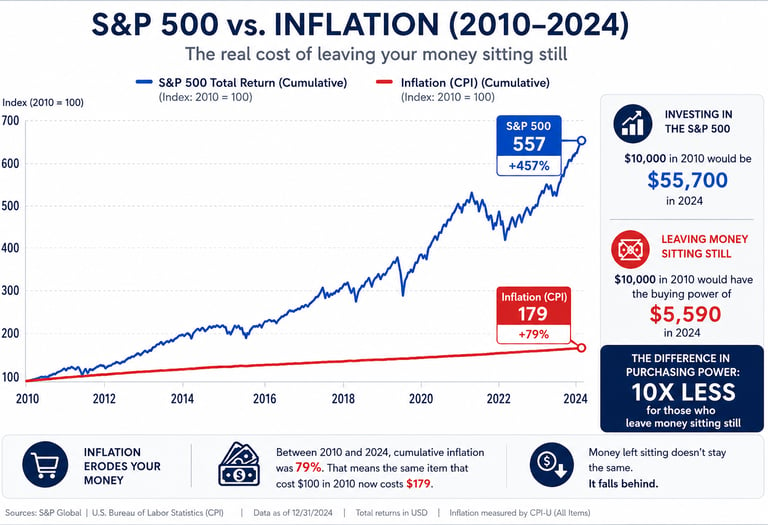
During Peaks: You maintain the habit and ensure your cash isn't being eroded by inflation.
This consistency is what allows compound interest to flourish, turning modest monthly contributions into significant generational wealth over decades.
Conclusion: The Three Pillars of Long-Term Success
Financial success isn't about a superior I.Q. or insider tips; it’s about three behavioral pillars:
Discipline: Sticking to the DCA plan through all market cycles.
Continuous Exposure: Avoiding the "paralysis by analysis" caused by negative headlines.
Self-Awareness: Understanding that volatility is the price of admission for high returns.
At 2t Economics, we believe that international investing via ETFs and the simplicity of monthly contributions is the most reliable path to financial independence. The market will fluctuate, and headlines will scream, but the long-term trend favors the disciplined.
Further Reading: Master the Mental Game
If you enjoyed this analysis on the power of consistency, there is one book you must have on your shelf: "The Psychology of Money" by Morgan Housel.
While we provided the math and the strategy, Housel provides the mindset. He famously explains that "Doing well with money has little to do with how smart you are and a lot to do with how you behave." This book is the perfect companion to the DCA strategy, helping you stay calm when the market gets loud.
[Further Reading: Master the Mental Game
If you enjoyed this analysis on the power of consistency, there is one book you must have on your shelf: "The Psychology of Money" by Morgan Housel.
While we provided the math and the strategy, Housel provides the mindset. He famously explains that "Doing well with money has little to do with how smart you are and a lot to do with how you behave." This book is the perfect companion to the DCA strategy, helping you stay calm when the market gets loud.