Colombia’s Trump Moment? The Rise of Security Politics, Taiwan Tensions, and the New Global Arms Race
As Colombia moves toward a pivotal 2026 election, a new wave of security-focused populism is reshaping Latin America. Meanwhile, rising U.S.-China tensions, Taiwan uncertainty, and growing defense spending are transforming the global investment landscape. Discover what investors need to watch next.
6/1/20264 min read
Colombia’s Trump Moment? Why Latin America’s Security Backlash Is Reshaping Global Politics
A New Political Wave Is Sweeping Latin America
Investors often focus on Washington, Beijing, and Brussels when assessing geopolitical risk. Yet some of the most consequential political shifts are emerging much closer to home in Latin America.
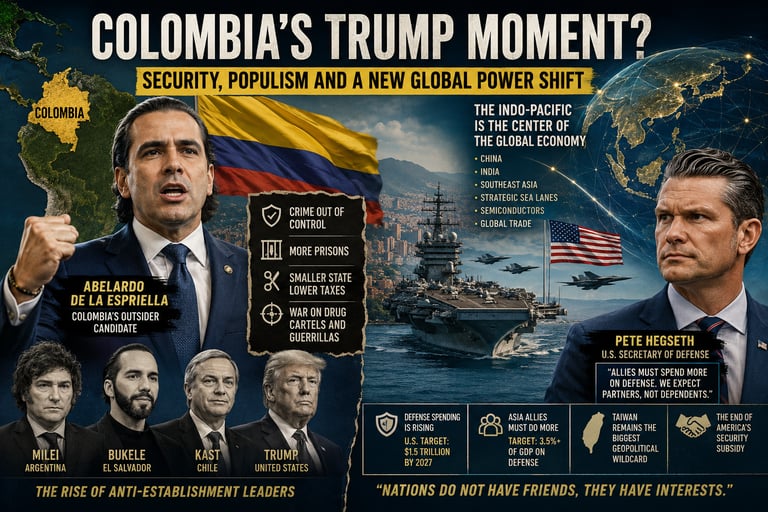
A new generation of anti-establishment leaders is gaining traction across the region. Figures such as Argentina’s Javier Milei, El Salvador’s Nayib Bukele, and Chilean conservative leader José Antonio Kast have built their popularity around a simple message: traditional politics has failed, and public security must become the state’s top priority. Now Colombia may be preparing to join that trend.
A relatively unknown political outsider, Abelardo de la Espriella, is rapidly attracting attention ahead of Colombia’s 2026 presidential race. Self-described as a political outsider and openly inspired by Donald Trump, Milei, and Bukele, he presents himself as a candidate willing to confront organized crime, guerrilla groups, and what he characterizes as a bloated state apparatus.
Whether he ultimately wins is almost secondary. The real story is what his rise reveals about voter sentiment across Latin America.
The Security Crisis Driving Political Realignment
A boots-on-the-ground perspective reveals a reality often overlooked by foreign observers: security concerns have become the defining political issue for millions of Latin Americans.
Colombia faces several structural challenges:
Persistent activity from guerrilla organizations.
Expanding narcotics trafficking networks.
Weak state control in certain rural regions.
Growing public dissatisfaction with crime levels.
Political polarization and fragmented governance.
The evidence suggests that economic promises alone are no longer enough to win elections. Voters increasingly prioritize physical security over ideological debates.
This trend mirrors what occurred in El Salvador, where Bukele transformed public frustration with gang violence into overwhelming political support. His controversial security model has become a reference point for politicians throughout the region.
De la Espriella openly embraces that comparison, proposing large-scale prison construction, aggressive anti-cartel operations, and sweeping executive actions during his first months in office.
For investors, this matters because political stability and security are often prerequisites for economic growth, foreign direct investment, and capital formation.
Why Colombia’s Election Matters Beyond Colombia
Many international investors underestimate Colombia’s importance.
The country remains:
One of Latin America’s largest economies.
A strategic U.S. partner.
A major energy producer.
A critical player in regional security.
A key link between South and Central America.
A shift toward a more security-focused administration could alter:
Fiscal Policy
Proposals include reducing the size of government and lowering corporate taxes, potentially creating a more business-friendly environment.
Foreign Investment
Improved security conditions could attract international capital currently hesitant to enter certain sectors.
Regional Politics
A victory by a populist-right candidate would further strengthen a continental trend already visible in Argentina and El Salvador.
However, investors should remain cautious.
Colombia's political system is highly fragmented. Even a strong presidential victory would not guarantee legislative support. The country's divided congress may limit the implementation of major reforms regardless of who wins.
The Pentagon’s New Message to Asia
While Latin America wrestles with internal security challenges, another geopolitical development deserves equal attention.
At a major defense forum in Singapore, U.S. Defense Secretary Pete Hegseth delivered a message that financial markets cannot afford to ignore: America's Asian allies must spend more on defense.
The statement reflects a broader strategic reality. The center of global economic gravity has shifted toward the Indo-Pacific.
Today, the most important economic corridor in the world includes:
China.
India.
Southeast Asia.
The South China Sea.
The Strait of Malacca.
Advanced manufacturing hubs throughout East Asia.
The Atlantic-centered world that dominated the twentieth century is increasingly giving way to a Pacific-centered economic order.
Taiwan Remains the Market’s Biggest Geopolitical Wildcard
One of the most sensitive topics discussed was Taiwan.
Recent comments from Washington have fueled speculation that there may be differences between political and military leadership regarding America's response to a potential Chinese move against Taiwan. Officially, U.S. policy remains strategically ambiguous.
Unofficially, markets are attempting to answer a much more important question: Would the United States risk a direct confrontation with China over Taiwan?
The answer carries enormous implications for:
Global semiconductor supply chains.
Artificial intelligence infrastructure.
Big Tech earnings.
Global trade routes.
Defense spending worldwide.
The evidence suggests that Washington wants to maintain deterrence while avoiding explicit commitments that could increase tensions.
That ambiguity may be uncomfortable for investors, but it remains a cornerstone of U.S. strategy.
The End of America's Security Subsidy?
Perhaps the most important takeaway from the defense summit was the evolving American approach toward alliances.
For decades, U.S. security guarantees allowed allies in Europe and Asia to maintain relatively modest defense budgets.
That era appears to be ending. Washington increasingly expects partners to carry a larger share of their own defense burden.
This shift reflects several realities:
Rising U.S. federal debt.
Strategic competition with China.
Domestic political pressure.
Expanding military commitments worldwide.
The lesson for policymakers is straightforward.
Nations that outsource their security eventually become vulnerable to political changes they cannot control.
As the old geopolitical saying goes, countries do not have permanent friends. They have permanent interests.
What Investors Should Watch Next
Several trends deserve close monitoring over the next 12 months:
Colombia
Polling trends ahead of the presidential election.
Security-related policy proposals.
Congressional coalition dynamics.
United States–China Relations
Military activity around Taiwan.
New defense agreements across Asia.
Trade negotiations between Washington and Beijing.
Global Defense Spending
NATO military budget increases.
Asian defense procurement programs.
Growth opportunities in aerospace and defense sectors.
The broader pattern is becoming increasingly clear.
Voters across the world are prioritizing security, governments are responding with higher defense spending, and geopolitical competition is becoming a larger driver of market outcomes.
Investors who continue viewing politics as background noise may find themselves unprepared for the next decade. The age of geopolitical investing has arrived.
For readers seeking a deeper understanding of how power, conflict, and national interests shape global events, one highly recommended book is The Tragedy of Great Power Politics by John J. Mearsheimer. Its framework helps explain the strategic competition now unfolding between major powers and why security concerns increasingly dominate both political decisions and financial markets.
Link: https://amzn.to/4vpu7TQ