
Brazil vs. USA Geopolitics: Rare Earths, PIX, and the Trump-Lula Meeting
Explore the growing tensions between Brazil and the USA. From the race for rare earth minerals to the threat PIX poses to the dollar, see why the Lula-Trump era is redefining global trade.
5/8/20263 min read
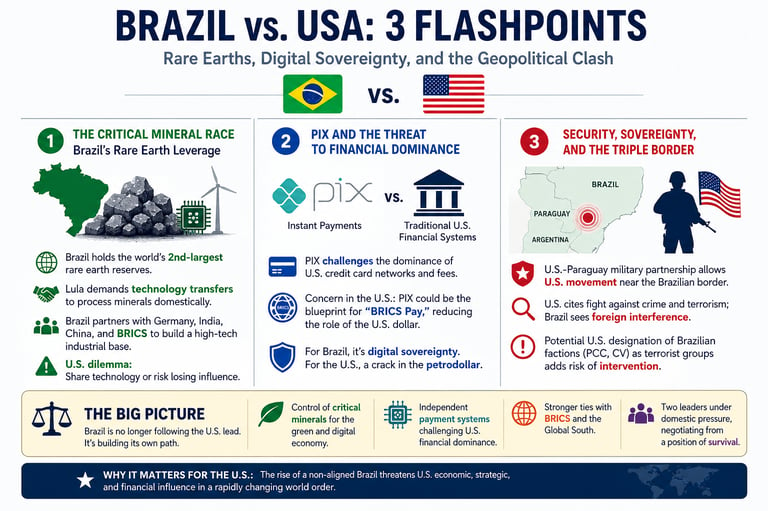
Brazil vs. USA: Rare Earths, Digital Sovereignty, and the Lula-Trump Geopolitical Clash
The diplomatic relationship between the United States and Brazil has entered a new, complex chapter. With the recent meeting between President Donald Trump and President Luiz Inácio Lula da Silva, the stakes have moved beyond mere trade agreements. From the race for mineral dominance to the digital revolution of payment systems, the "Giant of the South" is asserting its independence in ways that directly challenge U.S. interests.
At 2t Economics, we analyze the three critical friction points that every global investor and strategist must monitor.
1. The Critical Mineral Race: Brazil’s Rare Earth Leverage
As the U.S. desperately tries to decouple its supply chain from China, all eyes have turned to Brazil. Holding the world’s second-largest rare earth reserves, Brazil is no longer content with being a simple exporter of raw materials.
While the Trump administration seeks to secure these minerals for American tech and defense industries, the Lula administration is demanding technology transfers. Brazil’s strategy is clear: they want to process these minerals domestically, partnering with nations like Germany, India, and China to build a high-tech industrial base. For Washington, this creates a dilemma—secure the minerals at the cost of sharing technology, or risk seeing Brazil lean further into the BRICS alliance.
2. PIX and the Threat to Financial Dominance
One of the most surprising points of tension is PIX, Brazil’s instant payment system. While it may seem like a domestic convenience, American financial giants see it as a disruptive force.
Challenging U.S. Networks: PIX challenges the dominance of traditional American credit card networks and banking fees.
The BRICS Connection: There is growing concern in the U.S. that the PIX model is the blueprint for "BRICS Pay." If the BRICS bloc adopts a similar instant, blockchain-adjacent international settlement system, it could significantly diminish the role of the U.S. dollar in global trade.
For Brazil, PIX is an issue of digital sovereignty; for the U.S., it is a potential crack in the armor of the petrodollar.
3. Security, Sovereignty, and the Triple Border
Geopolitics gets physical at the "Triple Frontier" (Brazil, Paraguay, and Argentina). The recent military partnership between the U.S. and Paraguay has raised alarms in Brasília.
The agreement allows U.S. military movement near the Brazilian border without local oversight. While Washington cites the fight against organized crime and Hezbollah-linked financing in the region, Brazil views this as foreign interference. The possibility of the U.S. designating Brazilian factions (like PCC or CV) as terrorist organizations adds another layer of complexity, potentially allowing for U.S. intervention in South American internal security.
The "Popularity Trap": Two Leaders Under Pressure
Both Trump and Lula are operating under the shadow of domestic instability.
Donald Trump faces significant disapproval ratings as he approaches the midterm elections, forcing him to take a "tough on trade" stance to appease his base.
Lula is struggling with a divided Congress and a growing opposition, making him more likely to use "anti-imperialist" rhetoric to consolidate his political standing.
When two leaders in crisis meet, the result is rarely a compromise—it is a negotiation of survival.
Conclusion: Why Brazil Matters for the U.S. Economy
The era of Brazil following the U.S. lead is over. Whether it's through the BRICS expansion, the control of green energy minerals, or the development of independent payment systems, Brazil is positioning itself as a "Non-Aligned" power.
For Americans, the risk is no longer just economic competition; it’s the emergence of a regional leader that is willing to trade with Washington's rivals to secure its own future.
Deepen Your Analysis: The Strategic Roadmap
To truly understand why nations like Brazil are shifting their alignment, you must understand the immutable forces of geography and power. "The Revenge of Geography" by Robert D. Kaplan is the definitive guide to the geopolitical landscape we are witnessing today. Kaplan brilliantly illustrates how resources, borders, and location drive the friction between leaders like Trump and Lula. If you want to stay ahead of the next global shift, this book is essential reading for your strategic library.