
Brazil 2026: The "Goldilocks" Paradox — Social Triumphs vs. a 100% Debt-to-GDP Fiscal Trap
A deep dive into Brazil's 2026 economic landscape: balancing historic low unemployment and social progress against record-high taxation, a $8.5B deficit in state-owned enterprises, and rising global geopolitical pressure.
4/26/20262 min read
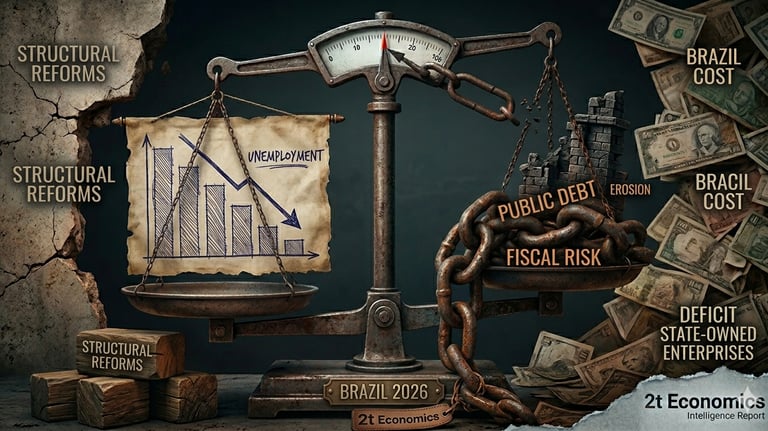
The Brazil Paradox: Social Gains, Fiscal Erosion, and the "Peugeot Dashboard" of 2026
After 36 months of the Lula III administration, Brazil remains a puzzle for global analysts. While the surface-level data suggests a "Goldilocks" scenario—low unemployment and controlled inflation—the structural integrity of the economy is being tested by record spending and institutional shifts.
For the 2t Economics reader, understanding this duality is the key to managing Brazil-risk in a 2026 portfolio.
1. The "Success" Facade: Real Gains or Momentum?
It is intellectually dishonest to ignore the positive metrics. The administration has managed to maintain a trajectory that started in previous cycles:
Historical Unemployment Lows: Brazil is experiencing its lowest jobless rate in the historical series. Whether this is "luck" from a pre-existing trend or effective stimulus, the outcome is a hot labor market and resilient household income.
The Inflation Anchor: Despite global pressures, inflation has returned to the target range. However, there is a catch: the government is "extinguishing the fire by tearing down the house."
The Interest Rate Strategy: By maintaining interest rates at punishing levels (near 15%), the administration controlled prices but effectively choked credit and long-term private investment.
2. The Dark Side: The 32.4% Tax Burden
The most alarming metric for international observers is the record-breaking tax burden.
The "Shaking" of Society: At 32.4% of GDP, the government is extracting capital from the productive sector at an unprecedented rate.
27 Tax Increases: In three years, the administration pushed through nearly 30 different tax adjustments. This "Custo Brasil" (Brazil Cost) makes the country less competitive against emerging peers in Southeast Asia and even neighboring Latin American markets.
3. The Return of the "Ghost of Corruption" & State Failure
The perception of risk in Brazil isn't just about numbers; it's about trust.
The $8.5 Billion Post Office Hole: The massive deficit in state-owned enterprises like the Post Office (Correios) signaling a return to inefficient management. For an investor, seeing $8 billion "burned" instead of invested in infrastructure is a major red flag.
The Master Bank & INSS Scandals: The resurgence of corruption headlines involving multi-billion dollar figures (reminiscent of the early 2000s) is the ultimate deterrent for Foreign Direct Investment (FDI).
4. Conclusion: A Bubble of Perceptions
The verdict on Brazil in 2026 is deeply polarized.
The Pro-Lula View: A successful social project that stabilized the country after the pandemic and kept the PIB growing.
The Market View: A government that is buying temporary popularity through social programs (Bolsa Família, Pé de Meia) while funding it with record debt and taxes.
Our Take: Brazil is currently an "expensive" play. The fiscal shield is holding, but with public debt approaching 100% of GDP, the margin for error is zero.